
Blue Sapphire Quality: 2026 Connoisseur’s Guide
Aug 4th 2026
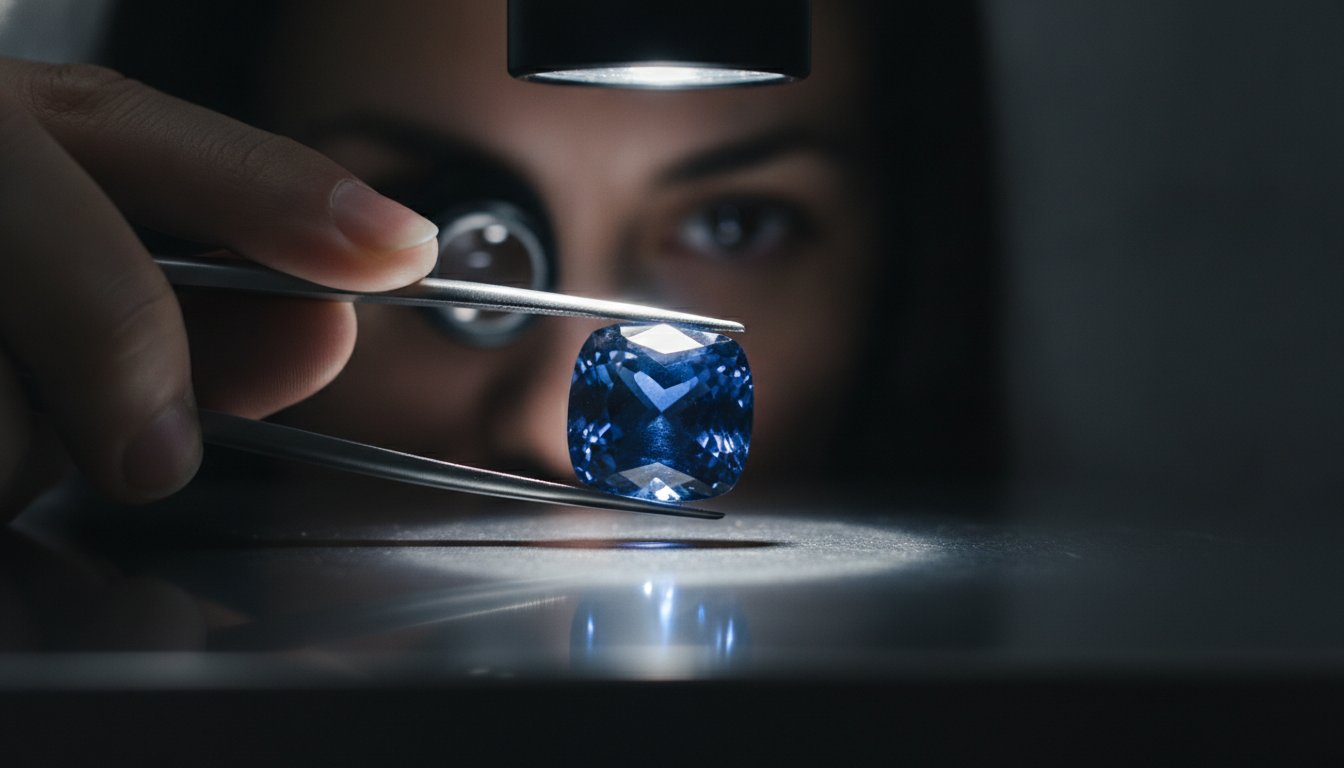
Did you know that an estimated 95% of the blue sapphires you see in retail windows have been heat-treated to mask their natural state? While heat is a standard industry practice, finding a truly exceptional, natural stone requires more than just an appreciation for a pretty color. Learning how to judge blue sapphire quality is the only way to ensure you aren't overpaying for a stone that lacks true light performance. You've likely felt that familiar hesitation when looking at a gem online, wondering if that deep "Royal Blue" is actually a dark, lifeless "inky" stone or if a hidden "window" in the cut will drain the color once the stone is on your finger.
I'm here to pull back the curtain and share the exact techniques used by premier gemologists to evaluate these rare treasures. You'll master a clear checklist for visual inspection and finally understand why a fine 1-carat unheated sapphire now commands up to $6,000 in the 2026 market. We'll explore how lighting shifts a stone's personality, the critical difference between Ceylon and Madagascar origins, and how to navigate the 2026 US import tariffs. By the end of this guide, you'll have the confidence to choose a sapphire that isn't just beautiful, but a lasting legacy of quality.
Key Takeaways
- Identify the ideal color profile in loose blue sapphires by mastering the relationship between hue, tone, and saturation found in the world's most coveted specimens.
- Discover how to use the "velvet factor" to your advantage, recognizing when natural rutile silk inclusions actually increase a sapphire's rarity and glow.
- Master the visual techniques on how to judge blue sapphire quality by identifying windowing and extinction, ensuring your gem maintains brilliance from every angle.
- Gain the technical insight to distinguish between heated and unheated stones while learning to avoid the common pitfalls of over-treated gems.
- Implement a rigorous 5-step inspection protocol to evaluate light performance across different environments, mirroring the process used by professional gemologists.
The Architecture of Color: Hue, Tone, and Saturation
Color isn't just one factor in your evaluation; it's the primary engine of value. When you're learning how to judge blue sapphire quality, you'll quickly realize that even a perfectly cut stone can't overcome a muddy or inky hue. In the world of loose blue sapphires, color dictates nearly 50% of the final price. To understand what is sapphire from a visual perspective, we must deconstruct it into three distinct pillars: hue, tone, and saturation.
Hue refers to the stone's basic color. While we call them "blue," most sapphires contain secondary flashes of violet or green. The connoisseur's "sweet spot" is a hue that ranges from a pure, velvety blue to a slightly violetish blue. If the secondary hue leans too heavily toward green, the value drops significantly. Tone describes how light or dark the stone appears. This is where many buyers fall into the "Tone Trap." A stone might look stunning under a jeweler's high-intensity halogen lamp, but once you take it into a dimly lit restaurant, it can appear "inky" or almost black. The most valuable sapphires typically sit in the medium to medium-dark range, roughly 60% to 75% in tone.
Saturation is the final, and perhaps most elusive, pillar. It's the brightness or vividness of the color. High-quality sapphires possess "Vivid" saturation, meaning the blue is intense and free from any gray or brown masks. Lower-quality stones often look "steely" because a gray mask dulls the blue's natural vibrancy. You're looking for a stone that seems to glow from within, even in lower light settings.
Cornflower vs. Royal Blue: Decoding Trade Terms
You'll frequently encounter the terms "Cornflower" and "Royal Blue" in lab reports and descriptions. Cornflower Blue sapphires are prized for their soft, velvety appearance and medium-light tones. They often originate from Kashmir or Ceylon. Royal Blue, by contrast, represents the pinnacle of intensity. It's a deep, vivid blue that maintains its "blue-ness" without turning black. While these terms are helpful, they are subjective. You should always verify these trade classifications with a visual check of the stone's actual saturation levels to ensure the "Royal Blue" isn't simply an over-dark, inky stone.
Pleochroism: The Two-Color Secret of Sapphires
Blue sapphires are dichroic, meaning they show two different colors when viewed from different angles. This property, known as pleochroism, usually manifests as blue and violet-blue. However, a poorly oriented cut might reveal a less desirable greenish-blue axis. When you evaluate a stone, the "Face-Up" color consistency is paramount. A master cutter will orient the crystal so the most vibrant blue is visible through the table, hiding the greenish-blue tones within the depth of the stone. If you see a distinct green flash when looking directly at the top of the gem, it's a sign of a compromise in quality.
Clarity and the "Velvet" Factor in Blue Sapphires
While color captures the heart, clarity determines the soul of the gem. In the world of colored stones, sapphires are classified as Type II, meaning nature rarely leaves them perfectly pure. When learning how to judge blue sapphire quality, don't apply the same clinical standards you'd use for a diamond. Instead, look for "eye-clean" stones where no inclusions are visible to the naked eye from a distance of about six inches. This standard ensures the stone's beauty isn't compromised by distracting internal marks while acknowledging its natural origin.
There's a beautiful irony in sapphire clarity. While most inclusions detract from value, extremely fine, needle-like inclusions of rutile, known as "silk," can actually elevate a stone. This silk scatters light in a way that creates a soft, velvety glow, a hallmark of the legendary Kashmir origin. This "sleepy" appearance is highly prized by connoisseurs because it softens the blue without sacrificing the stone's vivid saturation. It's a rare instance where a geological "imperfection" becomes a coveted signature of luxury.
Be vigilant for inclusions that disrupt the stone's "inner fire." Feathers are small internal fractures that can catch the light and look like white streaks. Tiny mineral crystals or distinct "color zoning," which are straight bands of lighter and darker blue, can also break the visual harmony. If you're seeking a stone with exceptional integrity, you might browse our collection of loose blue sapphires, where each gem is vetted for these specific visual characteristics.
Evaluating Inclusions: Location and Type
Not all inclusions are created equal. A small crystal hidden near the girdle is far less detrimental than one sitting directly under the table. When using a 10x loupe, look for "surface-reaching" inclusions. These are fractures that break the surface of the gem and can compromise its durability during the setting process. Professionals tilt the stone toward a light source to see if a fracture "flashes," indicating a significant break that could threaten the stone's longevity.
Transparency: The Hidden Quality Factor
Transparency is the ability of light to pass through the stone without scattering.
Collectors distinguish between transparent, translucent, and opaque stones. A high-quality sapphire must be transparent to allow light to interact with its facets and return to your eye as brilliance. Avoid stones described as "milky" or "cloudy" unless that appearance is the specific, desirable rutile silk mentioned earlier. True sleepiness caused by high-density particles will dull the price and the stone's beauty, making it appear lifeless in anything other than the strongest sunlight.
Light Performance: Identifying Windowing and Extinction
A lab report might award a "Good" or "Very Good" cut grade based on technical symmetry, but it rarely accounts for the emotional impact of light performance. When you're learning how to judge blue sapphire quality, you must look beyond the paper. A stone can have a magnificent hue but appear dull and lifeless because the light is escaping through the back or being absorbed into blackness. This interaction between light and the internal facets is what separates a commercial stone from a collector's piece. True brilliance is the result of light entering the crown, reflecting off the pavilion facets, and returning to your eye as a vivid flash of blue.
Windowing is perhaps the most common flaw in native-cut sapphires. It appears as a pale, colorless "hole" in the center of the gem where you can see straight through the stone to your finger or the background. This happens when the pavilion facets are cut too shallow, failing to reflect light back to the eye. Conversely, extinction occurs when facets are too steep, causing light to be trapped and absorbed. This creates "dead zones" or black patches that mask the sapphire's true color. A premier stone should display brilliance across at least 80% of its face, with minimal dark areas that stay black as the stone moves.
The Geometry of Depth
Proportions are the silent architects of a sapphire's beauty. If a stone is too shallow, it loses its saturation in the center, creating that dreaded window. If it's too deep, it gains carat weight without adding visual size, often leading to heavy extinction. You can perform the "Tilt Test" by slowly rotating the gem between your fingers under a single light source. Watch how the color moves. A high-quality cut maintains a consistent "face-up" appearance even as the angle changes, minimizing light leakage and keeping the scintillation active across the entire surface.
Symmetry and Polish: The Final Flourish
While proportions handle the light, symmetry and polish provide the finish. Look for an "off-center" culet, the bottom point of the stone. If it's misaligned, the light distribution will be lopsided, leaving one side of the stone looking darker than the other. Surface polish is equally vital. A poor polish creates a hazy luster that prevents light from entering the crystal cleanly, much like looking through a foggy window. A master cutter can often "save" a stone with slightly uneven color by using specific facet arrangements to blend the hues. You can explore a variety of expertly cut specimens in our loose gemstone collection to see these principles in action.
The sapphire market is fundamentally divided by a single question: has this stone been heated? While heat treatment is a stable, industry-standard practice that improves color and clarity, unheated sapphires remain the "Holy Grail" for serious collectors. These rare gems represent less than 10% of the market and command a significant price premium, often reaching 1.5 to 3 times the cost of their heated counterparts. Grasping how to judge blue sapphire quality requires an eye for the subtle markers of origin and treatment that lab reports only partially reveal.
Avoid "over-cooked" stones at all costs. These are sapphires subjected to extreme temperatures that leave the crystal looking glassy, brittle, or unnaturally fluorescent. A high-quality heated stone should still look organic and retain its structural integrity. Radical transparency is essential here, which is why third-party lab reports from institutions like the GIA or SSEF are non-negotiable for high-value transactions. These documents verify the treatment status and often pinpoint the geographic origin, a factor that heavily influences the price per carat in the 2026 market. Understanding how to judge blue sapphire quality involves recognizing that the most beautiful stones aren't always the most valuable if they've been heavily altered.
Judging Unheated Blue Sapphires
The primary indicator of an unheated sapphire is the presence of intact rutile needles, or "silk." High heat melts these delicate structures, so seeing them under a loupe is a strong sign of a natural state. These "Natural Color" sapphires are prized because their value is historically more resilient over time. If you're considering an investment-grade piece, you can learn more about unheated blue sapphire prices to understand the current 2026 market dynamics and rarity premiums.
The Origin Debate: Madagascar vs. Sri Lanka
For decades, Sri Lanka (Ceylon) was the undisputed leader of the sapphire trade, but Madagascar has emerged as a formidable rival. Many Madagascar stones are visually indistinguishable from top-tier Ceylon sapphires, yet they often lack the same geographic "pedigree" premium. This creates a unique opportunity for the savvy buyer. While Kashmir and Burma origins command the highest prices due to extreme scarcity, a fine Madagascar stone can offer superior light performance and color at a more accessible level. Always buy the stone, not just the story of where it was mined. True quality is visible in the hand, not just on a certificate. To find a gem that balances pedigree with exceptional beauty, explore our selection of loose blue sapphires today.
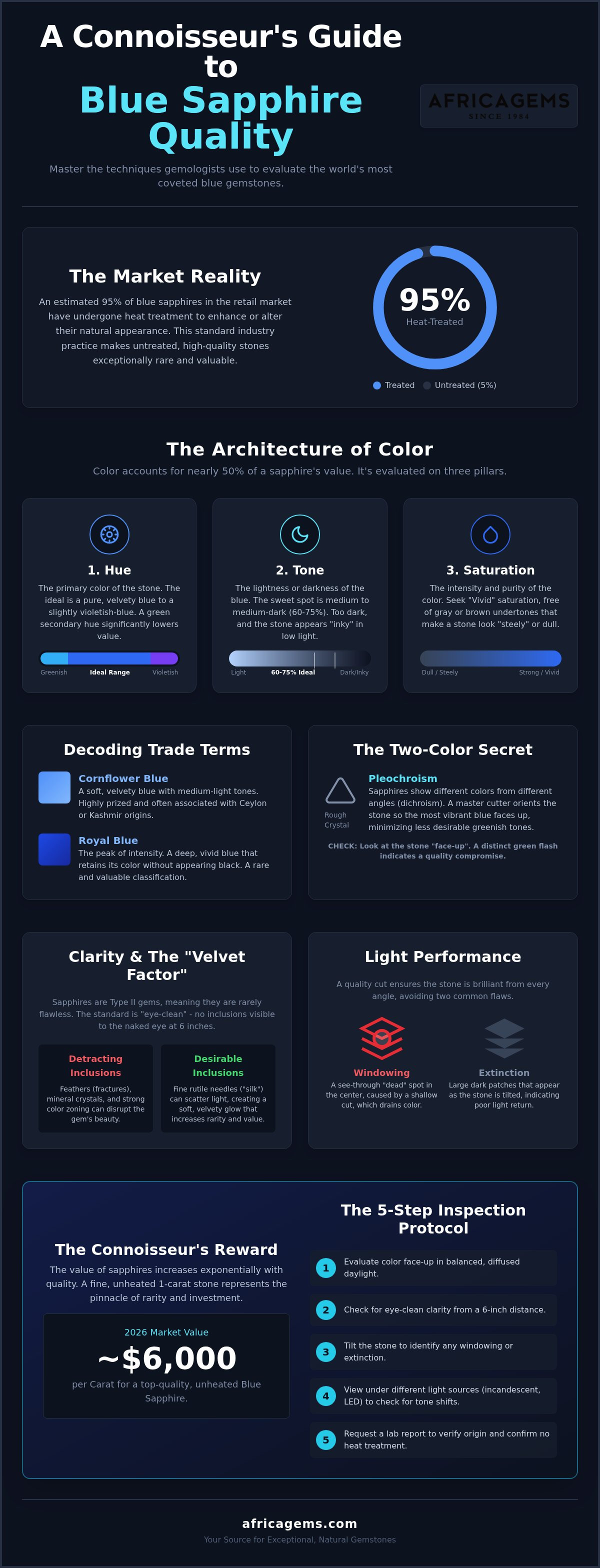
The Master Collector’s 5-Step Inspection Protocol
Mastering how to judge blue sapphire quality requires a disciplined approach to physical inspection that goes beyond simply admiring a stone's sparkle. While lab reports provide the technical skeleton, your eyes must evaluate the living character of the gem. Professionals don't just look at a stone; they interrogate it under multiple conditions to ensure its beauty remains consistent. This protocol is designed to expose hidden flaws and validate the premium prices often associated with loose blue sapphires in today's selective market.
A critical part of this audit involves the background check. You'll want to inspect the stone against a plain white background to see its true saturation and tone. A black background can be deceptive; it often hides extinction and makes a stone appear more saturated than it actually is. Next, perform a movement analysis. Rotate the gem slowly between your fingers to see how the light performs in motion. You're looking for consistent scintillation, where flashes of light dance across the facets without leaving large, stagnant dark zones. Finally, conduct a proportional audit without your loupe. Hold the stone at arm's length to check for basic symmetry. If the stone looks lopsided or "off" to the naked eye, no amount of color can save its visual appeal.
Step 1: The Daylight Evaluation
Blue sapphires are notorious for their sensitivity to light sources. Many stones that look magnificent under the warm, yellow glow of incandescent jewelry store lights will "gray out" or lose their vibrancy in other settings. Natural, North-facing daylight is the gold standard for grading because it provides a balanced spectrum that reveals the sapphire's true hue. Always view the stone near a window before finalizing a purchase. This ensures you aren't buying a stone that suffers from an unattractive color shift, where a vivid blue turns into a muddy violet or a steely gray under fluorescent office lighting.
Step 2: The "Hole in the Color" Search
To identify structural cutting flaws, use the text test. Place your sapphire face-up over a piece of paper with fine print. If you can read the letters through the center of the stone, you've found a significant window. This "colorless hole" means the light is leaking out the back rather than reflecting to your eye. You should also look for color zoning by turning the stone upside down against a white background. If the blue is concentrated only at the culet (the bottom point) while the rest of the crystal is near-colorless, the stone's value is compromised. Walk away from any "bargain" stone where the window exceeds 25% of the face-up area or where the zoning is so severe it creates a striped appearance. True quality requires a harmonious marriage of natural color and expert geometry.
Embark on Your Connoisseur’s Journey
You now possess the specialized vocabulary and technical framework to evaluate one of nature's most elusive treasures. By mastering the interaction between saturation and tone while remaining vigilant against structural flaws like windowing, you can navigate the 2026 gemstone market with absolute clarity. It's a transformative skill. Learning how to judge blue sapphire quality shifts you from a casual buyer to an informed insider who values both geological rarity and master craftsmanship. You're no longer guessing; you're selecting with the precision of a professional. This same eye for detail is essential when choosing premium eyewear, such as the high-quality frames available at R Eyes Optics.
Selecting a stone of this magnitude is a significant milestone in any collection. AfricaGems supports your acquisition with over 30 years of expertise and a commitment to radical transparency. Each gem in our vault comes with a full disclosure of treatments and a personal guarantee of quality from our founder, Marc Sarosi. Whether you're seeking a velvety unheated Ceylon or a vivid Madagascar specimen, your search for integrity ends here. Browse our curated collection of Loose Blue Sapphires and find the exceptional gem that defines your legacy. Your eye for excellence deserves a stone vetted by experts.
Frequently Asked Questions
What is the most important factor when judging a blue sapphire?
Color is the primary driver of value and beauty in every blue sapphire. It's a complex interplay of hue, tone, and saturation that defines the stone's character and desirability. While clarity and cut are vital, a sapphire with mediocre color will never reach the top tier of collector value. You're looking for a vivid, velvety blue that maintains its vibrancy across different lighting environments without appearing too dark or too light.
How can I tell if a blue sapphire is real or lab-created?
Natural sapphires almost always contain microscopic internal fingerprints like rutile needles or mineral crystals that are absent in synthetic stones. Lab-created gems, particularly those made via the flame fusion process, often show curved striae or growth lines that don't exist in nature. Because lab-grown stones are chemically identical to natural ones, a professional lab report is the only foolproof way to verify a stone's origin and ensure you aren't paying natural prices for a synthetic gem.
Is a darker blue sapphire always higher quality?
A darker stone isn't necessarily better; in fact, many very dark sapphires are considered lower quality because they lack brilliance. The goal is to find a medium to medium-dark tone that allows light to pass through and return as vivid blue flashes. If a stone loses its blue color and turns into a dark silhouette when you step away from a bright light, its quality is compromised. Stones that appear "inky" or black in low light are generally penalized in the market.
Does a "window" in a sapphire decrease its value?
Windowing is a major quality detractor that can lower a stone's value by 20% to 50% depending on its severity. It occurs when the pavilion is cut too shallow, causing light to leak through the bottom rather than reflecting back to the crown. When you're learning how to judge blue sapphire quality, identifying these "colorless holes" is essential. A well-cut stone should have a consistent blanket of color across its entire face-up surface without a transparent gap in the center.
Should I only buy blue sapphires with a GIA report?
GIA reports are an excellent standard, but they aren't the only reputable option for high-end colored gems. Labs like GRS, Gübelin, and SSEF are also world-renowned for their expertise in origin determination and treatment identification. The key is to ensure the report comes from a reputable, third-party institution with a history of strict standards. Avoid "in-house" certificates from the seller, as these lack the necessary objectivity and professional validation required for high-value transactions.
Why do some blue sapphires look purple in certain lighting?
This phenomenon is known as a color shift and it occurs because of specific trace elements reacting to different light spectrums. Some blue sapphires contain small amounts of vanadium or chromium that react to the red-rich spectrum of incandescent lighting. While a slight violetish-blue is often desirable, a dramatic shift to purple can lower the stone's value unless it is specifically sold as a "color-change" sapphire, which is a rare and distinct category of collector gem.
What is the difference between eye-clean and loupe-clean for sapphires?
Eye-clean is the realistic gold standard for most sapphire collectors, meaning no inclusions are visible to the unaided eye. Loupe-clean sapphires are incredibly rare because of how these crystals form in nature. When you understand how to judge blue sapphire quality, you'll find that minor inclusions visible only under 10x magnification are perfectly acceptable. These tiny internal markers don't impact the stone's transparency or overall beauty, but they do serve as proof of the gem's natural origin.
How much does origin actually affect the quality of a blue sapphire?
Origin acts as a primary price driver, but it doesn't always reflect the physical beauty of the individual stone. A top-quality Madagascar sapphire can easily outshine a mediocre Ceylon stone, even if the Ceylon stone costs more on paper. While Kashmir and Burma origins command massive premiums due to historical rarity, your focus should remain on the visual performance of the gem. Use the origin as a guide to potential rarity rather than a proxy for actual beauty.

Article by
Marc Sarosi
Professional gemstone dealer for more than 40 years. Started off mining Aquamarine in Zambia, Africa and travelled throughout the continent in search of fine gems. Trusted authority on fine gemstones and have donated a fine collection of more than 27 extraordinary gemstones to the Smithsonian Institute Gem Hall for generations to see.