
Alexandrite: The Connoisseur’s Guide to the Color-Changing Marvel (2026)
Sep 18th 2026
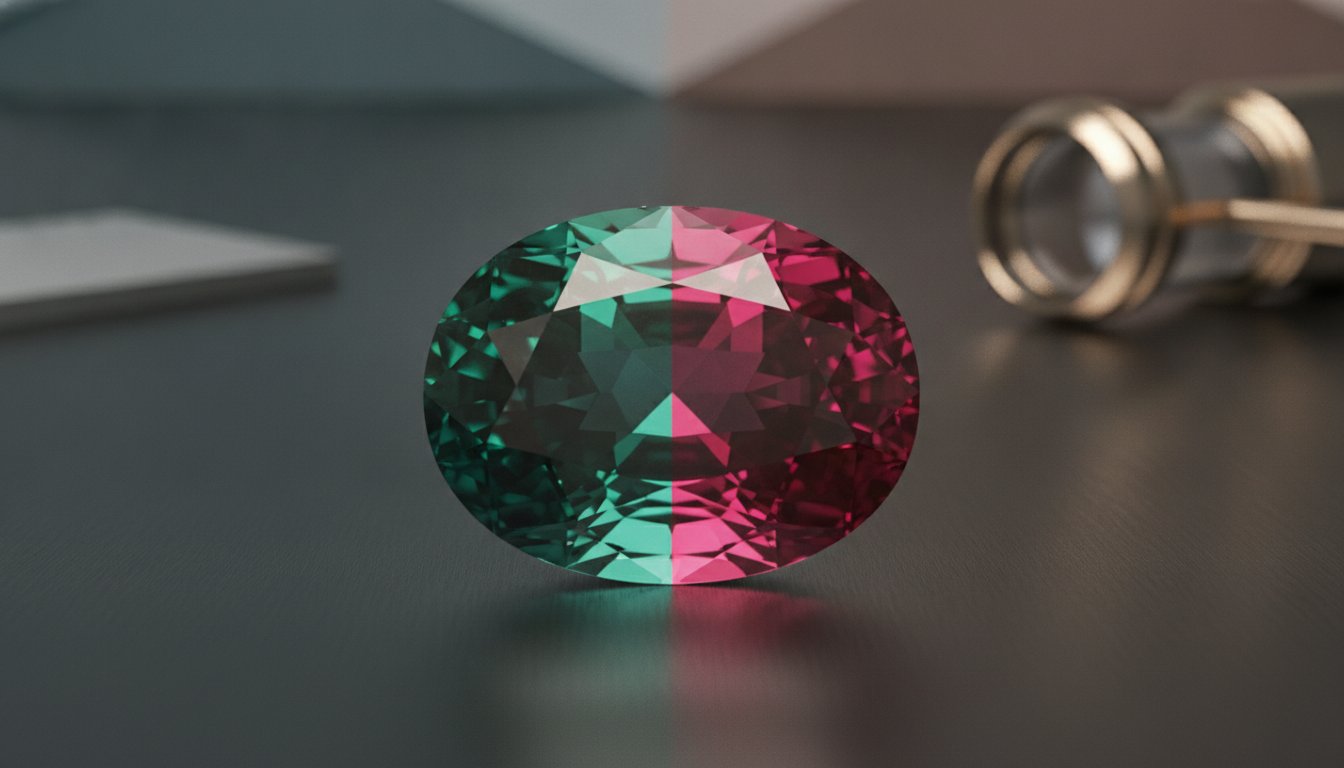
Could a single gemstone truly possess two distinct souls, one born of the cool forest and the other of the flickering flame? This is the central mystery of alexandrite, a rare chrysoberyl that defies the static nature of almost every other jewel on earth. You likely already appreciate its legendary "emerald by day, ruby by night" reputation, but you've probably also felt the frustration of trying to judge a stone's true quality through a computer screen. It's difficult to visualize a complete color shift when static photos often fail to capture the nuance of the transition.
We'll bridge that gap by mastering the technical benchmarks that define a connoisseur-grade specimen. You'll learn to decode grading reports, distinguish between natural and Chatham lab-created varieties, and understand why certain origins command such a premium. By the end of this guide, you'll have the expertise to move through the market without the fear of overpaying for a weak shift. We're moving beyond simple aesthetics to provide a methodical look at the integrity, rarity, and value of this color-shifting marvel.
Key Takeaways
- Understand the chromium-driven science behind the "emerald by day, ruby by night" phenomenon to accurately evaluate a stone's visual transformation.
- Master the "5th C" of gemstone grading to determine how color saturation and shift percentage dictate the market value of your alexandrite.
- Explore the historical prestige of the Ural Mountains and the impact of Brazilian discoveries on the modern availability of investment-grade specimens.
- Clarify the critical differences between natural gems and Chatham lab-created varieties so you can choose the ethical path that fits your specific collection goals.
- Learn why acquiring loose gemstones is the most secure way to verify technical quality and origin before committing to a custom jewelry design.
What is Alexandrite? The "Emerald by Day, Ruby by Night" Phenomenon
True luxury often lies in the unexpected, and few specimens capture this sentiment as vividly as alexandrite. This rare variety of chrysoberyl owes its existence to a geological coincidence where beryllium and aluminum meet trace amounts of chromium. It’s this chromium that acts as the stone’s color-change engine. First unearthed in the Ural Mountains of Russia during the 1830s, the alexandrite gemstone was named in honor of Tsar Alexander II. It quickly became a symbol of imperial prestige, mirroring the national colors of old Russia.
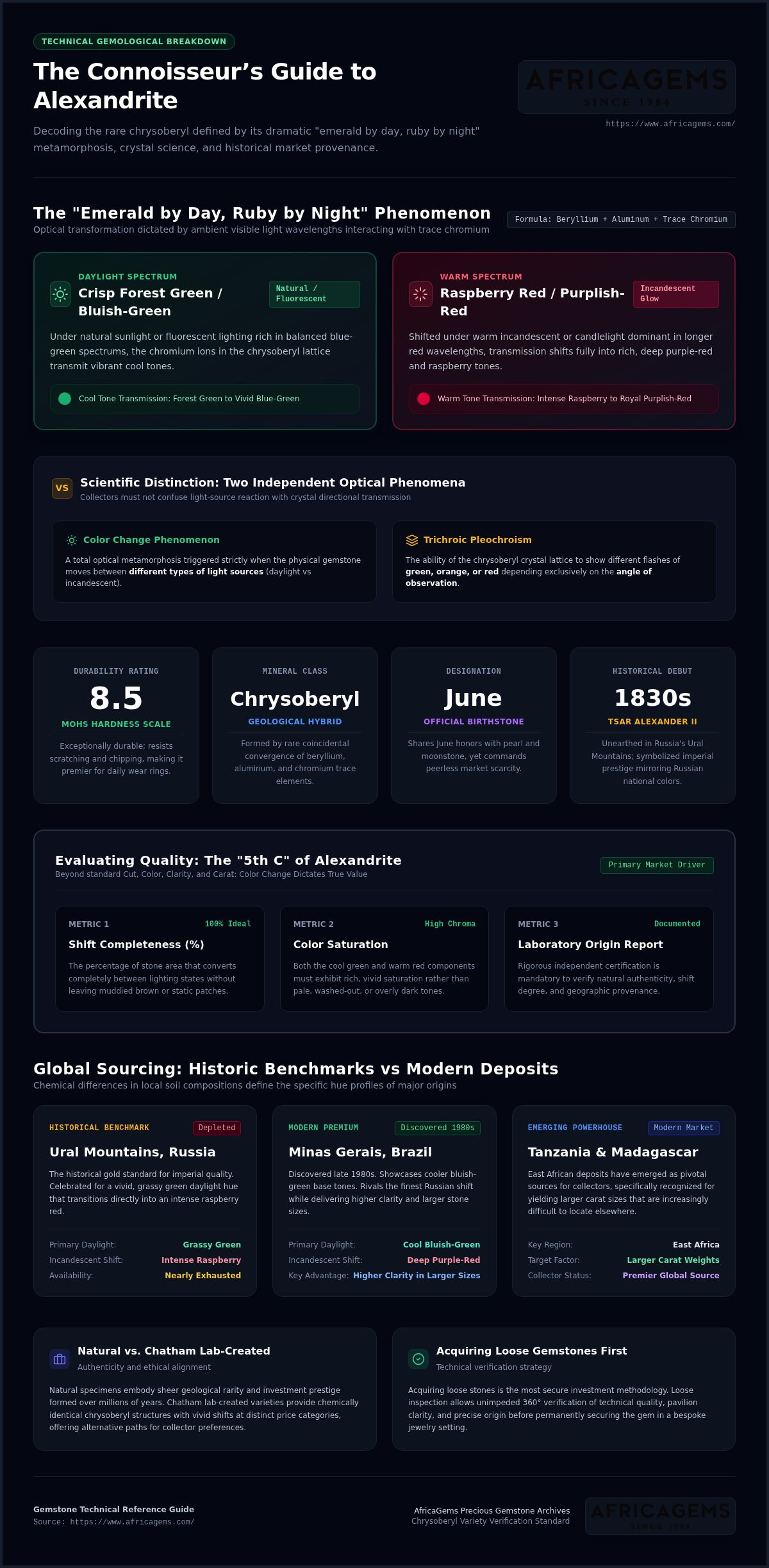
The hallmark of a fine alexandrite is its dramatic transformation, often described as "emerald by day, ruby by night." In natural daylight or fluorescent light, the gem displays a crisp, forest green or bluish-green. When moved under the warm glow of incandescent light, it shifts into a rich raspberry red or purplish-red. This isn’t just a subtle tint change. It’s a complete optical metamorphosis. This rarity and visual drama solidify its status among the world’s most prestigious rare gemstones.
The Science of Pleochroism
To understand this gem, we have to look at how its crystal lattice interacts with the visible light spectrum. While the color change is triggered by the light source itself, the stone also exhibits a secondary optical trait known as pleochroism. Many collectors confuse these two terms, but they’re distinct phenomena. Color change happens when the stone is moved between different types of light. Pleochroism is the ability of a gem to show different colors when viewed from different crystal directions. This means a single stone might reveal flashes of green, orange, or red depending on the angle of observation, adding layers of complexity to its visual profile.
Alexandrite as a Birthstone and Investment
Beyond its scientific intrigue, this chrysoberyl variety holds a cherished place in modern culture as the official June birthstone. It shares this month with pearl and moonstone, yet it stands alone in terms of sheer market scarcity. For serious gemstone investors, the combination of limited supply and high demand makes it a premier asset. It’s not just a trophy for a safe. Its physical resilience makes it practical for life’s milestones. With a hardness of 8.5 on the Mohs scale, it’s exceptionally durable. It resists scratching and chipping far better than most alternatives, making it an ideal candidate for bespoke gemstone rings that are intended to be worn and admired daily.
Origins and Rarity: From the Ural Mountains to Brazil
The provenance of a fine jewel often dictates its soul. For alexandrite, the Ural Mountains of Russia represent the historical pinnacle of quality. While the original mines are now largely depleted, the market still treats "Russian" as the gold standard for color shift. This prestige isn't just about heritage. It's about the specific chemical composition of the soil in the Urals, which produced stones with legendary clarity and a balanced color transition. Today, finding an authentic Russian specimen is a feat for even the most seasoned collector.
The Russian Legacy
The Ural mines set the benchmark for what connoisseurs call "imperial" quality. These stones are celebrated for a vivid grassy green that transitions into an intense raspberry red. Because these sources are nearly exhausted, authentic Russian specimens are exceptionally rare. If you're evaluating a stone claimed to be of Russian origin, rigorous laboratory documentation is mandatory. Understanding alexandrite quality factors is vital because origin alone can significantly inflate the price. We believe every high-value acquisition should be accompanied by certified gemstones reports to verify these provenance claims and ensure your investment is secure.
Modern Sourcing: Brazil and East Africa
The global landscape shifted in the late 1980s with a significant discovery in Minas Gerais, Brazil. These stones brought a fresh aesthetic to the market. While Russian stones lean toward grass-green, Brazilian specimens often showcase cooler bluish-green tones. In terms of the shift, Brazil can rival the finest Russian material, sometimes offering even higher clarity in larger sizes. This discovery was a turning point, making investment-grade stones accessible to a wider audience of enthusiasts.
Beyond South America, East Africa has emerged as a powerhouse for the modern collector. Deposits in Tanzania and Madagascar are known for producing larger carat sizes that are rarely seen in older mines. Sri Lanka also contributes to the global supply, though these stones often lean toward yellowish or brownish-green hues with a less dramatic shift. We take pride in our commitment to sourcing precious gemstones through ethical channels, ensuring that the journey from the mine to your collection is transparent. If you're curious about how these various origins compare, you can explore our curated selection of loose gemstones to see the subtle differences in hue and saturation for yourself.
Evaluating Quality: The Five Pillars of Alexandrite Value
While the traditional 4Cs provide a foundation for most jewels, evaluating a phenomenal stone like alexandrite requires a more nuanced lens. The market prioritizes what we call the "5th C": the color change. This phenomenon is the single most critical driver of value. If a stone exhibits a weak or muddy shift, even perfect clarity won't sustain its market price. We look for color saturation that creates a dramatic transition. A stone that is too light won't show the shift clearly; one that is too dark might look nearly black under certain lighting conditions. Balance is everything.
According to the Gemological Institute of America, the strength of the color change is often the primary factor in determining quality. When browsing our precious gemstones, you'll notice we prioritize stones where the shift is both distinct and complete. This level of transparency in grading ensures you're investing in a specimen that truly performs under different light sources.
Mastering the Color Change Percentage
There's a significant difference between the percentage of change and the quality of change. A 100% shift means the entire body of the stone changes color simultaneously. A 50% shift might only show the change in certain facets or zones. Connoisseurs also watch for "bleeding," which occurs when you see both the green and red hues at the same time. This overlap creates a brownish or muddy appearance that lowers the stone's value. The goal is a clean, crisp flip from one side of the color wheel to the other.
Use this checklist when evaluating a potential acquisition:
- Daylight Hue: Look for a vivid forest green or a cool bluish-green.
- Incandescent Hue: Look for a distinct raspberry red or purplish-red.
- Saturation: Aim for medium to medium-dark tones; avoid stones that look overly "inky."
- Transition: The change should feel instantaneous as you move between light sources.
Clarity, Cut, and Carat Weight
Alexandrite is classified as a Type II gemstone in clarity, meaning minor inclusions are expected and often tolerated if the color change is exceptional. However, "eye-clean" remains the benchmark for high-end collectors. The cut must be precise to maximize light return. A poor cut can cause light leakage, which effectively kills the color-change phenomenon by diluting the light as it passes through the stone. We often recommend a brilliant or step cut to best showcase these phenomenal properties.
Carat weight plays a massive role in the pricing structure. Large, high-quality crystals are incredibly rare in nature. Because of this scarcity, stones that weigh over 1.00 carat are exponentially more expensive than smaller specimens. Finding a clean, 2-carat stone with a 100% color shift is a rare event that even seasoned dealers celebrate.
Natural vs. Chatham Lab-Created Alexandrite
Choosing between natural and lab-created specimens is often the most significant decision for a collector. To make an informed choice, you must first understand the terminology. A "simulant" is merely an imitation, often color-change sapphire or glass, that mimics the look but lacks the chemical properties of chrysoberyl. In contrast, Chatham lab-created gemstones are true synthetics. They possess the same chemical, physical, and optical properties as their earth-mined counterparts. They aren't fakes; they're simply grown in a controlled environment rather than the earth's crust.
Chatham uses a sophisticated flux-growth process to create these stones. This method involves dissolving the necessary elements in a molten flux and allowing the crystals to grow over several months. It's a slow, meticulous process that mimics the high-heat conditions of the earth's crust. This results in stones with a color change that's often more vivid and consistent than what's found in all but the most expensive natural specimens. For many buyers, this provides a path to owning a world-class look without the seven-figure price tag of a large, natural Russian stone.
Why Choose Lab-Created?
The appeal of lab-grown options lies in the combination of perfection and accessibility. While a natural stone of high clarity and 100% color shift is a rare luxury, lab-created varieties offer that same "emerald by day, ruby by night" drama with fewer inclusions. There's also a significant ethical and environmental advantage. Lab-grown stones have a transparent supply chain and a smaller ecological footprint. We also provide custom gemstone cutting for Chatham stones. This means you don't have to settle for standard commercial cuts; you can secure a precision-cut gem tailored to your specific jewelry design.
Identifying Natural Alexandrite
Natural stones carry the "fingerprints" of their geological birth. Microscopic inclusions, such as fine "silk" or tiny mineral crystals, are often the keys to identifying a stone as earth-mined. Because the price difference between natural and synthetic material is vast, professional lab reports from institutions like the GIA or AGL are non-negotiable for natural purchases. We maintain a policy of radical transparency. Whether you're browsing our semi-precious gemstones or our most elite natural alexandrite, we provide full disclosure on every stone's origin and any enhancements. This ensures you're buying with absolute confidence.
If you're ready to compare the technical brilliance of flux-grown stones with the raw rarity of natural specimens, you can browse our full collection of loose alexandrite to find the perfect match for your collection and budget.
Buying Strategy: Securing Your Investment
Buying loose alexandrite gemstones is the most strategic path for a discerning collector. Preset jewelry often masks subtle imperfections or limits your ability to observe the full 360-degree color shift. When a stone is loose, you can place it under various light sources to verify the "emerald by day, ruby by night" effect without the metal's reflection influencing the hue. This transparency is the foundation of a secure high-value transaction. It allows you to inspect the pavilion and girdle for any hidden chips or inclusions that a setting might obscure.
Before you commit to an acquisition, you should vet the dealer with a series of technical questions. A reputable professional will welcome this level of scrutiny. We recommend asking the following:
- Is the stone's origin verified by a third-party laboratory like the GIA or AGL?
- What is the specific percentage of color change, and is the shift complete?
- Has the stone undergone any treatments, such as fracture filling or oiling?
- Does the dealer offer a personal guarantee or a clear return policy if the color shift doesn't perform as expected in your home lighting?
Reading the Lab Report
A certificate from a reputable laboratory is a prerequisite for any natural alexandrite purchase. Pay close attention to the "Comments" section. This is where any subtle treatments or enhancements are disclosed. You should also look for the "Degree of Change" notation. This technical assessment provides an objective measure of the stone's performance, moving beyond subjective marketing terms. For more details on navigating these high-value transactions, consult our Expert Guide to Buying Gemstones Online.
Designing Your Custom Piece
Once you've secured your stone, our custom jewelry design services can help bring your vision to life. The choice of mounting is crucial for this specific gemstone. You need a setting that allows maximum light to reach the pavilion and crown to trigger the color change. We typically recommend platinum or white gold. These neutral-toned metals don't compete with the stone's shifting colors. Yellow gold can sometimes muddy the green daylight phase, whereas white metals enhance the crispness of the transition. Whether you're envisioning gemstone pendants or a signature ring, the setting must serve the stone's phenomenal nature. A well-designed piece will ensure the gem remains the focal point while staying protected for daily wear.
Since 1984, AfricaGems has operated with a philosophy of radical transparency. Every acquisition is backed by the personal oversight and direct accountability of our founder, Marc Sarosi. We don't just sell stones; we provide a legacy-oriented consultation that ensures your investment is as enduring as the gem itself. Our commitment to full disclosure means you'll always know exactly what you're adding to your collection.
Begin Your Legacy with a Color-Shifting Masterpiece
Acquiring this gem is a significant milestone for any serious collector. You now understand that the true value of an alexandrite lies in the drama of its transformation and the integrity of its origin. Whether you're drawn to the historical prestige of the Ural Mountains or the ethical perfection of Chatham lab-created varieties, your decision is now grounded in technical expertise. You have the tools to look beyond static photos and evaluate the "5th C" with the confidence of a seasoned connoisseur.
Every stone in our vault has been expertly vetted by Marc Sarosi to ensure it meets our uncompromising standards for color saturation and shift percentage. We provide full lab certification on all natural stones and maintain a policy of radical transparency regarding ethical sourcing. You're no longer just a buyer; you're an informed insider ready to secure a piece of geological history. Explore Our Curated Collection of Loose Alexandrite Gemstones and find the specimen that speaks to your unique aesthetic. Your journey into the world of rare chrysoberyl is just beginning.
Frequently Asked Questions
Is alexandrite rarer than a diamond?
Natural specimens are significantly rarer than diamonds. While diamonds are found in numerous locations globally, this gem requires a rare geological meeting of beryllium and chromium. High-quality stones with a strong, distinct color change are exceptionally scarce. This rarity is a primary driver for its value among serious collectors who seek gems that are more unique and harder to source than traditional white diamonds.
How can I tell if my alexandrite is real or lab-created?
Professional laboratory testing is the only definitive way to distinguish natural stones from lab-grown varieties. Under a microscope, natural gems often contain tiny mineral inclusions or "silk" that reveal their geological origin. Lab-created stones, like those from Chatham, are chemically identical but often have different growth patterns. We prioritize radical transparency and provide full disclosure and lab reports for all our alexandrite offerings to ensure absolute certainty.
Does alexandrite change color in LED light?
LED light performance varies depending on the bulb's specific color temperature. Warm LEDs mimic incandescent light and will typically trigger the reddish-purple phase. Cool LEDs behave more like daylight, highlighting the green or bluish-green tones. For a true evaluation, we recommend viewing the stone under natural sunlight and traditional incandescent bulbs to see the most dramatic, unfiltered transition between its two distinct color states.
What is the most valuable color of alexandrite?
The most valuable stones exhibit a 100% color change from a vivid, grassy green to an intense raspberry red. Connoisseurs look for high saturation and a "clean" shift without muddy or brownish secondary tones. While bluish-green to purplish-red shifts are also highly prized, the closer the stone gets to the "emerald by day, ruby by night" ideal, the higher its market value and investment potential will be.
Why is Russian alexandrite so expensive?
Russian specimens command a premium due to their historical prestige and the near-depletion of the original Ural Mountain mines. These stones established the global standard for the variety's color shift. Because authentic Russian material is now mostly found in estate collections rather than new mining, the extreme scarcity and "imperial" heritage drive prices significantly higher than stones from newer deposits found in Brazil or East Africa.
Can I wear alexandrite in an engagement ring every day?
You can wear this gem daily because it ranks 8.5 on the Mohs scale of hardness. It's one of the most durable gemstones available, sitting just below sapphire and ruby. This resilience makes it an excellent choice for engagement rings or other frequent-wear jewelry. Its resistance to scratching and chipping ensures the stone remains beautiful through decades of use, provided it's set in a protective mounting.
What is the "alexandrite effect" in other gemstones?
The "alexandrite effect" refers to a phenomenon where a mineral changes color under different light sources. While alexandrite is the most famous example, other gems like certain sapphires, garnets, and even rare zultanite can display similar properties. However, none match the distinct, high-contrast flip from green to red found in top-tier chrysoberyl. This optical trick is caused by the way the stone's chemical structure absorbs specific wavelengths of light.
How do I clean and care for my alexandrite jewelry?
Clean your jewelry using warm, soapy water and a soft-bristled brush to remove oils and debris. While the stone is tough enough for ultrasonic or steam cleaners, we generally recommend gentle hand-cleaning to avoid stressing the metal setting. Avoid exposing the gem to harsh household chemicals or sudden, extreme temperature shocks. Storing your pieces in a separate soft pouch prevents harder stones like diamonds from scratching the surface over time.

Article by
Marc Sarosi
Professional gemstone dealer for more than 40 years. Started off mining Aquamarine in Zambia, Africa and travelled throughout the continent in search of fine gems. Trusted authority on fine gemstones and have donated a fine collection of more than 27 extraordinary gemstones to the Smithsonian Institute Gem Hall for generations to see.