
Alexandrite Price Per Carat: The 2026 Collector’s Guide to Value and Rarity
May 26th 2026
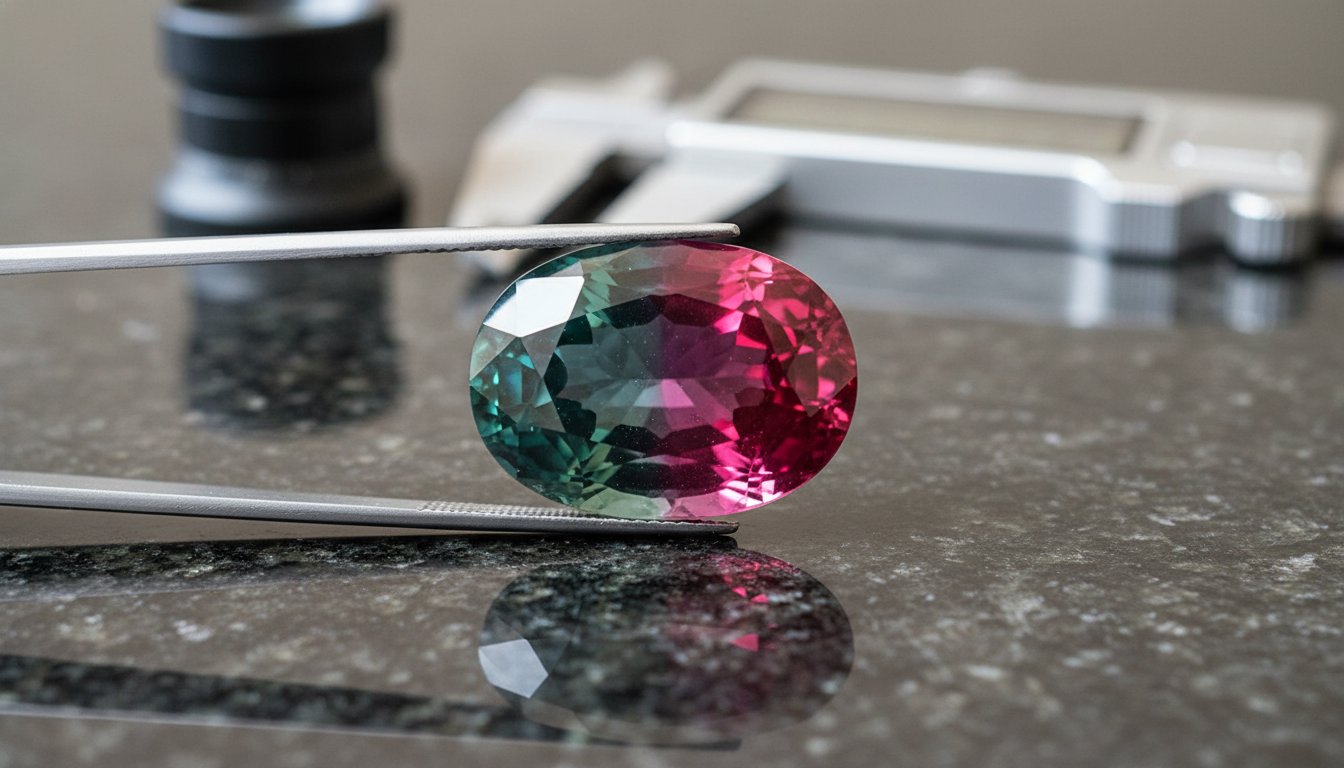
Did you know that gem-quality alexandrite is approximately 8,000 times rarer than a white diamond? While many are drawn to the mesmerizing "emerald by day, ruby by night" transformation, you've likely realized that finding a stone with a 100% color shift is becoming a significant challenge in today's market. It's common to feel a sense of hesitation when faced with the vast price gaps between Russian and Brazilian origins, or the fear of mistakenly purchasing lab-grown material that carries zero resale value.
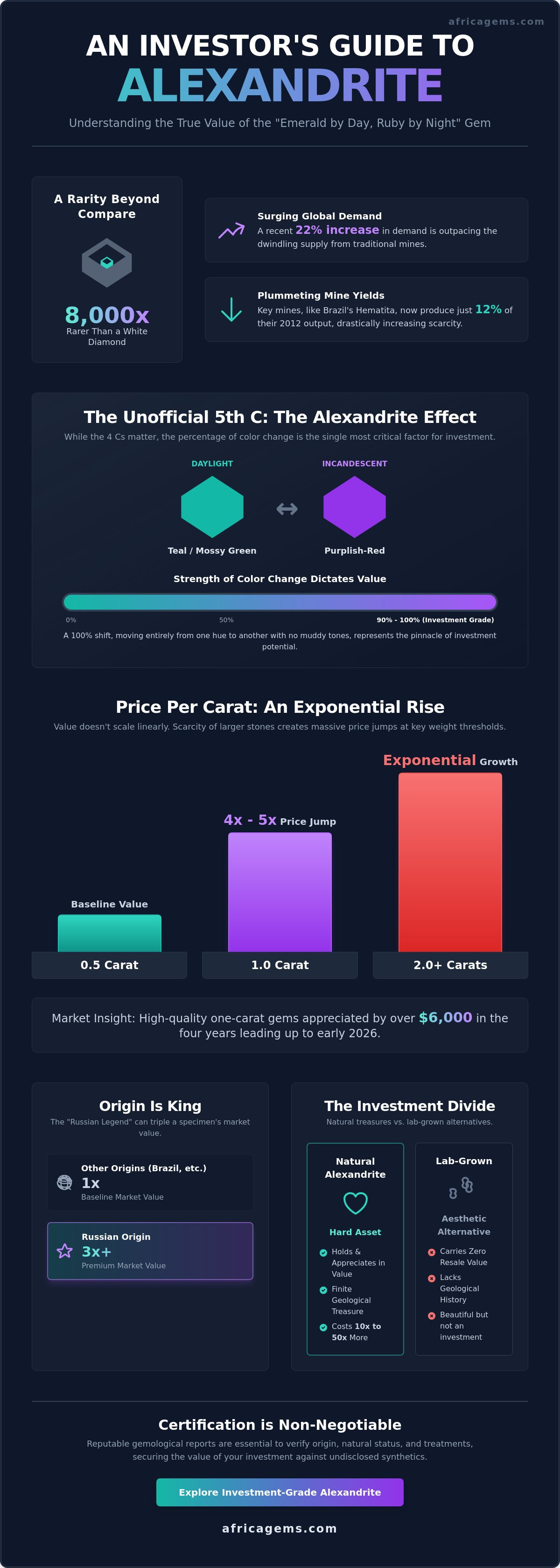
This guide will help you master the complex variables of the alexandrite price per carat so you can secure a high-value investment stone with absolute confidence. You'll gain a clear framework for evaluating a stone's true worth beyond its weight alone. We'll analyze why global demand has surged by 22% recently, how to weigh color-shift percentage against pure clarity, and what the 2026 market shifts reveal about the long-term ROI of these exceptional natural treasures.
Key Takeaways
- Learn why the percentage of color change acts as the unofficial "5th C" and why it's the most critical factor in determining a stone's investment potential.
- Navigate the current market with our definitive 2026 guide to the alexandrite price per carat, including the specific thresholds where value jumps exponentially.
- Understand the "Russian Legend" and how geographical origin can triple a specimen's market value compared to stones from other regions.
- Identify the essential certification protocols needed to distinguish rare natural treasures from lab-grown alternatives that carry no resale value.
- Discover the rigorous vetting process and ethical sourcing standards used by Marc Sarosi to curate AfricaGems' collection of investment-grade loose alexandrite.
Understanding Alexandrite Price Per Carat in 2026
Alexandrite isn't just another gemstone. It's the most prestigious variety of the Chrysoberyl mineral family. Collectors often refer to it as "emerald by day, ruby by night." This dramatic shift from teal or mossy green in sunlight to a purplish-red under incandescent light is what defines its soul. In 2026, natural alexandrite remains a pinnacle of the gem world. It's consistently ranked among the most expensive materials on Earth.
When you evaluate these stones, you'll notice the alexandrite price per carat doesn't follow a simple straight line. In the world of rare materials, the scale is non-linear. As the size of a stone increases, its scarcity rises exponentially. This scarcity creates massive price jumps at specific weight thresholds. A one-carat stone isn't just twice the price of a half-carat stone. It might be four or five times more expensive. This premium reflects the extreme difficulty of finding large, gem-quality rough material that survives the cutting process without losing its signature color-changing properties.
To better understand the nuances of color change and pricing, watch this detailed analysis:
The Rarity Factor: Why Costs Are Rising
Traditional mines are struggling to keep up with global demand. For instance, yields from the famous Hematita mine in Brazil have plummeted to just 12% of what they were in 2012. While diamonds are marketed as rare, gem-quality alexandrite is actually 8,000 times scarcer. This supply-demand gap is driving costs higher in 2026. High-quality one-carat gems have appreciated by over $6,000 in the four years leading up to early 2026. For those looking at a legacy purchase, stones with a 90% or higher color change represent the highest tier of investment potential. They hold their value even when the broader economy fluctuates.
Natural vs. Lab-Created: A Price Comparison
The market for synthetic stones has grown, but the value proposition is entirely different. You'll find a massive price gap between a natural specimen and a Chatham lab-created stone. Natural gems often cost 10 to 50 times more than their lab-grown counterparts. While lab-grown options offer a beautiful aesthetic for casual jewelry, they lack the "hard asset" status of the real thing. Natural alexandrite is a finite resource that carries a legacy of geological history. It's a tangible asset that collectors can pass down through generations. If you want to dive deeper into why certain minerals command such premiums, explore our Rare Gemstones: A Connoisseur’s Guide for a full breakdown of the world's scarcest treasures.
The Four Pillars of Alexandrite Valuation
While the diamond industry popularized the traditional "4 Cs," evaluating this color-changing chrysoberyl requires a more sophisticated lens. The alexandrite price per carat is primarily dictated by a factor that doesn't exist for most other stones: the spectral shift. This makes color change the unofficial "5th C." Beyond the shift, transparency and cut play a vital role in showcasing the stone's internal fire. According to GIA's guide to alexandrite quality factors, the interplay between these elements determines whether a stone is a commercial-grade piece or a museum-quality investment.
Transparency is often sacrificed in natural specimens due to the complex geological conditions required for alexandrite to form. A stone that maintains a high degree of "glow" or brilliance despite its inclusions is highly coveted. Similarly, the cut quality must be precise. A master lapidary will orient the stone to preserve its pleochroism, which is the ability to show different colors from different angles. A poorly cut stone might hide the very color change you're paying for, effectively burying the stone's value.
The Color Change Percentage (The 'Alexandrite Effect')
The strength of the "Alexandrite Effect" is measured by the percentage of the stone that actually changes color. A specimen with a 100% shift moves entirely from one hue to another without residual muddy tones. In the 2026 market, a stone with a 100% shift from teal to purple-red typically costs 60% more than a stone with a 70% shift. One of the most detrimental factors in pricing is "bleed," which occurs when you see both the green and red components simultaneously under a single light source. The ideal specimen exhibits a crisp, definitive transition from a cool teal-green in daylight to a warm, vibrant raspberry-red under incandescent light.
Clarity and Inclusions in Rare Chrysoberyl
Finding an "eye-clean" alexandrite is an exceptionally rare feat, and the price reflects this scarcity. Most natural chrysoberyl contains microscopic inclusions like silk or fine needles. While heavy inclusions can dull the stone's luster, a specific arrangement of these needles can create a phenomenal result. If the inclusions are parallel and dense enough, they can produce the rare "Cat's Eye" effect, known as chatoyancy. This unique phenomenon can actually increase the value of a stone that might otherwise be overlooked for its lack of transparency. If you're beginning your search for a specimen that meets these rigorous standards, exploring a curated selection of loose alexandrite gemstones is the best way to see these pillars in action.
Alexandrite Price Per Carat: 2026 Value Tiers
The 2026 market for alexandrite is defined by a phenomenon known as the "Threshold Effect." While most commodities follow a linear pricing model, the alexandrite price per carat experiences sharp, exponential jumps at specific weight milestones. This "Carat Jump" is most visible at the 1.00-carat mark. A stone weighing 0.98 carats might be priced significantly lower than a 1.02-carat stone of identical quality. This happens because crossing the one-carat threshold places the gem into a higher tier of scarcity, making it a more desirable "hard asset" for serious collectors.
As you move beyond the one-carat mark, the availability of clean, natural rough material drops precipitously. Finding a specimen that maintains a 100% color shift while exceeding two or three carats is a rare event in the industry. For these reasons, professional valuations are structured around specific weight brackets and quality grades that reflect the current supply-demand gap.
Price Breakdown by Weight (0.50ct to 5.00ct+)
- Sub-1.00 Carat: These stones are the primary entry point for fine jewelry. While more accessible, they still command respect if the color change is vivid.
- 1.00 to 1.99 Carats: This is the "Investment Grade" sweet spot. You should expect to pay between $15,000 and $35,000 per carat for specimens that meet high-quality criteria.
- 3.00+ Carats: You've entered museum-quality territory. At this size, stones are 8,000 times rarer than diamonds, and prices are almost always negotiated privately rather than listed on a standard schedule.
- 5.00+ Carats: These are "legacy" stones. They rarely appear on the open market and are typically the crown jewels of private collections or high-end auctions.
Quality Grading: Commercial vs. Fine vs. Extra Fine
The quality of the "shift" is the primary driver within these weight brackets. Commercial Grade stones often feature brownish or grayish modifiers that dull the color change, typically ranging from $3,000 to $6,000 per carat. Fine Grade stones offer a strong, distinct change with good clarity, commanding between $10,000 and $25,000 per carat. Extra Fine specimens, particularly those of Russian or Brazilian origin with a 100% shift and vivid hues, easily exceed $40,000 per carat. In some cases, exceptional stones have reached $70,000 per carat in early 2026.
Be wary of any listing offering "natural alexandrite" at prices significantly below these tiers. If a stone is priced under $2,000 per carat, it almost certainly lacks a visible color change or is a lab-grown alternative being misrepresented. In a market where demand has surged by 22% in the last 24 months, "deals" that seem too good to be true usually indicate a compromise in authenticity or origin disclosure.
Origin and Certification: The Hidden Value Drivers
Geography acts as a powerful multiplier when determining the alexandrite price per carat. While two stones might appear identical to the untrained eye, their geological birthplace can cause their market values to diverge by tens of thousands of dollars. This isn't mere sentimentality; it reflects the historical prestige and the specific trace elements found in legendary deposits. In 2026, savvy collectors prioritize documented origin as much as they do the quality of the color shift itself.
The "Russian Legend" remains the pinnacle of this market. The Ural Mountains represent the original source of the 19th-century discovery, and these stones set the benchmark for the ideal color transition. Because these mines are largely exhausted, "Old Mine" Russian stones command a staggering 200% price premium over their Brazilian or Sri Lankan counterparts. To protect your investment, don't rely on verbal claims. Reputable third-party certification from laboratories like the GIA, Gübelin, or SSEF is non-negotiable. These certificates verify the stone's authenticity and trace its chemical fingerprint back to its source, ensuring you don't pay a premium for a stone of lesser pedigree.
The Russian Origin Premium
Russian specimens are the most sought-after by collectors because they typically exhibit the most balanced color change, avoiding the muddy modifiers found in other regions. In early 2026, auction prices for verified Russian stones have reached new heights as supply continues to dwindle. A stone with a documented Ural provenance is more than a gemstone; it's a piece of history that functions as a "hard asset" in a volatile economy. This rarity is why the alexandrite price per carat for Russian material remains the highest in the industry.
Brazilian vs. Sri Lankan Alexandrite
Brazil has emerged as the primary source for high-end material, currently accounting for 85% of the market for fine specimens. The Hematita mine is famous for stones that rival Russian quality, though its yields have dropped to just 12% of 2012 levels. Brazilian alexandrite is prized for its vivid teal-to-raspberry shift. By contrast, Sri Lankan stones are often found in larger sizes, sometimes exceeding five carats, but they frequently struggle with yellowish-green hues that lack the crispness of a top-tier Brazilian specimen. Understanding these nuances is a critical part of the process when you learn how to buy gemstones online from a trusted partner.
If you're ready to add a pedigreed stone to your collection, you can browse our curated selection of loose alexandrite gemstones to find a piece with verified origin and exceptional color change.
Beyond South America and Russia, East Africa has entered the conversation. Deposits in Tanzania and Ethiopia produce specimens with respectable color change, though they rarely reach the vivid saturation of the classic sources. These stones often serve as an accessible option for those who want a natural stone without the heavy premium associated with the Ural Mountains. However, even with these newer sources, the widening supply-demand gap in 2026 continues to push the market value higher across all reputable origins.
Acquiring Rare Alexandrite: The AfricaGems Advantage
Securing a specimen of this caliber requires more than just a budget; it requires a mentor who understands the subtle nuances of the trade. Marc Sarosi has spent over 40 years cultivating direct mine relationships, providing AfricaGems with a level of access that few dealers can match. When the alexandrite price per carat reaches the investment levels of early 2026, the source of your stone becomes your greatest security. We operate with a policy of radical transparency, ensuring that every significant gem is accompanied by an independent lab report to verify its authenticity and origin.
Purchasing loose gemstones offers a distinct advantage over buying pre-set jewelry. It allows you to inspect the stone's color-change integrity from every angle without the interference of a mounting. This level of scrutiny is essential for stones that command a premium. By selecting a loose stone, you're not just buying a gem; you're securing a documented asset that can be tailored to your specific vision through our custom jewelry design services.
The Connoisseur’s Selection Process
Every stone that enters our inventory undergoes a rigorous vetting process. We analyze the saturation of the teal and the vibrancy of the raspberry-red to ensure the shift meets our uncompromising standards. The "Sarosi Guarantee" is our personal promise of full disclosure. You'll never find undisclosed treatments or ambiguous origin claims in our collection. For those seeking museum-quality specimens, we offer access to our "Collector’s Vault." This private selection contains unlisted, investment-grade stones that represent the absolute pinnacle of what the 2026 market has to offer.
Custom Design for Your Alexandrite
Once you've secured your stone, the setting must be engineered to celebrate its unique properties. We often recommend open-back settings. This design allows maximum light to interact with the crystal lattice, which is vital for triggering the "alexandrite effect." Pairing your stone with high-grade white diamonds can further enhance its beauty. The colorless brilliance of a diamond provides the perfect backdrop for the alexandrite's shifting hues. If you're ready to begin your journey, explore our Loose Alexandrite Gemstones and let us help you create a legacy piece that reflects your personal taste and investment goals.
Securing Your Legacy in the 2026 Gemstone Market
The 2026 landscape for rare minerals has made one thing clear; natural alexandrite is a premier choice for those seeking tangible, hard assets. You've learned that the alexandrite price per carat is driven by a unique spectral equation where the strength of the color shift and the prestige of the origin outweigh almost every other factor. As production from legendary mines in Russia and Brazil continues to diminish, the stones you acquire today represent a finite slice of geological history that cannot be replicated.
Choosing a partner for such a significant acquisition is a matter of trust and legacy. AfricaGems was founded in 1984 by expert Marc Sarosi, and our commitment to transparency has never wavered. We provide GIA certified stones and prioritize ethically sourced natural gems, ensuring that your collection is built on a foundation of integrity. Whether you're a seasoned collector or a first-time investor, the right specimen is a powerful addition to any portfolio.
Secure Your Investment: Shop Natural Loose Alexandrite at AfricaGems
Frequently Asked Questions
Is alexandrite more expensive than a diamond?
Yes, gem-quality natural alexandrite is often significantly more expensive than white diamonds of comparable size and grade. While common commercial diamonds are widely available, natural alexandrite is roughly 8,000 times rarer. This extreme scarcity, combined with the complex color-change phenomenon, ensures that high-quality specimens maintain a much higher entry price and resale value than standard diamonds. To better understand the value of traditional loose diamonds in this context, read more.
Why is Russian alexandrite so much more expensive than others?
Russian specimens command a premium due to their historical prestige and superior color-change balance. The original Ural Mountain deposits produced stones with a near-perfect transition from emerald green to raspberry red without the brownish modifiers found elsewhere. Since these mines are largely exhausted, the limited supply of "Old Mine" material creates a 200% price premium over stones from Brazil or Sri Lanka.
Can I find natural alexandrite for under $1,000 per carat?
It's highly unlikely to find a gem-quality natural stone at that price point in the current market. Most natural material priced under $1,000 per carat either lacks a visible color change or is heavily included to the point of being opaque. When you evaluate the alexandrite price per carat for investment-grade gems, you'll find that even commercial-grade natural stones typically start at $3,000 per carat.
What is the best lighting to see the alexandrite color change?
You need two distinct light sources to observe the full "Alexandrite Effect." Natural sunlight or fluorescent light brings out the cool teal and green tones, while incandescent light or candlelight triggers the shift to warm purples and reds. Professional collectors often use a penlight with a warm filament to test stones in a controlled environment, ensuring the transition is crisp and complete.
Does alexandrite lose its color change over time?
No, the color-changing property of natural alexandrite is a permanent result of its crystal structure and chemical composition. The effect is caused by the way chromium ions within the chrysoberyl lattice absorb specific wavelengths of light. Unlike some treated gems that may fade when exposed to UV light, alexandrite's signature shift will remain vibrant for centuries, making it an ideal choice for legacy jewelry.
How can I tell if an alexandrite is natural or lab-grown?
Distinguishing between the two requires professional gemological equipment and expertise. Lab-grown stones often appear "too perfect," with overly vivid colors and a lack of the microscopic inclusions typical of natural chrysoberyl. To protect yourself, always insist on a report from a reputable lab like the GIA. This certification is the only way to verify that your alexandrite price per carat reflects a genuine product of nature rather than a synthetic alternative.
What is the most valuable color of alexandrite?
The most valuable specimens are those that exhibit a 100% color shift between a vivid bluish-green and a deep purplish-red. Collectors look for stones that avoid "bleed," where both colors are visible at once, or "muddy" tones like brown or grey. The higher the saturation and the more dramatic the contrast between the two states, the more valuable the gemstone becomes in the eyes of connoisseurs.
Is alexandrite a good investment for 2026?
Alexandrite remains one of the strongest "hard asset" investments in the luxury market. With global demand surging by 22% recently and production from key mines in Brazil dropping significantly, the supply-demand gap continues to widen. High-quality stones have shown consistent appreciation over the last decade. They offer a tangible way to preserve wealth that's independent of traditional currency fluctuations.

Article by
Marc Sarosi
Professional gemstone dealer for more than 40 years. Started off mining Aquamarine in Zambia, Africa and travelled throughout the continent in search of fine gems. Trusted authority on fine gemstones and have donated a fine collection of more than 27 extraordinary gemstones to the Smithsonian Institute Gem Hall for generations to see.