
Alexandrite Color Change Quality: The Connoisseur’s Guide to the Chameleon Gem
Jul 17th 2026
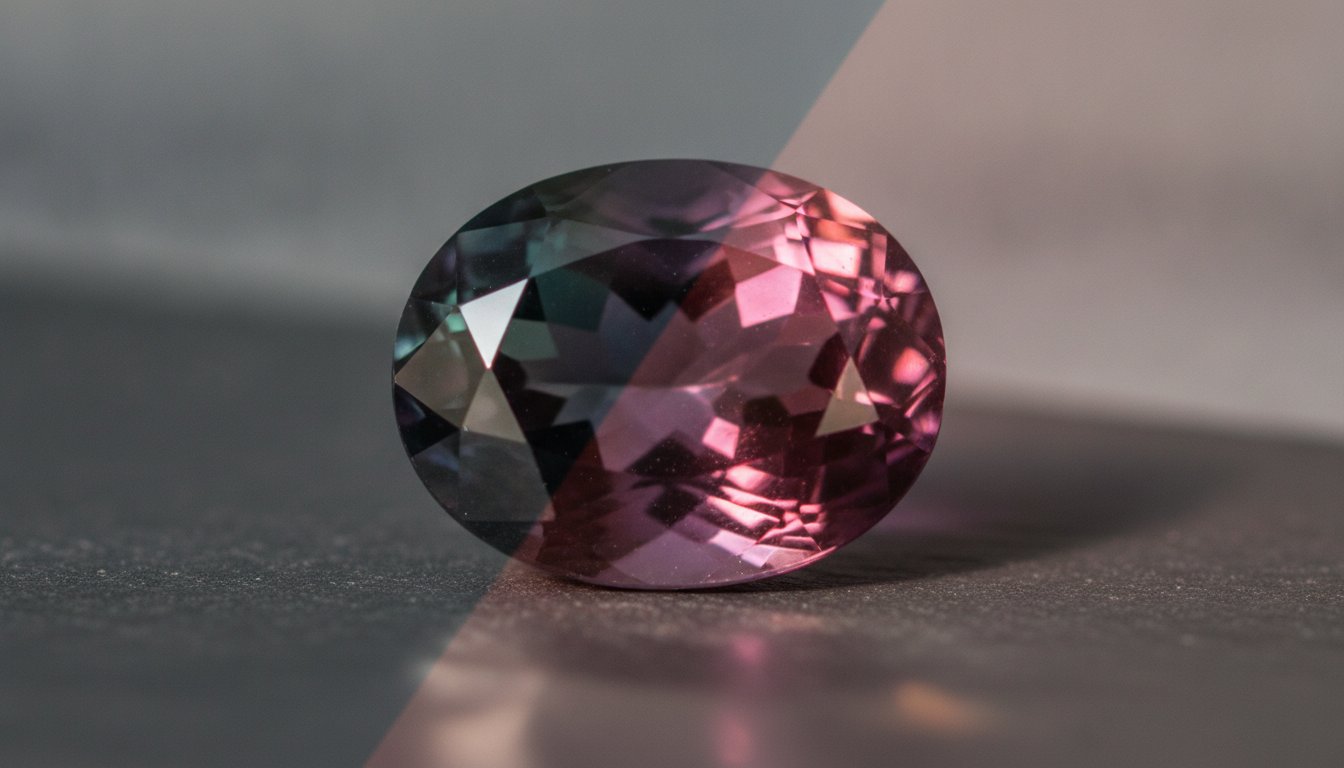
The most expensive mistake a gemstone collector can make isn't overpaying for a stone; it's buying a "chameleon" that refuses to change its colors. While alexandrite represents less than 0.01% of all gemstones mined, the market is flooded with specimens that look like murky pond water regardless of the light source. Mastering the nuances of alexandrite color change quality is the only way to ensure you're acquiring a true "emerald by day, ruby by night" specimen rather than a dull compromise.
You've likely felt the frustration of staring at a certificate that promises a dramatic shift, only to see a faint, muddy transition in person. It's a common anxiety for those seeking investment-grade material, especially when color can account for up to 70% of an alexandrite's total value. This guide will teach you how to identify a 100% color change and distinguish between the intense shifts of rare Russian material and the larger stones from Brazil or Sri Lanka. We'll break down the technical markers of a "crisp" transition so you can navigate high-value transactions with the confidence of an informed insider.
Key Takeaways
- Understand how chromium trace elements interact with light to produce the "Alexandrite Effect," the scientific foundation of the gem's shifting hues.
- Master the specific criteria for evaluating alexandrite color change quality by identifying the ideal transition from vivid bluish-green to intense purplish-red.
- Learn to quantify the "percentage of change" to ensure you invest in a stone with a crisp, 100% transition rather than a muddy or incomplete shift.
- Explore the impact of geography on rarity, from the legendary Ural Mountains of Russia to the exceptional modern material sourced from Brazil.
- Gain clarity on the differences between natural heirlooms and Chatham lab-created options, allowing you to choose the quality level that best fits your collection.
What is Alexandrite Color Change? Understanding the Chameleon Effect
The phenomenon known as the "Alexandrite Effect" is a rare optical performance where a gemstone displays completely different colors depending on the light source. It isn't a surface reflection or a trick of the eye; it's a profound interaction between light and the internal structure of the mineral chrysoberyl. Specifically, the presence of chromium trace elements within the crystal lattice creates an environment where the stone is torn between two worlds: the green spectrum of daylight and the red spectrum of incandescent light.
Achieving peak alexandrite color change quality requires a perfect balance of these chromium ions. Too little chromium, and the stone looks like a pale, washed-out chrysoberyl. Too much, and the stone becomes so dark that the colors are indistinguishable. The true magic happens when the stone's transmission of red and green light is so evenly balanced that the human brain switches its perception entirely based on the dominant wavelengths of the surrounding light.
To better understand this concept and see the shift in action, watch this helpful video:
The Science of Light Absorption
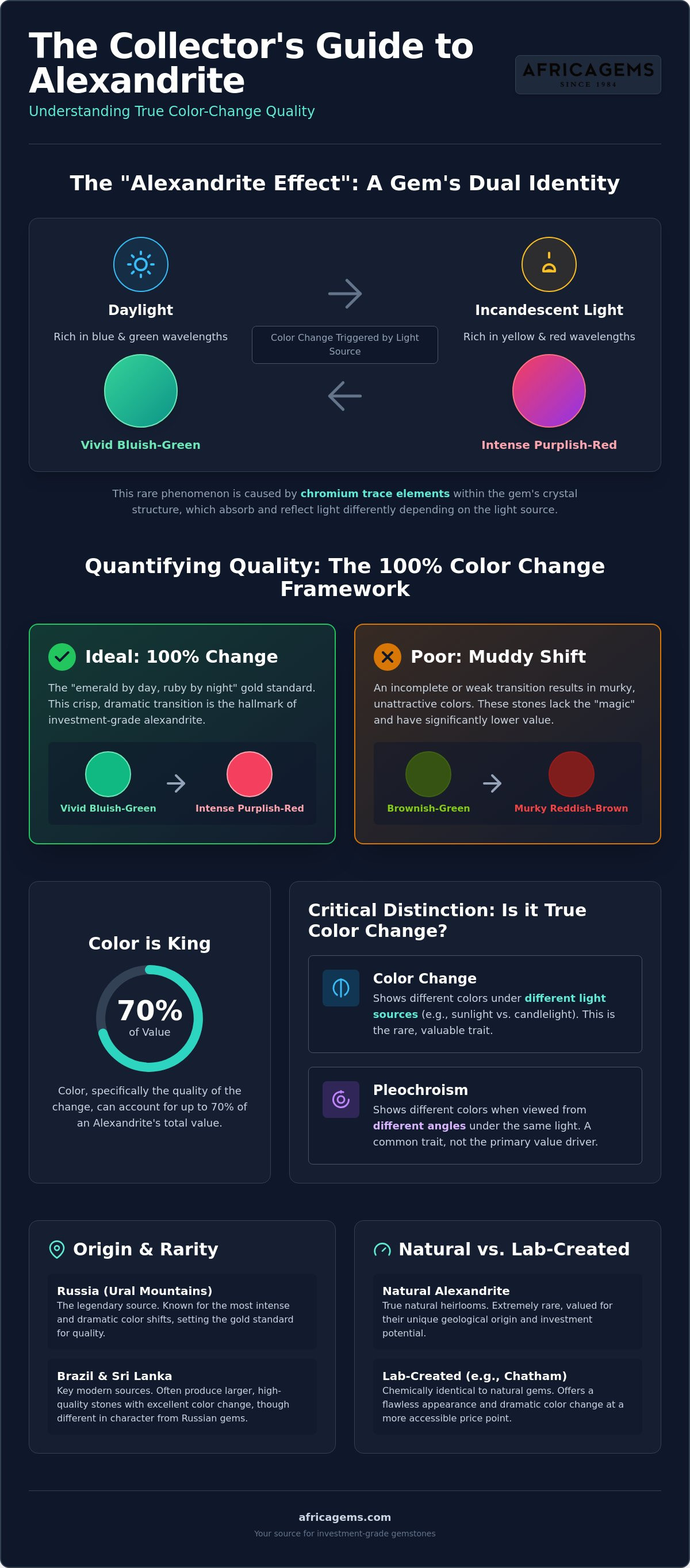
At the heart of this transformation is a specific absorption band in the yellow region of the visible spectrum, centered around 580 nanometers (nm). While most gemstones absorb light across broad ranges, alexandrite has a unique "window" of transmission. In daylight, which is rich in blue and green wavelengths, the stone reflects the lush forest tones we associate with emeralds. When you move into the warm, yellow-rich glow of incandescent light or candlelight, the stone shifts its reflection to the red end of the spectrum, appearing as a deep raspberry or purplish-red.
Pleochroism vs. Color Change: The Critical Difference
Many collectors confuse pleochroism with true color change, but they are entirely different mineralogical traits. Pleochroism is the ability of a stone to show different colors when viewed from different angles under the same light source. While alexandrite is naturally pleochroic, its primary value lies in its light-source-dependent shift. High alexandrite color change quality is defined by the stone's reaction to the light environment, not just your viewing angle.
For a quick field test, perform the "tilt test." If the stone changes color simply by rotating it under a single lamp, you're seeing pleochroism. If the stone remains green regardless of the angle in sunlight, but transforms into red when you strike a match or turn on a warm bulb, you've found a genuine color-change gem. This distinction is vital because true color change is significantly rarer and commands a much higher premium among precious gemstones in the global market.
The Ideal Palette: Evaluating Hue and Saturation
Evaluating alexandrite color change quality involves more than just checking for a shift; it requires a discerning eye for the specific hues present in both lighting environments. The gold standard, often described as "emerald by day, ruby by night," remains the ultimate benchmark for collectors. In its finest form, the stone displays a vivid bluish-green in daylight and transforms into an intense purplish-red under incandescent light. Because color accounts for up to 70% of a stone's total value, even slight deviations from these primary hues can significantly impact the investment potential of the gem.
Saturation plays a critical role in this evaluation. If the saturation is too light, the colors appear washed out, and the transition feels weak. Conversely, if the stone is too dark, it suffers from "extinction," where the gem looks nearly black and fails to show its true colors. The most desirable stones possess a medium-to-medium-dark tone with vivid saturation. The Gemological Institute of America (GIA) notes that a dramatic color change is the hallmark of the finest specimens, but that drama is only possible when the underlying colors are pure and vibrant.
One of the most common value-killers is the "Brown Factor." Many commercial-grade stones exhibit yellowish or brownish modifiers that create a muddy appearance. A stone might technically change color, but if it shifts from a brownish-olive to a brick-red, it lacks the "crispness" required for a connoisseur-grade piece. True value lies in color purity; you want to see distinct, clean colors without the interference of gray or brown masks. If you're currently hunting for a specimen that meets these rigorous standards, exploring a curated selection of high-saturation precious gemstones can help you calibrate your eye for top-tier color quality.
Daylight Quality: From Grass Green to Teal
The ideal daylight hue for high alexandrite color change quality is a cool, vibrant green. Collectors often look for a "teal" or bluish-green tint, which provides a more sophisticated look than a simple grass green. You should be wary of stones that appear overly yellowish or "olive" in natural light. These yellowish secondary hues are often a sign of lower-quality material and usually result in a less impressive shift when the lighting changes.
Incandescent Quality: The Ruby Red Standard
Under warm incandescent light or candlelight, the stone should ideally shift to a raspberry red or a rich purplish-red. This is the "ruby" half of the equation. A "brick red" or brownish-red shift is a common trait in more affordable, commercial-grade material, but it doesn't hold the same allure or value. Finding a stone that exhibits a true, saturated red is exceptionally rare, as most natural specimens tend to lean toward purple or mauve tones in incandescent settings.
If you're ready to see how these ideal palettes translate into real-world beauty, you can view our current collection of loose alexandrite gemstones to find a stone that matches your specific criteria for hue and saturation.
Quantifying Quality: The 100% Color Change Framework
To the untrained eye, a gemstone that shifts slightly from a forest green to a brownish-green might seem like a success. To a serious collector, it's a compromise. Assessing alexandrite color change quality requires a rigorous metric known as the "Percentage of Color Change." This isn't a subjective feeling; it's a technical evaluation of how much of the stone's visible surface area actually transforms when moved from daylight to incandescent light. You can have a stone with beautiful individual colors, but if the transition is sluggish or incomplete, it won't command the respect of the investment market.
Two common issues that plague lower-quality specimens are "bleeding" and "muddy" transitions. Bleeding occurs when patches of both red and green are visible at the same time under a single light source, often a result of poor orientation during the cutting process. A muddy transition is perhaps even more detrimental to value. This happens when the stone passes through a dull gray, brown, or "olive" phase while moving between light sources rather than "snapping" cleanly from one hue to another. The finest precious gemstones in this category bypass these middle-ground shadows entirely.
The Percentage Scale for Collectors
The industry uses a percentage scale to define the strength of the "Alexandrite Effect." A 100% change is the holy grail. This indicates a total transformation where no trace of the previous color remains. In contrast, a 50% change describes a stone that looks "split" or muddy under mixed lighting environments. Because of the extreme rarity of a clean shift, stones that exhibit a verified 100% change often command a 5x to 10x price premium over those with a 50% or 60% shift. For an investment-grade purchase, anything less than an 85% change is generally considered commercial grade.
The Impact of Cut and Clarity on Color Shift
The technical execution of the cut is just as vital as the mineral's chemistry. A "windowed" cut, where the center of the stone is too shallow, allows light to leak through the back rather than reflecting it toward the eye. This leakage weakens the color intensity and makes the shift look pale. While eye-clean stones are the standard for maximum color reflection, some collectors appreciate a light presence of "silk." These microscopic rutile needles can occasionally scatter light in a way that enhances the internal "glow" of the color change, though excessive inclusions will always cloud the transition and lower the overall alexandrite color change quality.
If you're looking for a stone that hits that elusive 100% mark, you can browse our inventory of loose alexandrite gemstones to see how professional cutting preserves the integrity of the shift.
Origin and Rarity: How Geography Dictates Quality
Geography acts as the silent architect of a gemstone's soul. While the chemical composition of chrysoberyl remains consistent, the specific geological conditions in different corners of the globe fundamentally alter alexandrite color change quality. For the serious collector, origin is more than a label on a certificate; it's a predictor of how the stone will perform when moved from the afternoon sun to the glow of a dinner candle. Each mining locality possesses a unique chemical "fingerprint" that dictates the crispness of its transition.
The legend of this stone began in the Ural Mountains of Russia. These specimens established the historical "emerald by day, ruby by night" benchmark that all other origins strive to emulate. Because the original Russian mines were largely depleted by the late 1890s, authentic Russian material has become an extreme rarity in the modern market. Today, these stones command a 200% price premium over Brazilian or Sri Lankan material. They are prized for an intense, balanced shift from a cool bluish-green to a saturated purplish-red that remains the gold standard for connoisseurs.
Russian vs. Brazilian: The Battle for the Best Shift
Brazil has emerged as the premier modern source for investment-grade material, currently supplying approximately 85% of the high-end market. Brazilian stones often rival the legendary Russian shift, providing a deep, saturated green in daylight. While Russian stones lean toward a blue-green hue, Brazilian specimens typically showcase a more lush, forest-green palette. Because the visual differences can be subtle, securing an origin certificate from a laboratory like GIA or AGL is vital for protecting your investment. You can learn more about the scarcity of these geological wonders in our connoisseur's guide to rare gemstones.
Sri Lankan Alexandrite: Size vs. Strength
If you encounter a natural alexandrite exceeding 5 carats, it likely originated in Sri Lanka. While this region produces impressively large crystals, the trade-off is often found in the color change strength. Sri Lankan material frequently exhibits a yellowish or brownish-green daylight color, which results in a "muddy" transition. Instead of a sharp snap between colors, these stones might shift into a dull brownish-red. In the world of rare materials, a smaller stone with a 100% color change will consistently outperform a larger, muddy specimen in both beauty and long-term appreciation.
Africa has also entered the conversation, with Tanzania and Madagascar producing material that often sits between the high saturation of Brazil and the larger sizes of Sri Lanka. Regardless of the source, the market continues to favor stones with a verified 90% to 100% color change, which have seen an average of 15% annual appreciation. If you are seeking a specimen with a verified origin and a world-class shift, explore our collection of loose alexandrite gemstones to find your next heirloom.
Natural vs. Lab-Created: Choosing the Right Quality for You
Deciding between a natural heirloom and a lab-grown alternative is a pivotal moment for any collector. While natural alexandrite represents a rare connection to the earth's deep history, Chatham lab-created gemstones provide an accessible path to technical perfection. It's vital to understand that lab-created alexandrite is not a mere imitation; it is chemically, physically, and optically identical to the material found in nature. The primary difference lies in the predictability of the alexandrite color change quality.
In the natural world, achieving a 100% shift is a geological miracle that happens under rare conditions. In a laboratory setting, this transition is a standard. Lab-grown stones are engineered to maximize the chromium-driven effect, ensuring a crisp snap from forest green to raspberry red every time. AfricaGems has built a 40 year legacy on the pillar of radical transparency. Whether you choose a natural investment or a lab-grown beauty for daily wear, our full disclosure policy ensures you are an informed participant in the transaction rather than just a spectator.
The Chatham Advantage
Chatham uses a sophisticated flux-growth process to create their crystals. This method mimics the high-pressure, high-heat environment of the earth's crust, allowing crystals to grow over the course of about a year. Because the growth environment is controlled, these stones can achieve the coveted "Russian" color profile, shifting from a cool teal to a purplish-red, at a fraction of the cost of mined material. For those who prioritize brilliance and a perfect shift for high-jewelry designs, exploring our selection of Chatham lab-created gemstones offers a way to capture world-class beauty without the investment-grade price tag.
Securing Your Investment
Natural alexandrite remains one of the world's best-performing portable assets, especially as traditional mines face depletion. When evaluating a natural stone for investment, the lab report is your most important tool. Look specifically for the "Color Change" comments; a top-tier report will explicitly state the percentage and quality of the shift. High-quality natural specimens with a verified 90% to 100% color change have historically seen significant annual appreciation, making them a secure choice for legacy collections.
Whether your goal is to own a piece of geological history or to enjoy the flawless performance of a lab-grown crystal, the key is to prioritize the integrity of the shift. If you're ready to find a stone that meets these uncompromising standards, view our curated collection of loose alexandrite gemstones and secure a gem that truly masters the art of the chameleon.
Securing Your Legacy with the Chameleon Gem
You now possess the analytical tools to distinguish a mediocre, muddy stone from a world-class specimen. Remember that the ultimate measure of alexandrite color change quality is the crispness of the transition. Whether you're seeking the blue-green fire of a Russian-style shift or the saturated forest tones of Brazilian material, you should prioritize the percentage of change over raw carat weight. A smaller stone with a verified 100% color change remains a far superior asset than a larger, sluggish alternative.
At AfricaGems, we apply these rigorous standards to every gem in our vault. With over 40 years of gemstone expertise, Marc Sarosi ensures that every stone is ethically sourced and fully disclosed. We even provide free GIA or AGL reports on select high-value stones to give you absolute security in your investment. This transparency is the foundation of our reputation as a premier dealer for serious collectors.
Explore Marc Sarosi’s Hand-Selected Loose Alexandrite Collection and find the centerpiece for your next custom design. Your journey into the world of rare materials is just beginning. We're honored to act as your mentor in finding a gem that will captivate for generations.
Frequently Asked Questions
Is 100% color change alexandrite real?
Yes, a 100% color change is real and represents the pinnacle of alexandrite color change quality. This technical designation means the stone completely transforms from one hue to another with no trace of the previous color remaining. While such specimens are exceptionally rare in nature, they are the most sought after by collectors and command a massive price premium in the investment market.
Why does my alexandrite look gray or brown in some lights?
Gray or brown modifiers often appear in lower quality stones or under mixed lighting conditions that interfere with the stone's light absorption. This muddy appearance is frequently seen in Sri Lankan material or stones with weak saturation. Collectors look for stones with high color purity and a crisp transition that snaps between green and red without passing through a dull middle phase.
Which lighting is best for seeing alexandrite color change?
The best way to observe the shift is by comparing natural northern daylight with warm incandescent light. Daylight, which is rich in blue and green wavelengths, brings out the emerald side of the gem. Moving the stone to a room lit by a traditional warm bulb or a candle highlights the ruby side. You should avoid fluorescent office lighting, as it often makes the stone look dull and prevents a full transition.
Does lab-grown alexandrite change color as well as natural?
High end lab grown stones like Chatham alexandrite often exhibit a 100% color change more consistently than natural specimens. Because the growth environment is controlled, the chromium levels are optimized to ensure a dramatic shift every time. While natural stones are prized for their rarity and legacy value, lab grown varieties offer a technically perfect visual performance for daily wear jewelry at a more accessible price point.
What is the most valuable color for an alexandrite?
The most valuable color is a vivid bluish green in daylight that shifts into a saturated raspberry or purplish red in incandescent light. This emerald by day, ruby by night palette is the historical benchmark for alexandrite color change quality. Since color can account for up to 70% of a stone's total value, any presence of yellowish or brownish secondary hues will significantly lower the market price.
How does the origin of an alexandrite affect its price?
Origin is a primary driver of value, with Russian stones commanding a 200% price premium over material from other regions. This is due to their legendary color purity and historical status. Brazilian stones are the next most valuable modern source, often providing shifts that rival Russian quality. Sri Lankan stones are usually larger, but they are often more affordable because they tend toward more yellowish daylight colors.
Can I use alexandrite in an engagement ring for daily wear?
Alexandrite is an excellent choice for an engagement ring because it has a hardness of 8.5 on the Mohs scale. This makes it one of the most durable colored gemstones, surpassed only by diamonds, rubies, and sapphires. It is resistant to scratching and chipping, though we still recommend a protective setting for loose gemstones to ensure the longevity of the piece over decades of daily wear.
Is alexandrite rarer than diamond?
Alexandrite is significantly rarer than diamond, representing less than 0.01% of all gemstones mined in 2025. While diamonds are widely available in various sizes and qualities, finding a natural alexandrite with a high quality color change is a difficult task for even seasoned dealers. This extreme scarcity is why investment grade specimens often command a higher price per carat than traditional white diamonds.

Article by
Marc Sarosi
Professional gemstone dealer for more than 40 years. Started off mining Aquamarine in Zambia, Africa and travelled throughout the continent in search of fine gems. Trusted authority on fine gemstones and have donated a fine collection of more than 27 extraordinary gemstones to the Smithsonian Institute Gem Hall for generations to see.