
AGL vs GIA Certification: The Collector’s Guide to Colored Stone Grading in 2026
Apr 25th 2026
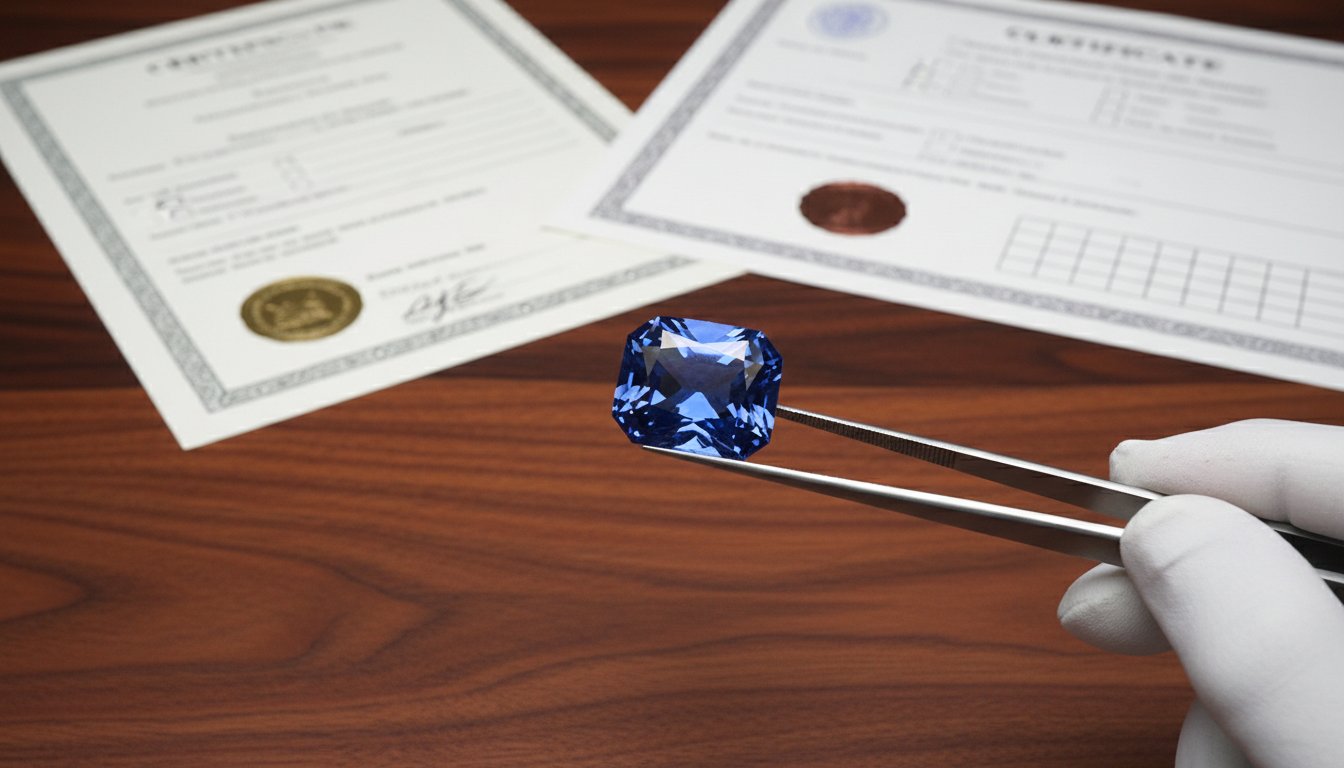
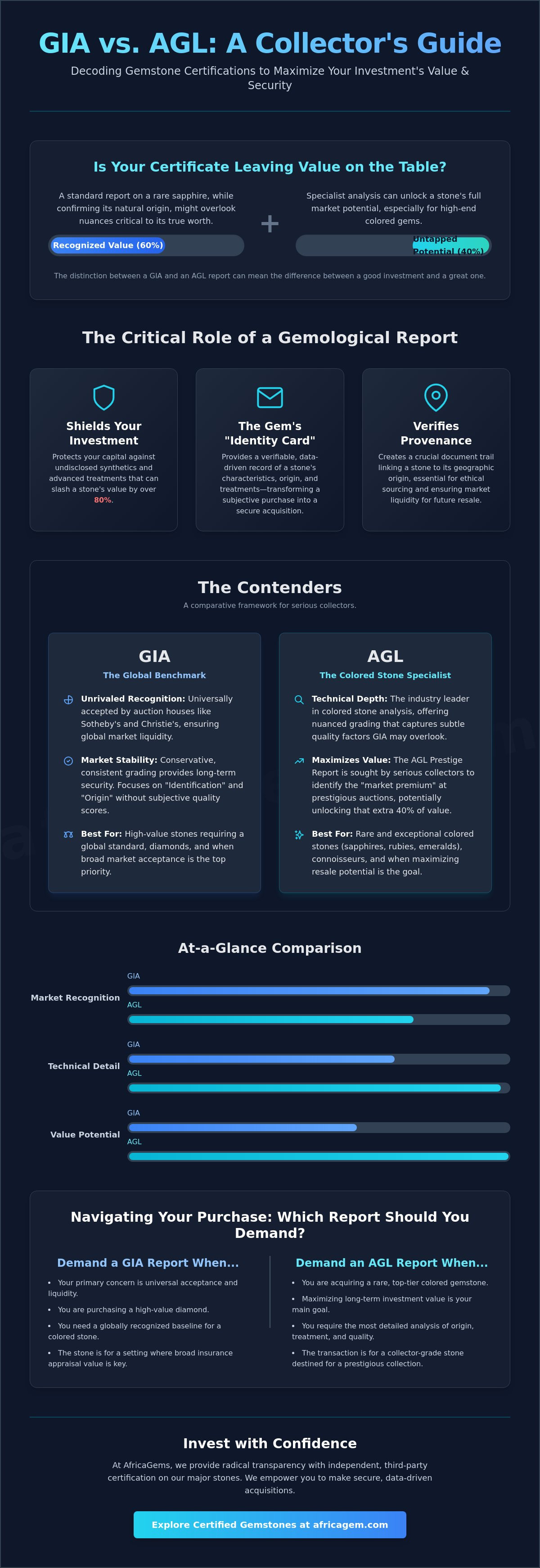
A GIA report on a rare sapphire tells you the stone is natural, but it might still leave 40% of the gem's potential market value on the table. For the serious collector, a certificate isn't just a piece of paper. It is the definitive shield against the treatment trap that often plagues the high-end market. You've likely felt that familiar pang of anxiety when comparing two seemingly identical stones with different price tags. It's a valid concern. The distinction between an unheated Ceylon sapphire and a heat-treated one can shift the value by thousands of dollars per carat. Mastering the nuances of AGL vs GIA certification for colored stones is essential to ensure your investment is protected by the industry's most rigorous standards.
We agree that the technical jargon of lab reports can feel like a barrier to the breathtaking beauty of the minerals themselves. This guide will provide you with the exact knowledge needed to decode these documents with the confidence of a seasoned connoisseur. We will examine the 2026 grading standards for both labs, compare their origin consistency, and show you which seal of approval maximizes your stone's resale potential in the global market.
Key Takeaways
- Understand why a professional gemological report serves as the essential "identity card" for any high-value gemstone investment in the modern market.
- Learn how the GIA’s conservative grading standards provide a global benchmark of consistency, ensuring your investment is backed by long-term market trust.
- Discover the critical nuances of AGL vs GIA certification for colored stones and how these reports influence the "market premium" at prestigious auctions.
- Identify when to demand the technical depth of an AGL Prestige Report versus the widely recognized reliability of a GIA certificate for your rare acquisitions.
- Gain the insider knowledge needed to navigate high-stakes transactions with the confidence of a seasoned collector and the security of radical transparency.
The Critical Role of Certification in the 2026 Gemstone Market
Gemological certification acts as the definitive identity card for a rare mineral. In a market where lab-grown technology and sophisticated enhancement techniques advance every month, a report provides the only verifiable record of a stone's journey from the earth to your hand. This document relies on the science of gemology to quantify characteristics that the naked eye or a standard jeweler's loupe simply cannot detect. It transforms a subjective purchase into a secure, data-driven acquisition.
Relying on "self-grading" from a seller is a significant red flag in high-value online transactions. While a dealer might possess decades of experience, their internal assessment lacks the impartiality of an independent third-party lab. The AfricaGems Difference centers on this exact point; we prioritize external validation for every major stone to ensure our clients never have to take our word for it. This commitment to radical transparency protects you from the bias inherent in "house grade" systems that still affect roughly 15% of the secondary market. Understanding the nuances of AGL vs GIA certification for colored stones is the first step toward building a collection with lasting value.
To better understand the specific differences between these two industry leaders, watch this helpful video comparison:
It's vital to distinguish between a jewelry appraisal and a gemological lab report for investment clarity. An appraisal focuses on the retail replacement value for insurance purposes, often written by a local appraiser who may not be a colored stone specialist. A lab report from AGL or GIA focuses strictly on technical specifications, identification, and origin. While an appraisal tells you what it might cost to replace a ring, the lab report tells you exactly what the stone is, which is the only way to determine its true market liquidity.
Risk Management for the Modern Collector
Certification protects your capital against undisclosed synthetics and advanced treatments that can slash a stone's value by 80% or more. In 2026, sophisticated high-pressure heat treatments require advanced spectroscopy to identify accurately. A reputable report ensures the liquidity of your collection, making it significantly easier to trade or sell at fair market prices in the future. A major lab report is the only objective proof of a stone's natural origin.
Ethical Sourcing and the Paper Trail
Modern labs play a growing role in verifying the ethical status and geographic origin of minerals. A report serves as the first step in buying gemstones online securely. It creates a document trail that links a specific stone to its declared provenance, reducing the risk of purchasing stones from conflict zones. This document integrity is the foundation of the AfricaGems promise, ensuring that every breathtaking sapphire or emerald meets our rigorous standards for transparency and ethical trade.
GIA Certification: The Global Benchmark for Consistency and Recognition
The Gemological Institute of America (GIA) stands as the titan of gemology. Founded in 1931, it established the universal language of gemstones. When debating the merits of AGL vs GIA certification for colored stones, collectors often prioritize GIA for its unrivaled global footprint. Every major auction house, from Sotheby's to Christie's, accepts GIA reports without hesitation. Their conservative stance isn't just a preference; it's a mechanism for market stability. They don't inflate grades or use flowery language. This discipline ensures that a stone's value remains protected through decades of ownership, providing a level of security that is essential for high-value transactions.
The GIA Grading Philosophy
GIA's approach focuses on "Identification" and "Origin" reports. They intentionally avoid subjective quality numbers that might fluctuate with market trends. This scientific detachment creates a baseline of trust that is recognized in every corner of the world. Whether a stone is graded in Carlsbad, New York, or Bangkok, the criteria remain identical. This consistency is vital for identifying the unheated status of blue sapphires. GIA utilizes advanced spectroscopy to detect even the most subtle thermal signatures, providing a definitive verdict on a stone's natural state. While the president of AGL lends his expertise to high-profile discussions on gem rarity in publications like The New York Times, GIA provides the institutional scale required for the global trade.
When GIA is the Optimal Choice
For many buyers, GIA is the default choice for standard high-end jewelry and investment-grade engagement rings. If you're purchasing loose burma rubies for a piece that might one day be sold at a retail level, the GIA name offers the quickest path to a "yes" from a potential buyer. It's the right choice when the goal is maximum marketability and professional consensus.
- Brand Recognition: GIA is the only laboratory name widely recognized by the general public and retail jewelers.
- Resale Liquidity: A GIA report acts as a universal currency in the gem trade, making it easier to liquidate a collection.
- Conservative Standards: Their strictness regarding treatment disclosure means a "no heat" comment from GIA is gold-clad.
- Global Reach: Their network of laboratories ensures that a stone can be verified almost anywhere in the world.
GIA's reports are straightforward and prioritize the physical facts of the mineral. This transparency is a core part of the AfricaGems philosophy. If you're looking to start your collection with a verified masterpiece, you can browse our certified gemstones to see how these reports influence value in the current market. Choosing GIA means choosing a legacy of trust that has been built over 90 years of rigorous scientific study.
AGL Certification: The Technical Leader in Colored Stone Analysis
American Gemological Laboratories (AGL) occupies a unique space in the trade. Founded by C.R. Beesley in 1977, the lab brought a level of scientific rigor that the industry previously lacked. While GIA's official colored stone evaluation process focuses on consistency and wide-market accessibility, AGL caters to the technical purist. Beesley’s legacy is built on the idea that beauty isn't just subjective; it can be quantified. This makes the AGL vs GIA certification for colored stones debate particularly relevant for those investing in five-figure or six-figure specimens.
AGL doesn't just look at a stone. It measures it. By applying a rigorous numerical framework to the ephemeral qualities of light and hue, the lab provides a level of detail that satisfies the most demanding connoisseurs. Collectors often view an AGL report as a "birth certificate" that follows a stone from the mine to the auction house.
The Prestige Report Advantage
AGL’s Prestige Report functions as a technical manual for a gemstone. It uses a sophisticated 1 to 10 scale for both Color Rating and Tone. A rating of 1 represents the pinnacle of quality, while 10 indicates a commercial-grade stone. AGL's linear grading allows collectors to compare stones numerically, removing the guesswork often found in descriptive-only reports.
- Color Rating: Quantifies the purity and intensity of the primary hue.
- Tone: Measures the lightness or darkness of the stone on a dedicated scale.
- Stability: A crucial rating for sensitive stones like padparadscha sapphires or emeralds, indicating how the stone reacts to light and heat.
The stability rating provides a layer of security that protects the long-term value of your acquisition. It's a proactive disclosure that ensures you're aware of any potential for color fading or treatment degradation over time.
Treatment Disclosure: The AGL Gold Standard
Transparency is the core of the AfricaGems philosophy, and AGL shares this commitment. They've pioneered the quantification of clarity enhancements, particularly in emerald gemstones. Instead of a simple "yes" or "no" regarding oil, AGL classifies treatments on a precise scale from Insignificant to Significant. This level of detail is vital because a "Minor" oil emerald can command a 50% premium over a "Moderate" oil stone of the same size.
For rare gemstones, origin determination is often the primary value driver. AGL's database for identifying geographic sources like Kashmir or Burma is legendary. They're frequently the first choice when a stone has a complex treatment history or a disputed origin. Their methodology provides the granular data needed to justify premium prices in the AGL vs GIA certification for colored stones landscape. When millions of dollars are on the line, the technical depth of an AGL report offers a level of confidence that few other labs can match.
AGL vs. GIA: A Comparative Framework for Serious Collectors
Choosing between these two gemological powerhouses isn't about finding a single winner. It's about matching a lab's specific philosophy to your gemstone's unique requirements. GIA provides a universal language that's recognized from New York to Hong Kong, while AGL offers a granular level of analysis that speaks directly to the seasoned connoisseur. When you evaluate AGL vs GIA certification for colored stones in 2026, you're weighing the security of a global brand against the surgical precision of a boutique specialist.
- Color Grading: AGL utilizes the proprietary ColorScan system to quantify tone and saturation with numerical values. GIA uses descriptive terms like "vivid" or "intense" that are easier for retail consumers to visualize.
- Treatment Depth: AGL’s "Enhancement Stability" rating is a game-changer for transparency. It provides a specific assessment of how a treatment might react to heat or wear over time.
- Market Premium: In high-stakes environments like Sotheby's or Christie's, an AGL Prestige Report often commands a 10% to 15% price premium for unheated "pigeon's blood" rubies compared to stones carrying only a standard GIA report.
Practicality also influences the decision. GIA’s expansive global network often results in more predictable turnaround times for standard identification reports. AGL maintains a more centralized, hands-on operation in New York. This results in a technical narrative that feels more personal, reflecting the AfricaGems Difference of radical transparency and expert advocacy.
Origin Determination Accuracy
GIA takes a famously conservative stance on geographic origin. If the chemical "fingerprint" of a stone is even slightly ambiguous, they'll issue a "no origin" result. This protects their institutional reputation but can be frustrating for owners of genuine locality-specific gems. AGL utilizes highly specialized data sets that often allow for more definitive calls on historically significant sources. For a 5-carat Kashmir Sapphire or an exquisite Colombian Emerald, an AGL report is the gold standard. It provides the technical backbone required to justify the significant investment these origins demand.
The Detail vs. Simplicity Debate
AGL reports are dense and technical. They're filled with diagrams and detailed commentary that some novices find "busy," but experts find indispensable. GIA reports are streamlined and clean, designed for quick confidence during a retail transaction. If you're a non-expert buyer, GIA's layout is much easier to digest. However, if you're building a legacy collection, the complexity of AGL vs GIA certification for colored stones becomes a major advantage for AGL. It reveals the stone's internal soul through rigorous data.
Navigating Your Purchase: Which Report Should You Demand?
Choosing the right laboratory isn't just about a piece of paper. It's about protecting your financial equity. When Marc Sarosi evaluates a new acquisition for AfricaGems, he weighs the stone's potential against the specific strengths of each lab to ensure the "AfricaGems Difference" is maintained. The decision on AGL vs GIA certification for colored stones usually comes down to the specimen's rarity and your ultimate goal as a collector.
Consider a $50,000 unheated sapphire. In this tier, AGL is the likely winner. Their Prestige Report offers a "Total Quality Integration" score and a level of origin precision that high-end auction houses and serious connoisseurs demand. If you're buying a high-quality tanzanite for an engagement ring, GIA is perfectly sufficient. GIA provides the global brand security and clear treatment disclosure that ensures your investment is exactly what it claims to be. For world-class investment stones, we often employ a "Dual-Cert" strategy. Having both reports eliminates ambiguity and creates a bulletproof provenance that maximizes liquidity in the global market.
Variety-Specific Recommendations
- Emeralds: AGL’s treatment degree grading is non-negotiable for top-tier stones. While GIA notes the presence of enhancement, AGL quantifies it as "Insignificant," "Minor," or "Moderate." This distinction can cause price swings of 30% or more for a Colombian emerald.
- Rubies: Both labs are essential for identifying heat versus flux-healing. AGL’s ability to detect trace elements helps distinguish a natural Burmese ruby from a Mozambican specimen, while GIA provides the international stability buyers trust.
- Sapphires: Use GIA for brand security and AGL for origin precision. AGL’s specialized origin reports are the gold standard for Kashmir or Padparadscha varieties, providing the technical data needed to justify a premium price.
Final Checklist for the Smart Investor
Before finalizing any high-value transaction, follow this rigorous verification process to ensure the AGL vs GIA certification for colored stones meets the highest standards of transparency:
- Verify the report date: Gemological technology evolves. If a report is older than five years, it's wise to request an update to check for modern treatment methods.
- Match the stone to the photo: Use a 10x loupe to confirm that the internal inclusions match the map or photograph provided on the lab document.
- Scan for 'Special Comments': Look for addendum reports that mention "no evidence of heat" or specific color calls like "Pigeon's Blood" or "Royal Blue," as these phrases significantly impact market value.
At AfricaGems, we don't just sell stones; we provide a gateway to rare minerals with the integrity of full disclosure. We personally select the lab that best serves the stone's unique story and your peace of mind.
Explore our collection of AGL and GIA certified loose sapphires
Mastering Your Portfolio for the 2026 Gemstone Market
Navigating the nuances of AGL vs GIA certification for colored stones ensures your collection maintains its prestige as the global market evolves. While the GIA offers a benchmark of consistency established since 1931, the AGL provides the specialized technical analysis required for high-value origin and treatment identification. In 2026, the distinction between these reports often determines the ultimate liquidity of investment-grade rubies and sapphires. You shouldn't have to guess about the integrity of your acquisition. AfricaGems provides the clarity you need through radical transparency.
We've spent over 40 years cultivating a reputation for excellence in rare minerals. Every gemstone in our vault is backed by the personal guarantee and direct accountability of Marc Sarosi. We provide full disclosure on all gemstone treatments and origins, ensuring you act as a true industry insider. Your journey into the world of exquisite minerals deserves a partner who prioritizes your security and the stone's natural beauty. Build a breathtaking collection that stands the test of time today.
Secure Your Investment: Browse GIA & AGL Certified Gems at AfricaGems
Frequently Asked Questions
Is AGL better than GIA for colored gemstones?
Neither laboratory is objectively superior, but AGL is often the preferred choice for serious collectors focusing on colored stone origin and treatment analysis. While GIA remains the global authority for diamonds, AGL specialized in colored stones since its inception in 1977. Many elite auction houses like Christie's frequently rely on AGL for high-value rubies because of their nuanced color grading and stability assessments.
Does a GIA report increase the value of a sapphire more than AGL?
No, an AGL report often carries a higher market premium for colored stones in the 2026 secondary market. While GIA provides incredible security and brand recognition, AGL’s "Prestige" grading for origin and heat treatment is the industry benchmark for sapphires. A 2023 market analysis indicated that unheated Kashmir or Burmese sapphires with AGL papers often command 10 to 15 percent higher prices than those with standard lab reports.
What is the AGL Prestige report, and is it worth the extra cost?
The AGL Prestige Professional Report is the laboratory's most comprehensive document, providing an exhaustive analysis of a stone's origin, treatment, and quality. It includes a full color and clarity grade based on AGL’s proprietary scales. For stones valued over 5,000 dollars, this report is essential. It offers the transparency needed to justify a high-end investment and ensures you aren't paying for undisclosed enhancements or synthetic materials.
Can I send a stone I already own to GIA or AGL for certification?
You can submit loose gemstones directly to both the GIA and AGL for a formal grading report. You'll need to create a client account on their respective websites and follow specific shipping protocols for high-value minerals. Most collectors choose to send stones through an authorized dealer to ensure the items are insured properly during transit. This process typically takes between 3 and 6 weeks depending on current laboratory volume.
Why do some stones have both GIA and AGL reports?
High-value investment grade stones often carry multiple reports to provide a double layer of verification for the buyer. Having both AGL vs GIA certification for colored stones eliminates any doubt regarding origin or treatment. This dual-certification strategy is common for 85 percent of "Big Three" gems sold at major international auction houses to maximize buyer confidence and final sale price.
What happens if GIA and AGL disagree on the origin of a stone?
Discrepancies in origin opinions are rare but do occur because origin determination is a subjective expert opinion based on inclusions and trace elements. In these cases, the market generally defaults to the more conservative or prestigious opinion for that specific species. If AGL identifies a sapphire as "Kashmir" but GIA labels it "Madagascar," the price will likely reflect the Madagascar origin until a third tie-breaking lab provides a definitive verdict.
How do I verify the authenticity of an AGL or GIA report online?
You can verify any report by entering the unique identification number into the official online database of the respective laboratory. GIA uses their "Report Check" tool, while AGL provides a similar verification portal on their website. Always cross-reference the stone's weight and dimensions listed on the digital record with the physical stone. This step ensures the report hasn't been tampered with or paired with a different gemstone.
Is certification necessary for semi-precious stones like aquamarine or garnet?
Certification isn't strictly necessary for low-cost semi-precious stones, but it's highly recommended for any gem over 1,000 dollars or those prone to treatment. For example, 90 percent of aquamarines are heat-treated to enhance their blue hue. A brief identification report protects your investment by confirming the stone is natural and disclosing any permanent or unstable treatments that could affect its long-term value and the AGL vs GIA certification for colored stones decision helps clarify these nuances.