
Understanding Gemstone Return Policies: A Connoisseur’s Guide to Secure Investing
May 25th 2026

What if the most critical document for your next investment in a rare Padparadscha sapphire isn't the laboratory report, but the dealer's return policy? Many collectors view these terms as a mere safety net, but a truly robust policy serves as a transparency certificate that proves a dealer's confidence in their own technical grading. It's an essential pillar of security in a market that is rapidly evolving with new tariffs and expanded GIA origin services for stones like opal and peridot.
It's natural to feel a sense of trepidation when purchasing high-value items like Colombian emeralds or Mozambique rubies online. You might worry about a stone looking different in person or feel anxious about the specific protocols for a safe home inspection. Mastering the nuances of understanding gemstone return policies will transform your buying experience from a leap of faith into a secure, professional transaction. This guide provides a clear framework for vetting dealer trustworthiness and outlines the exact steps to protect your capital. We'll explore how to navigate inspection windows and explain why the AfricaGems 30-day guarantee is designed to give you total peace of mind.
Key Takeaways
- Learn why a formal inspection period is a non-negotiable standard for any high-value online gemstone acquisition.
- Differentiate between the high liquidity of loose stones and the non-refundable nature of custom jewelry design labor and CAD fees.
- Gain professional confidence by understanding gemstone return policies to distinguish between legitimate business expenses and predatory "final sale" traps.
- Discover the "Tweezers and Loupe" protocol to safely evaluate your new sapphire or emerald at home without risking damage or voiding return eligibility.
- Leverage independent appraisals during your inspection window to verify technical specifications and the integrity of the dealer's claims.
The Role of Return Policies in High-Value Gemstone Investing
In the world of rare materials, a return policy isn't just a safety net. It's a technical validation window. When you're understanding gemstone return policies, you should view them as an extension of the dealer's integrity. For a collector interested in buying gemstones online, this window is the only time to reconcile digital imagery with the physical reality of the stone. It's a moment of truth where high-resolution videos meet the scrutiny of a 10x loupe.
This period allows you to cross-reference your purchase with third-party certifications from institutions like the GIA, AGL, or SSEF. In 2026, the GIA expanded its origin-determination services to include opal, peridot, and demantoid garnet, making the inspection window even more critical for these specific varieties. Ethical sourcing standards now demand full disclosure of treatments and origin. A dealer's willingness to stand behind a stone for a full 30 days proves they've done their due diligence. It ensures that the Mozambique ruby or Colombian emerald you've acquired matches its laboratory profile exactly.
To better understand how these policies function in practice, watch this helpful video:
Why the Clock Starts at Delivery
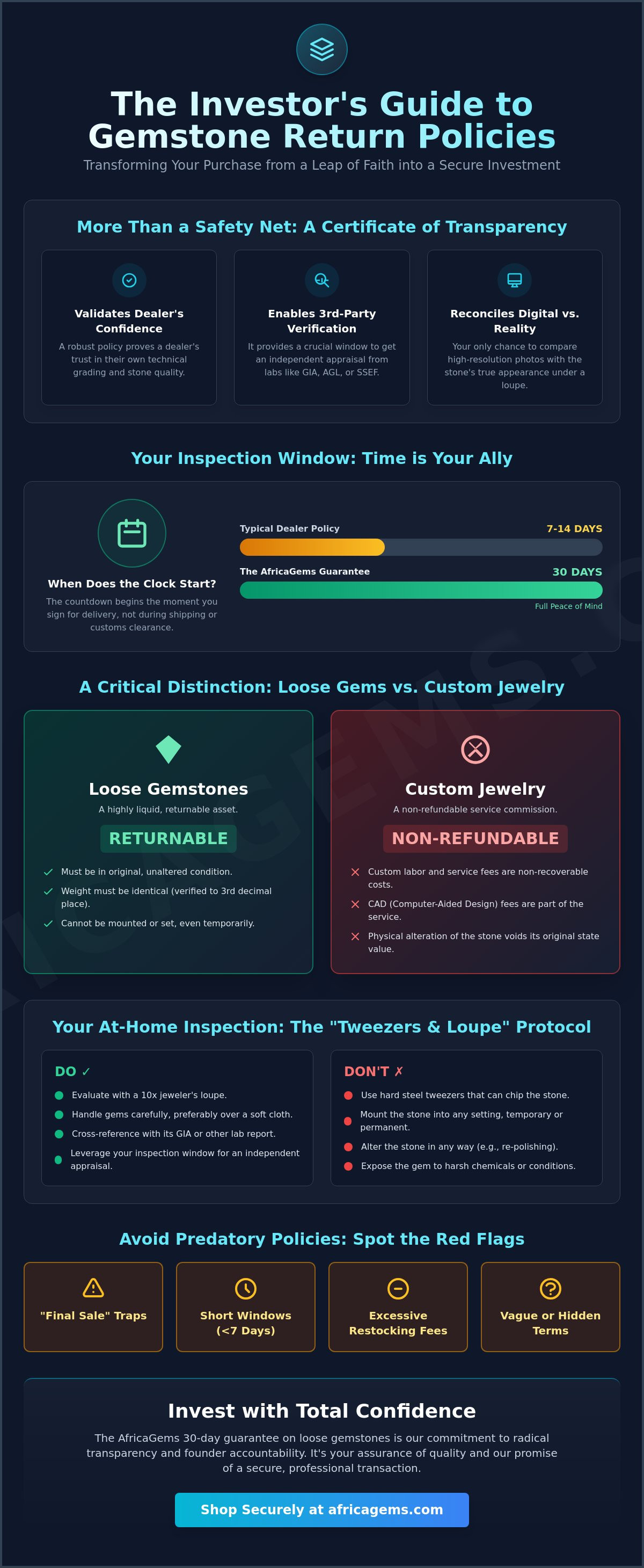
Most premier dealers offer an inspection period ranging from 7 to 30 days. This mirrors the legal concept of a consumer rights cooling-off period, giving you time to breathe after a significant financial commitment. The clock typically starts the moment you sign for the package. Signature-required delivery isn't just a hurdle. It's a security protocol that protects your investment from being left unattended. If you're acquiring stones internationally, remember that customs clearance times don't count toward your inspection days. The focus is strictly on the time the stone is in your hands.
The "Memo" Tradition in the Digital Age
Historically, the gemstone trade operated "on memo." Dealers would send stones to colleagues or trusted clients to view without an immediate obligation to buy. Modern online return policies are the digital evolution of this legacy. They build a bridge of trust through radical transparency. Having a no-questions-asked period removes the psychological pressure often found in high-pressure sales environments. It allows you to become an informed insider, making decisions based on technical data and natural beauty rather than urgency. This methodical approach is the hallmark of a serious collector who values security as much as the gems themselves.
Loose Gems vs. Custom Jewelry: Why the Rules Change
A critical distinction in understanding gemstone return policies lies in the physical state of the asset. Loose gemstones represent high liquidity. They're easily transportable and can be returned to inventory without loss of value, provided they remain in their original condition. Once that stone is integrated into a custom setting, the transaction shifts from a commodity exchange to a service-based commission. This is a vital point highlighted in FTC consumer advice on gemstone purchases, which urges collectors to verify return rights before any physical alteration occurs. Understanding this boundary is the first step toward a secure investment.
Evaluating Loose Gemstone Returnability
Loose stones are the gold standard for returnable assets. However, the condition requirements are uncompromising. When a stone returns to a dealer, it's weighed to the third decimal place to ensure its mass is identical to the day it was shipped. Even a microscopic chip from a pair of steel tweezers can alter its value. Most dealers, including AfricaGems, enforce a "no-setting" rule. This means that if you mount the stone into a temporary or permanent setting, you've likely voided your return window. Mounting creates "prong marks" or tiny abrasions on the girdle that permanently change the stone's status from "new" to "used." For serious collectors, the goal is to conduct a thorough evaluation while the stone remains loose and pristine.
The Complexity of Bespoke Jewelry Returns
Bespoke jewelry involves costs that cannot be reclaimed. Labor for CAD design, 3D printing, and the manual artistry of a master setter are sunk costs. When you commission a piece featuring a rare emerald gemstone, you're paying for specialized expertise. Emeralds are notoriously "sleepy" or fragile due to their internal inclusions, requiring a delicate touch during the setting process. Similarly, loose burma rubies demand an elite level of craftsmanship to ensure the mounting doesn't obscure their rare color. Because custom settings are tailored to the unique dimensions of a specific stone, they're rarely returnable. To maintain your security, consider inspecting your loose stone first. Once you're 100% satisfied with the gem, you can then proceed to our custom jewelry design services with complete confidence.
The Inspection Protocol: How to Evaluate Gems Without Voiding Eligibility
The moment your package arrives, your role shifts from investor to amateur gemologist. Successfully understanding gemstone return policies requires more than just reading the fine print. It demands a disciplined, non-invasive approach to physical evaluation. Your goal is to verify the stone's identity and beauty while ensuring it remains in the exact condition it left the vault. This isn't just about protecting your refund. It's about performing the professional due diligence that characterizes a serious collector.
A professional-grade inspection environment doesn't require a laboratory, but it does require control. You should compare the stone to its certificate under varied lighting conditions to see how the color shifts. Does that sapphire hold its blue in incandescent light, or does it turn slightly purple? This is the time to find out. However, you must resist the urge to use ultrasonic cleaners. Even if you're certain the stone is eye-clean, high-frequency vibrations can expand microscopic internal inclusions or cause liquid to penetrate surface-reaching fissures. This kind of "invasive" cleaning can permanently damage a stone and is a common reason for return denials.
Tools of the Trade for Home Inspection
A 10x achromatic, aplanatic loupe is your most essential ally. Use it to inspect the stone's facet junctions and internal landscape. Don't be alarmed by tiny inclusions that are invisible to the naked eye. These often act as "fingerprints" that prove the stone is natural. Lighting is equally critical. Professional dealers evaluate color under North-facing daylight. You should avoid direct, harsh LED spotlights that can "over-brighten" a stone and hide its true saturation. Always use a lint-free gemstone cloth to wipe away fingerprints. Oils from your skin can dull a stone's brilliance and make it difficult to assess the true luster during your window of evaluation.
Protecting the Stone’s Integrity
Safe handling is the foundation of a successful inspection. Never use steel tweezers if you aren't practiced in their use. Plastic-coated or "soft" tweezers are much safer for the uninitiated because they prevent the "chip risk" associated with applying too much pressure to the girdle. Certain stones, like tanzanite, require extreme care because of their perfect cleavage in one direction. A sharp knock against a granite countertop could cause a clean break, instantly voiding your return eligibility.
Finally, treat the paperwork with as much respect as the gem. Keep all original lab reports, certificates, and specialized packaging in pristine condition. A missing GIA report or a crumpled certificate can lead to administrative fees that diminish your final refund. By following this methodical protocol, you maintain the professional standing of an informed insider while keeping your investment capital secure.
Identifying Red Flags in Online Gemstone Policies
A dealer’s return policy is a window into their business ethics. While the previous sections focused on your responsibilities as a buyer, understanding gemstone return policies also requires a keen eye for dealer-side red flags. Some merchants use overly restrictive language to discourage returns on high-value assets. This is particularly common with unheated or exceptionally rare gemstones, where a "Final Sale" tag might be used to trap a buyer into an irreversible transaction. In a market projected to reach $38.40 billion in 2026, transparency is your most valuable shield.
Vague condition clauses are another warning sign. If a policy states that returns are accepted at the "sole discretion of the dealer" without defining technical parameters, you're at risk. A professional policy should clearly outline what constitutes an acceptable return, such as the absence of new inclusions or weight loss. Without these specifics, a dealer could arbitrarily deny a refund based on subjective criteria. Trustworthy partners provide a clear, objective framework for evaluation.
Watch for these specific policy deterrents before you commit:
- Hidden restocking fees exceeding 5% of the item's value.
- Policies that don't explicitly mention insurance coverage for returns.
- "Final Sale" status on natural, untreated stones that haven't been customized.
- Short inspection windows (under 7 days) that don't allow for independent appraisal.
Deconstructing the Restocking Fee
Restocking fees are often a point of contention. In some cases, a small fee is justified to cover the cost of a professional gemological re-evaluation or minor re-polishing if a stone was handled poorly. However, many online sellers use these fees as a deterrent, charging up to 15% of the purchase price just to put a stone back in the vault. This practice shifts the business risk onto the collector. At AfricaGems, we believe buyer confidence is more important than administrative fees. We prioritize a transparent experience, ensuring you don't feel penalized for performing due diligence on a significant investment.
The Importance of Insured Return Shipping
Return logistics are the final hurdle in securing your capital. A standard courier label often lacks the high-limit insurance required for a five-figure sapphire or ruby. If a stone is lost or damaged during transit and the insurance is insufficient, the financial burden often falls on the sender. You should look for dealers who provide pre-paid, fully insured return shipping labels. This shows they're invested in the safety of the stone even when it's leaving their possession. Always document the packing process with photos or video to provide a clear audit trail for insurance purposes. If you're ready to invest with a partner who values your security, browse our collection of certified gemstones today.
The AfricaGems Philosophy: Radical Transparency and Founder Accountability
At the heart of every high-value transaction is a personal promise. While many digital storefronts hide behind faceless corporate terms, AfricaGems is built on the visible leadership and personal guarantees of our founder, Marc Sarosi. This accountability is the cornerstone of our approach to understanding gemstone return policies. We don't view a return as a failure. Instead, we see it as a vital part of the collector's journey. If a stone doesn't meet your expectations in person, our 30-day inspection period ensures your capital remains protected.
We actively encourage you to seek independent appraisals during this window. A truly exceptional gem should withstand the scrutiny of any qualified gemologist. By inviting third-party validation, we demonstrate our absolute confidence in our technical grading and ethical sourcing. This "Connoisseur’s Edge" is rooted in radical transparency. We provide full disclosure on all gemstone enhancements, ensuring you're an informed insider before the stone even leaves our vault. If you need to initiate a return, our team provides a streamlined, professional process that respects your time and your investment.
A Legacy of Trust Since 1984
Our standards haven't wavered since we began our journey in 1984. Over the decades, our policy has evolved to meet the needs of a global digital market, but the core principle remains the same: integrity above all. This long-term perspective is essential for maintaining the health of the blue sapphires trade and other rare material markets. A personal guarantee from an industry leader provides a level of security that a standard checkout page simply cannot match. It transforms a digital purchase into a personal consultation with a knowledgeable mentor.
Expert Consultation Before You Buy
The best return policy is one you never have to use. We aim to reduce return rates by providing an unprecedented density of information upfront. Every listing includes high-definition 360-degree videos and exhaustive technical data. This methodical approach helps you visualize the stone's "life" and brilliance accurately. For those utilizing our custom jewelry design services, we bridge the gap between artistic vision and technical reality, ensuring the final piece aligns with your expectations. We're here to guide you through every nuance of understanding gemstone return policies, helping you build a legacy collection with total peace of mind. If you're ready to acquire your next investment-grade stone, we invite you to explore our collection with the confidence of a guaranteed 30-day inspection period.
Securing Your Legacy with Confidence
A sophisticated collector knows that the beauty of a rare Mozambique ruby or a Padparadscha sapphire is only as secure as the terms of the acquisition. Understanding gemstone return policies allows you to navigate the high-value market with the precision of a seasoned gemologist. By distinguishing between the liquidity of loose stones and the bespoke nature of custom jewelry, you protect both your vision and your capital. Remember that a professional inspection period is your time to verify technical data and ensure the stone's natural brilliance aligns with your expectations.
AfricaGems brings over 30 years of expert gemstone leadership to every transaction. We provide full disclosure on all treatments and a personal guarantee from our founder, Marc Sarosi, to ensure your peace of mind. Our commitment to radical transparency is designed to make you an informed insider in the world of rare materials. We invite you to explore our collection of ethically sourced loose gemstones with a 100% satisfaction guarantee. Your journey into the extraordinary world of fine gems should be as flawless and secure as the stones themselves.
Frequently Asked Questions
Can I return a gemstone if I have already had it set in a ring?
You cannot return a gemstone once it has been set into a ring or any other jewelry mounting. Setting a stone is considered a permanent alteration because the process often leaves microscopic marks on the girdle or facet junctions. To maintain your eligibility for a refund, you must perform your full evaluation while the stone is loose. This ensures the gem remains in the pristine state required for a full return.
Does AfricaGems charge a restocking fee for loose gemstone returns?
AfricaGems does not charge restocking fees for loose gemstones returned in their original, unaltered condition within the 30-day inspection window. We believe that understanding gemstone return policies should involve transparency rather than hidden deterrents. As long as the stone is returned in its original state and accompanied by all its documentation, you'll receive a full refund of the purchase price without any administrative penalties.
What happens if the gemstone lab report is lost or damaged during my inspection?
If a gemstone lab report is lost or damaged, you will likely be responsible for a replacement fee to cover re-certification. Certificates from institutions like the GIA or AGL are vital to the stone's provenance and market value. Because a gem cannot be returned to inventory without its verified "papers," we must have a new report issued before finalizing your refund. Always store documentation in a secure location during your evaluation.
How do I safely ship a high-value gemstone back for a refund?
To ship a high-value stone safely, you should use the pre-paid, fully insured return shipping label provided by AfricaGems for domestic US orders. This protocol ensures the package is tracked and covered against loss or damage. We recommend placing the gemstone in its original protective case and then double-boxing the item to prevent tampering. Documenting the packing process with photos provides an extra layer of security for your return.
Will a local jeweler’s appraisal be accepted as a reason for a return?
You don't need a specific reason to return a stone within our 30-day window, so an appraisal from a local jeweler is perfectly acceptable. We actually encourage independent validation to confirm our technical grading and ethical sourcing claims. If the appraisal doesn't align with your expectations or you simply decide the stone isn't the right fit for your collection, you can initiate a return for a full refund.
Are lab-created stones like Chatham gems subject to the same return policy as natural stones?
Chatham lab-created gemstones are subject to the exact same 30-day inspection policy as our natural stones. Whether you're investing in a natural sapphire or a lab-grown emerald, the rules regarding condition and alteration remain consistent. Understanding gemstone return policies for lab-grown materials is essential for modern collectors. As long as the Chatham gem remains loose and unaltered, it is eligible for a full refund during the inspection period.
Is the original shipping cost refundable if I choose to return a gem?
AfricaGems provides a full refund on the purchase price of unaltered items returned within the 30-day inspection window. For domestic US orders, we also provide a pre-paid, fully insured return shipping label at no cost to you. This approach is designed to minimize your financial risk and build confidence in the online acquisition process. It reflects our commitment to a transparent, secure environment for high-value gemstone transactions.
How long does it take to process a refund once the gemstone is received?
Refunds are typically processed within a few business days after the gemstone arrives at our facility and passes inspection. Our gemologists must verify that the stone is in its original condition and that its weight is identical to the day it was shipped. Once this technical validation is complete, the credit is issued to your original payment method. The time for funds to appear depends on your bank's processing cycles.