
The Custom Jewelry Design Process Step-by-Step: A Connoisseur’s Guide
Jun 11th 2026
What if the true value of a bespoke heirloom isn't found in a price index, but in the absolute transparency of the journey that created it? For many connoisseurs, the desire for a unique piece is often tempered by the fear that the final product won't mirror their original vision. You might worry about the hidden complexities of gemstone treatments or feel anxious about a production timeline that feels like a black box. It's a valid concern for any collector who demands both aesthetic perfection and ethical certainty in their jewelry.
We believe you deserve the confidence of an industry insider. This guide will help you master the custom jewelry design process step-by-step, providing a clear, expert-led framework that prioritizes radical transparency and technical excellence. By merging your personal story with our professional expertise, we transform rare materials into legacy pieces. We'll explore every phase of creation, from selecting ethically sourced loose gemstones to the precision of MatrixGold 4.0 digital modeling and the final master craftsmanship that ensures your piece is a singular, one-of-a-kind masterpiece.
Key Takeaways
- Master the "gemstone-first" philosophy, where the unique dimensions and optical properties of your selected centerpiece dictate the architectural integrity of the final design.
- Navigate the custom jewelry design process step-by-step to eliminate uncertainty and ensure your bespoke vision is realized with uncompromising technical precision.
- Explore how high-resolution 3D rendering and resin prototyping provide a tangible preview of your piece, allowing for meticulous adjustments before the casting phase.
- Understand the rigorous quality assurance standards required during master setting and hand-polishing to achieve a mirror-like finish worthy of a legacy heirloom.
The Foundation: Defining Your Vision and Design Goals
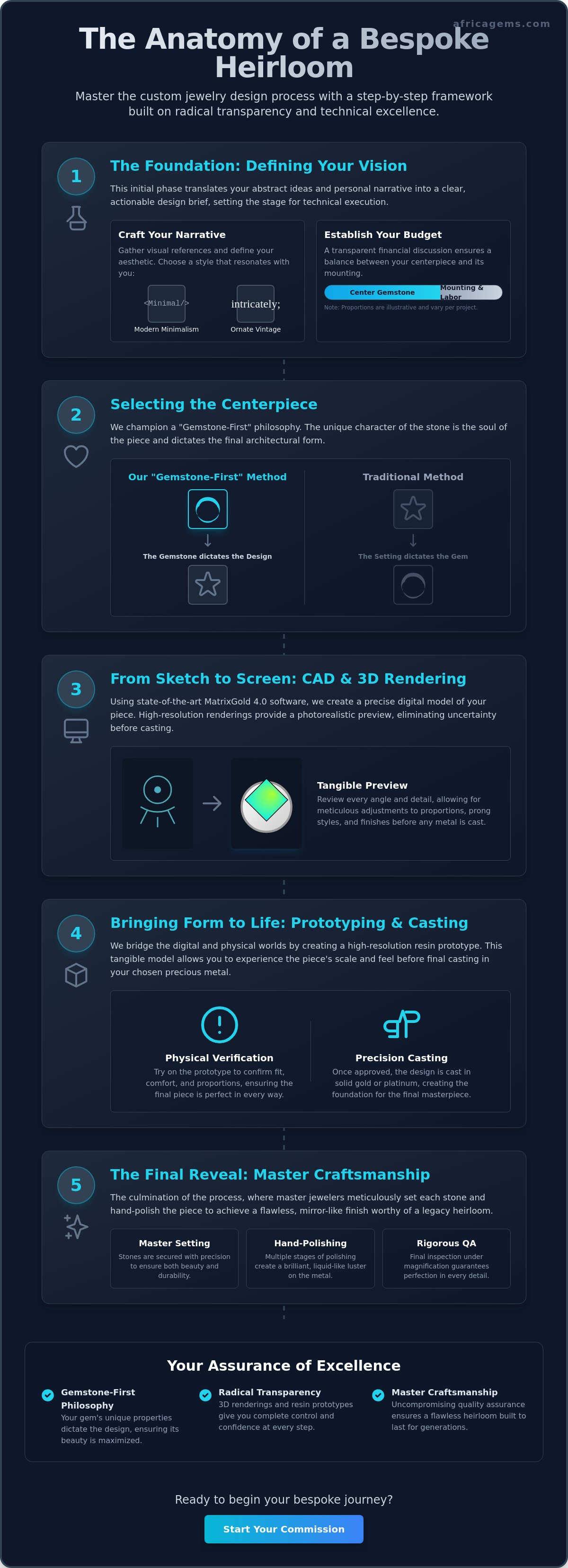
Every legacy piece begins with an intention. Whether you're commemorating a milestone engagement or diversifying a portfolio with a rare gemstone investment, the custom jewelry design process step-by-step starts with clarity. You aren't just buying a ring; you're commissioning a work of art that reflects a specific narrative. This phase is about stripping away the abstract and identifying the core emotional or financial goals of the project.
During the inspiration phase, we encourage you to gather visual references that resonate with your personal style. This might include architectural sketches, vintage family heirlooms, or modern textures. Understanding the broader Jewellery design process helps you appreciate how these abstract ideas eventually translate into technical CAD drawings. Collecting these fragments of inspiration allows our team to see the world through your eyes, ensuring the final masterpiece is unmistakably yours.
To better understand how these initial ideas begin to take shape, watch this helpful video overview:
Crafting Your Design Narrative
Identifying your aesthetic is a collaborative effort. Do you lean toward the clean lines of modern minimalism, or does the intricate milgrain of an ornate vintage setting speak to you? It's essential to decide on the jewelry type early, as the structural requirements for gemstone earrings differ significantly from a high-impact cocktail ring. Consider how the piece will be worn; a daily-wear engagement ring requires a different level of durability than a pendant reserved for evening galas. Communicating your non-negotiables, such as specific prong styles or metal finishes, ensures the initial sketches align with your ultimate expectations.
The Preliminary Budget Discussion
A transparent partnership requires an honest look at the financial framework. We balance the allocation between the center gemstone and the structural mounting. If you are pursuing a rare centerpiece from our collection of precious gemstones, the stone often represents the primary investment. However, high-quality mountings are equally vital for security. Market conditions in June 2026 show gold at approximately $4,120.73 per ounce and platinum at $1,651.50 per troy ounce; these fluctuations directly influence the material costs of your setting. Beyond the metal, you must factor in the skilled labor required for high-resolution CAD modeling using tools like MatrixGold 4.0 and the master setting of delicate stones. Establishing these parameters early prevents design compromises later in the journey.
The initial consultation is where we bridge the gap between your abstract vision and a wearable reality. This conversation sets the technical boundaries for the project while protecting the creative soul of the piece. By aligning your goals with our technical expertise, we ensure the custom jewelry design process step-by-step remains a rewarding experience from the very first sketch.
Selecting the Centerpiece: The AfricaGems Advantage
The gemstone is the soul of your bespoke creation. While many jewelers select a setting and then find a stone to fit, our "Gemstone-First" philosophy reverses this dynamic. In the custom jewelry design process step-by-step, the physical dimensions, refractive index, and pleochroism of your chosen stone dictate the final architectural form. A rare Colombian emerald or a vibrant selection of loose blue sapphires shouldn't be forced into a generic mounting. Instead, the mounting must be engineered to protect the stone while maximizing its light performance. This ensures the jewelry serves the gem, not the other way around.
Transparency is the cornerstone of our selection process. We provide full disclosure regarding enhancements, particularly heat treatments which are common in the industry. For collectors seeking the ultimate rarity, we prioritize unheated stones that retain their natural color exactly as they were mined. If your preference leans toward technical perfection and attainable luxury, you might consider Chatham lab-created gemstones. These offer the same physical and chemical properties as natural stones but provide a different entry point for your custom jewelry design process step-by-step journey.
Evaluating Gemstone Quality and Rarity
Color is king. Unlike diamonds, where the absence of color is often prized, colored gemstones are valued for their hue, tone, and saturation. We evaluate clarity based on "eye-clean" standards, recognizing that certain stones, like emeralds, naturally possess "jardins" or internal gardens. Our use of high-definition video and 360-degree photography allows you to inspect these details remotely with the same precision as a physical loupe. This level of detail is vital when selecting unheated stones, which command a significant premium due to their scarcity. You can confidently explore our gemstone collection to find a centerpiece that meets these rigorous standards.
Ethical Sourcing and Radical Transparency
Our commitment to social responsibility is uncompromising. We adhere to the Responsible Jewellery Council's 2024 Code of Practices, which became the mandatory audit standard in January 2026. This ensures every stone in our inventory is sourced through supply chains that respect human rights and environmental integrity. We also support the Kimberley Process Certification Scheme, currently chaired by India for the 2026 term, to maintain the integrity of our diamond sourcing. By providing third-party laboratory certifications from respected institutions like the GIA or AGL, we offer a verified chain of custody. You don't have to guess about the origin or ethics of your materials; the documentation provides the security you need for a high-value investment.
From Sketch to Screen: The CAD and 3D Rendering Phase
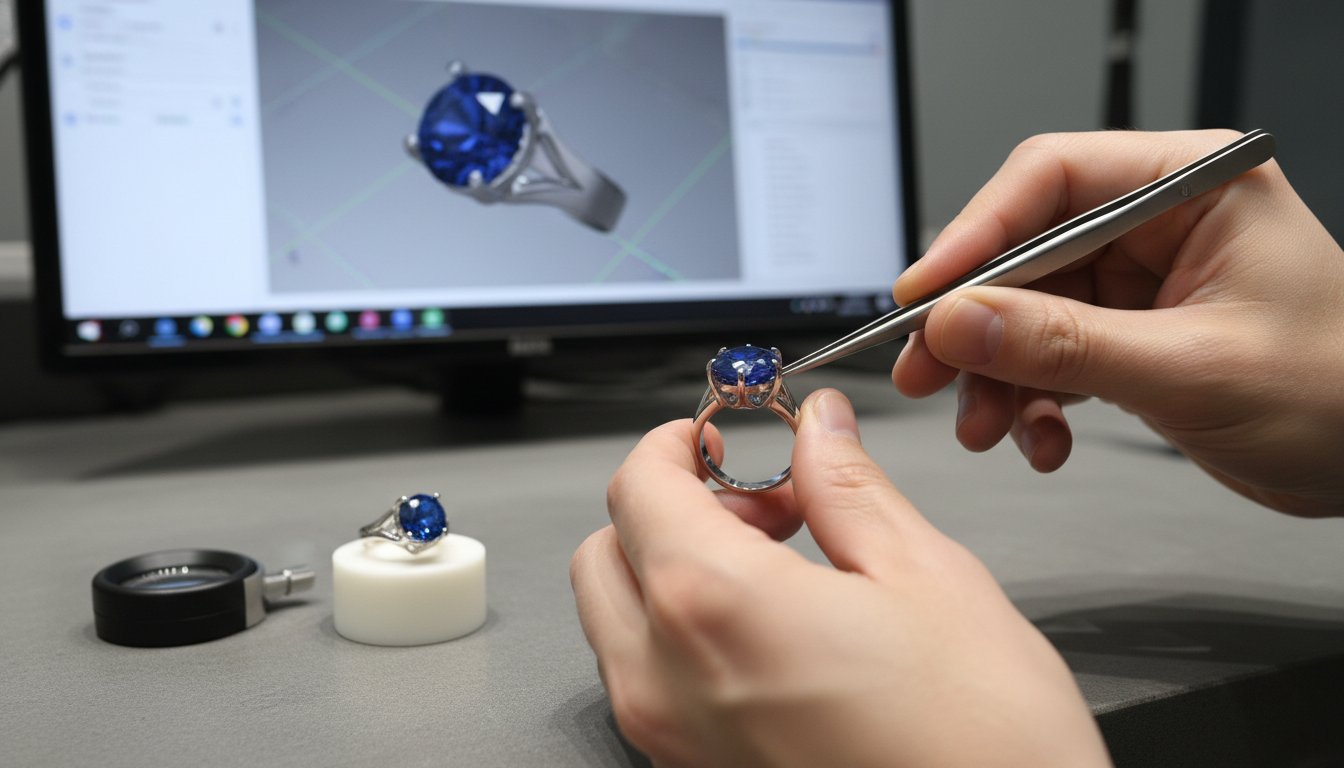
Once you've selected a rare centerpiece from our collection, the journey moves into the digital atelier. This is where the custom jewelry design process step-by-step shifts from artistic vision to rigorous engineering. We use industry-leading software like MatrixGold 4.0 to translate your sketches and inspirations into a precise three-dimensional environment. Unlike a traditional hand-drawn sketch, a Computer-Aided Design (CAD) model allows us to calculate the exact volume of metal and the precise placement of every accent stone with micron-level accuracy.
Structural integrity is the priority during this phase. A design might look stunning on paper but fail to provide the security your gemstone requires. We address the SERP gap often left by other jewelers by focusing on technical durability. We analyze the shank width to prevent bending and ensure prong thickness is sufficient to protect the girdle of your stone. This digital stage serves as a technical "stress test" for your piece, ensuring it isn't just beautiful, but built to last as a multi-generational heirloom.
The feedback loop is a vital part of our transparent framework. Before we proceed to the physical creation of your piece, you'll have the opportunity to review the digital model. This allows for micro-adjustments to the height of the setting or the curvature of the band. It's a collaborative process that eliminates the anxiety of the final reveal, as you've already "seen" the piece in its digital form.
Visualizing Your Bespoke Piece
We provide photorealistic renderings that simulate how light interacts with your chosen metal and gemstone. You'll move beyond technical wireframes to see high-fidelity images that showcase your design from every possible angle. This visualization ensures the proportions are balanced and the aesthetic aligns with your original vision. For intricate designs like halos or pavé-set bands, CAD ensures a level of mathematical symmetry that traditional hand-carving cannot replicate, resulting in a cleaner, more refined finish.
Technical Validation and Gemstone Fit
Every stone is unique. We perform a digital "mapping" of the specific dimensions of your loose gemstones to create a custom "seat" within the setting. This bespoke fit is essential for stones with unique proportions, ensuring they sit securely and at the optimal height for light return. By optimizing these angles in the CAD phase, we enhance the color saturation and brilliance of the gem. Additionally, the software provides an exact metal weight estimate for the mountings, which maintains our commitment to transparent pricing before we move to the casting phase.
Bringing the Form to Life: Prototyping and Casting
Following the digital validation, the custom jewelry design process step-by-step enters its most transformative phase: the transition from bits to atoms. We use high-resolution 3D printers to create a physical resin or wax prototype of your mounting. This isn't just a placeholder; it is a mathematically perfect replica of the CAD model we finalized together. This prototype becomes the master for the lost wax casting process, an ancient technique modernized with vacuum-pressure casting chambers that ensure the molten metal fills every microscopic detail of the design.
Choosing your alloy is a decision that balances aesthetics with physical properties. While 18k gold is a timeless choice for its rich color and workable nature, many connoisseurs opt for 950 platinum for its superior density and natural white luster. As of June 10, 2026, market conditions show gold at approximately $4,120.73 per ounce and platinum at $1,651.50 per troy ounce. These market values influence your investment, but the choice should also consider the gemstone. For instance, a colorless diamond or a cool-toned sapphire often benefits from the neutral backdrop of platinum, which doesn't cast yellow reflections into the stone.
Once the metal has cooled, the raw casting emerges with a rough texture and a casting sprue attached. This sprue is the channel where the metal entered the mold. Our artisans carefully remove this excess material and begin the initial cleanup, refining the raw form so it's ready for the intricate work of the master setter. If you're ready to select the foundation for your masterpiece, explore our professional jewelry mountings to see the quality of our starting points.
The Wax Model Review
The physical prototype is the final opportunity for a fit check. We encourage you to verify the scale of the piece against your hand or existing jewelry. It's vital to understand that wax or resin models often look slightly bulkier than the finished metal. This is because the metal will undergo multiple stages of polishing that remove microscopic layers to achieve a mirror-like finish. Seeing the model in person or via high-definition video provides the security that the proportions are exactly as you imagined before we commit to the permanent casting phase.
Precision Casting and Metallurgy
High-density casting is essential for lifelong durability. We manage the science of metal cooling to prevent porosity, which are tiny bubbles or voids that can weaken the structure of a ring or pendant. By using a vacuum-casting environment, we ensure the metal is compact and free of internal flaws. This rigorous attention to metallurgy creates a stronger "seat" for your gemstone, ensuring that prongs remain secure even after years of daily wear. This technical foundation is what separates a commercial-grade piece from a true heirloom-quality work of art.
The Final Reveal: Setting, Polishing, and Quality Assurance
The culmination of the custom jewelry design process step-by-step is where the raw metal casting and the loose gemstone finally unite. This phase represents the peak of technical risk and artistic reward. A master setter doesn't just place a stone; they secure a legacy. Each prong is meticulously carved and folded over the gem's crown, ensuring a fit that's both secure and aesthetically balanced. After the stones are seated, the piece undergoes hand-polishing. Using progressively finer abrasive rouges, artisans achieve a mirror-like finish that highlights the architectural integrity of the mounting. This detailing removes the last microscopic imperfections from the casting phase, allowing the metal to reflect light with the same intensity as the gemstones it holds.
The Master Setting Process
Setting delicate stones like emeralds or opal gemstones requires exceptional connoisseurship. These materials are sensitive to pressure and heat, demanding a light touch that only years of experience can provide. We ensure every prong is smooth and snag-free, preventing the jewelry from catching on fine fabrics during daily wear. The setter also performs a final orientation check, ensuring the stone's refractive performance and natural beauty are showcased at their absolute best within the finished mounting. This precision ensures the stone remains the focal point of the entire composition.
Quality Assurance and Delivery
Our quality control protocol is a rigorous, multi-point inspection that exceeds commercial standards. We verify the final piece against the original CAD specifications to ensure every micron of the design was realized. This isn't just a visual check; we examine the structural security of every accent stone and the integrity of the hallmarking. As of February 2026, we strictly adhere to the National Gold and Silver Marking Act, ensuring that if a fineness mark like "14K" or "PT950" is present, our registered trademark is there to guarantee its authenticity. We don't compromise on these technical validations because they're the pillars of your trust.
You'll receive a comprehensive documentation suite, including the official AfricaGems guarantee and grading reports from respected laboratories like the GIA or AGL. These documents are essential for protecting your investment and securing insurance for your new heirloom. Once the piece passes our final reveal, it's ready for delivery, marking the successful end of your custom jewelry design process step-by-step. Your next steps involve scheduling regular professional cleanings and ensuring your appraisal is updated to reflect current market values for precious gemstones and metals. This methodical approach ensures your piece remains as stunning as the day it was first revealed.
Your Legacy in Rare Materials
Transforming a vision into a tangible heirloom is a journey of both technical precision and personal storytelling. By following the custom jewelry design process step-by-step, you ensure that every decision, from the selection of ethically sourced rare gemstones to the final master setting, is grounded in expert authority and radical transparency. You've already seen how the "Gemstone-First" philosophy protects the integrity of the stone while digital modeling eliminates the fear of the unknown. This methodical framework isn't just about manufacturing jewelry; it's about crafting a legacy that reflects your unique standards.
AfricaGems has been a pillar of the industry since 1984. Founded by Marc Sarosi, our business is built on a foundation of full disclosure regarding gemstone treatments and a deep expertise in rare gemstones. We invite you to step into the role of the informed insider. Start your custom design journey with a personal consultation today. We look forward to helping you create a masterpiece that will be cherished for generations.
Frequently Asked Questions
How long does the custom jewelry design process usually take?
The custom jewelry design process step-by-step typically requires four to eight weeks from the initial consultation to final delivery. This duration allows for meticulous CAD modeling, wax prototyping, and the expert setting of your chosen gemstones. More complex designs involving multiple rare materials or intricate pavé work might extend this timeline. We prioritize technical perfection over speed to ensure your heirloom meets our rigorous standards.
Can I use my own gemstone for a custom design at AfricaGems?
You can certainly provide your own gemstone for a bespoke mounting. We require a thorough inspection of the stone to verify its structural integrity and suitability for the intended design. This ensures that the custom jewelry design process step-by-step results in a secure and durable piece. Our experts will discuss any potential risks associated with the stone's specific inclusions or fragility before the project begins.
Is custom jewelry design more expensive than buying a pre-made piece?
Custom jewelry isn't necessarily more expensive than mass-produced luxury items of comparable quality. While there's a labor cost for CAD and hand-finishing, you gain full control over the material allocation. You can choose to invest more in a superior center stone while simplifying the setting. This transparency ensures you aren't paying for the overhead associated with large retail inventories.
What happens if I don’t like the CAD rendering of my design?
The CAD rendering phase is a collaborative feedback loop designed to prevent any surprises. If the initial rendering doesn't match your vision, we'll make micro-adjustments to the proportions, heights, or stone placements. We don't move to the prototyping phase until you're completely satisfied with the digital model. This process ensures the final physical piece is exactly what you intended to create.
Do you provide a warranty for custom-designed jewelry?
Every custom piece is backed by the AfricaGems guarantee of authenticity and craftsmanship. We provide a lifetime guarantee against manufacturing defects to ensure your peace of mind. Additionally, we include official grading reports from laboratories like the GIA or AGL for your center stones. While we don't cover normal wear and tear, we're committed to the long-term integrity of your investment.
How do I care for my custom gemstone ring or pendant?
Maintaining your custom piece requires gentle cleaning with mild dish soap, warm water, and a very soft brush. It's essential to avoid harsh chemicals or ultrasonic cleaners for delicate stones like emeralds or opals. We recommend professional inspections every six months to check prong security and metal wear. Proper care preserves the mirror-like finish and ensures the stones remain securely seated for decades.
Can I design a custom piece using lab-created gemstones?
You can absolutely use Chatham Lab Created Gemstones for your custom design. These stones offer the same chemical and physical properties as natural gems but allow for a different price point or aesthetic preference. They're an excellent choice for those seeking high-clarity centerpieces in vibrant hues. Our design framework applies the same level of technical precision to lab-created gems as it does to our rarest natural specimens.
What metals are best for a custom engagement ring?
Platinum and 18k gold are the premier choices for custom engagement rings due to their durability and beauty. Platinum is highly prized for its density and natural white color, which doesn't require rhodium plating. 18k gold, available in yellow, white, and rose, offers a classic warmth and excellent workability for intricate details. Both metals provide the structural security needed to protect precious gemstones over a lifetime of wear.