
The Connoisseur’s Guide to Emerald Colors: Hue, Saturation, and Origin
Apr 2nd 2026
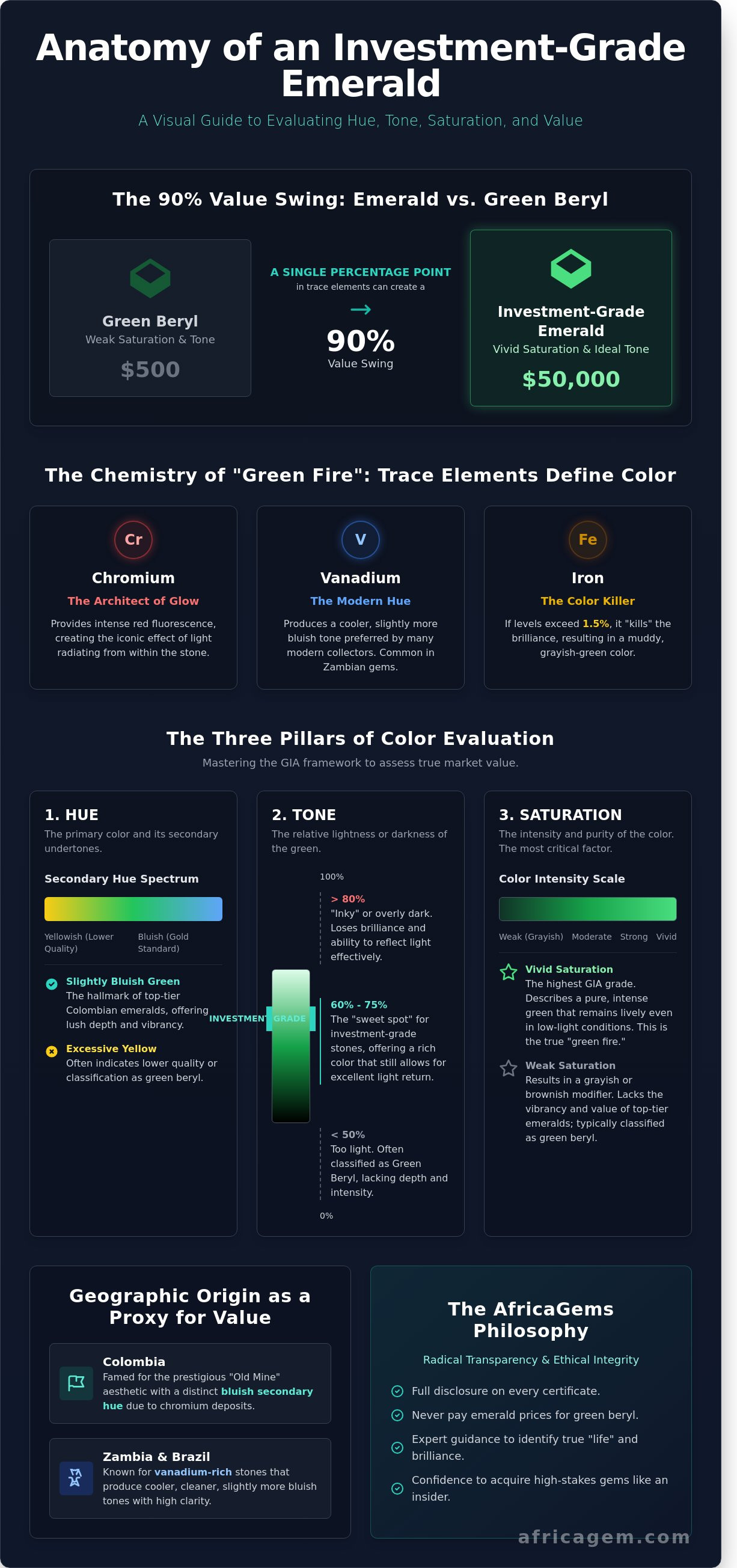
A single percentage point difference in trace chromium or vanadium can transform a $500 green beryl into a $50,000 investment grade emerald. According to GIA grading benchmarks established in 1963, the boundary between these two stones is often a subjective threshold that dictates a 90% swing in market value. You've likely felt the frustration of squinting at a digital screen, trying to determine if a stone's emerald colors are truly "vivid" or just the result of aggressive photo editing. It's a valid concern to fear paying a premium for a gem that arrives looking "muddy" or flat in natural light.
At AfricaGems, we believe that radical transparency is the only way to bridge the gap between our vaults and your collection. I'll help you master the professional nuances of hue, tone, and saturation so you can identify stones that maintain their brilliance and value. We'll examine how a 2.15 carat Colombian emerald differs from its Zambian counterpart and provide the technical vocabulary you need to evaluate these high-stakes acquisitions with the confidence of an insider.
Key Takeaways
- Learn how the precise balance of chromium, vanadium, and iron acts as the "ink" that defines the world's most exquisite beryl varieties.
- Master the GIA grading framework to identify investment-grade emerald colors by evaluating the critical relationship between hue, tone, and saturation.
- Discover why geographic origin serves as a proxy for value and how to recognize the prestigious "Old Mine" aesthetic sought by global connoisseurs.
- Understand how internal "jardin" inclusions and pleochroism affect light travel to ensure your selected gemstone possesses true "life" and brilliance.
- Adopt the AfricaGems "Eye Test" to navigate the complexities of gemstone treatments and secure stones with radical transparency and ethical integrity.
The Spectrum of Green: What Defines 'Emerald Colors' in 2026?
True emeralds represent the most prestigious variety of the mineral beryl, defined specifically by their bluish-green to pure green hues. In the 2026 market, the definition of emerald colors has narrowed as collectors seek stones with vivid saturation that remains lively even in low-light environments. This color isn't a broad category; it is a surgical slice of the visible spectrum between 500 and 520 nanometers. When a stone falls within this window, it triggers a unique psychological response. High-saturation green is clinically proven to reduce ocular strain and evoke a sense of biological vitality, a phenomenon we call the "green fire" of the gem.
To understand the value of these stones, one must look at the chemical "ink" within the crystal lattice. While pure beryl is colorless, the presence of specific trace elements transforms it into a masterpiece. You can learn more about these Emerald gemstone properties to see how they influence market classification and value. At AfricaGems, we emphasize that transparency regarding these elements is the only way to ensure you're making a sound investment in a rare mineral.
The Chemistry of the 'Green Fire'
Chromium is the primary architect of the iconic emerald glow. It provides the intense red fluorescence that makes a stone appear to radiate light from within. Modern mining in Zambia and Brazil has highlighted the role of Vanadium, which produces a cooler, slightly more bluish tone that many 21st-century collectors prefer for its modern aesthetic. However, the presence of Iron must be carefully monitored. While a small amount of Iron can stabilize the crystal, levels exceeding 1.5% often "kill" the color. This results in a muddy, grayish-green that lacks the breathtaking brilliance of a top-tier specimen.
The Emerald vs. Green Beryl Debate
The distinction between an emerald and a green beryl is a matter of intensity that impacts price by as much as 90%. Major laboratories like the GIA and AGL use master stones to draw a definitive line. If the saturation is too weak, the stone is classified as green beryl. This is a critical distinction for the Expert Enthusiast to recognize on a lab report. A stone labeled "Green Beryl" might look attractive, but it lacks the rarity and historical prestige associated with true emerald colors. We provide full disclosure on every certificate to ensure you never pay emerald prices for a lighter beryl variety. This commitment to integrity is the cornerstone of the AfricaGems Difference.
The Three Pillars of Color Evaluation: Hue, Tone, and Saturation
The Gemological Institute of America (GIA) provides the essential lexicon for evaluating emerald colors. This framework moves beyond simple descriptions to dissect gemstones into three distinct components. Mastering this language transforms a casual buyer into an expert enthusiast, allowing for a precise assessment of a stone's true market value. At AfricaGems, we utilize these rigorous standards to ensure every gem in our vault meets the expectations of serious collectors.
Primary and Secondary Hues
Emeralds are defined by a primary green hue, but secondary colors dictate their pedigree and geographic associations. A "slight" bluish secondary hue represents the gold standard for high-end gems. This cool undertone is the hallmark of the finest Colombian specimens, providing a depth that feels both lush and vibrant. These secondary hues are a direct result of the specific chemical environment during the geological formation of emeralds, where trace amounts of chromium and vanadium determine the final visual outcome.
You should remain cautious of "yellowish" secondary hues. While a hint of yellow can provide a warm, grassy appearance, excessive yellow often indicates a lower-quality stone or a different mineral variety like green beryl. A "pure" green emerald, devoid of any secondary blue or yellow, is exceptionally rare. These stones account for less than 3% of top-tier production and are highly prized for their balanced, neutral profile. Identifying these subtle shifts in emerald colors requires a trained eye and controlled lighting conditions.
The Balance of Tone and Saturation
Tone refers to the relative lightness or darkness of the green. In the professional trade, a tone between 60% and 75% is considered investment grade. When the tone exceeds 80%, the stone often appears "inky" or overly dark, losing the ability to reflect light effectively. Conversely, if the tone is too light, a phenomenon known as "windowing" occurs. This is where light leaks through the pavilion of the stone instead of reflecting back to the eye, creating a pale, washed-out center where color seems to disappear.
Saturation is the color's strength, intensity, and purity. It's the most critical factor in determining the "wow" factor of a gem.
- Vivid Saturation: This is the pinnacle of quality. High saturation can effectively mask internal inclusions, making a moderately included stone appear visually stunning.
- Dull or Grayish Saturation: When saturation is low, the green appears "muddy" or "sleepy." A gray mask reduces the brilliance and significantly drops the price per carat.
Understanding how these three pillars interact is vital for any serious acquisition. A stone with 72% tone and vivid saturation will always outperform a darker stone with duller color. You can explore these nuances in our carefully curated emerald collection, where we prioritize the "Expert Enthusiast" standards of color excellence and transparency.
Origin-Specific Color Profiles: Mapping the World’s Finest Greens
Origin serves as a vital proxy for color in the gemstone market. Serious collectors often pay a 30% to 50% premium for stones from specific mines because the local geology dictates the crystal's chemical soul. The "Old Mine" look represents the pinnacle of this demand. These stones feature a high chromium-to-iron ratio, creating a vivid, glowing saturation that modern commercial production rarely matches. When iron levels are high, they act as a "quencher," dampening the natural fluorescence that gives a gem its life. According to GIA's guide to emerald quality factors, these trace elements are the primary drivers of both visual beauty and market value.
The Colombian Standard: Warmth and Glow
Colombian emerald colors are defined by a unique lack of iron in the sedimentary host rock. This geological quirk allows the stones to fluoresce under UV light, creating a signature "glow" that appears to radiate from within the crystal. Understanding why origin matters for Colombian emeralds requires looking at specific mining districts:
- Muzo: These stones are the gold standard for "forest green." They possess a deep, velvety saturation with a neutral to slightly yellowish secondary hue.
- Chivor: Known for an "electric" appearance, Chivor stones lean into a bluish-green profile that feels sharper and more piercing than Muzo material.
- Coscuez: Stones from this mine often display a "warm" yellow-green secondary. This subtle shift provides a sun-drenched quality that many collectors find breathtaking.
Zambian and Brazilian Profiles: Cool and Deep
Zambian emeralds offer a distinct, cool profile. Their higher iron content introduces a bluish-green hue that feels sophisticated and deep. While they may lack the intense fluorescence of Colombian stones, they are frequently 20% to 30% cleaner when viewed under a 10x loupe. This transparency allows for a different kind of brilliance. Brazilian stones, particularly those from the Itabira region, are famous for the "Mint" profile. These gems are typically lighter and brighter. They offer a refreshing, spring-like green that works exceptionally well in modern jewelry designs where clarity is prioritized over deep saturation.
Emerging Origins: Ethiopia and Panjshir
Newer sources are currently disrupting the traditional market hierarchy. The 2016 discovery of high-quality deposits in Ethiopia brought "neon" green stones to the forefront. These gems challenge the Colombian monopoly by offering intense saturation and high transparency. Afghan emeralds from the Panjshir Valley are equally impressive. Their chemical composition often mirrors the finest Muzo deposits, resulting in a pure, lush green. To spot high-quality emerald colors in these lesser-known regions, look for stones that maintain their color consistency across the entire face of the gem without showing gray or brown undertones. High-quality Afghan material is particularly noted for its exceptional "crystal," a trade term for superior transparency and luster.
How Inclusions and Light Influence Perceived Color
An emerald's hue isn't just a result of its chemical composition; it's a complex dance between light and the stone's internal architecture. Unlike diamonds, where clarity is a quest for nothingness, emeralds embrace their "Jardin" or garden. These moss-like inclusions are a hallmark of the species. They influence how we perceive emerald colors by diffusing light throughout the crystal. This internal landscape determines whether a stone glows from within or appears dull and lifeless.
Emeralds are also naturally dichroic, a property known as pleochroism. This means they display two distinct colors depending on the viewing angle: typically a deep blue-green and a lighter yellow-green. A master cutter must orient the stone with extreme precision to showcase the rich blue-green axis. If the orientation is off by even 10 degrees, the face-up color suffers, losing that velvety depth that collectors crave. Beyond pleochroism, microscopic "silk" inclusions can act as tiny reflectors. When these are distributed evenly, they scatter light into the "dead zones" of a stone, actually enhancing the perceived color saturation.
The Scattering Effect of the Jardin
A perfectly "clean" emerald can sometimes appear "sleepy" or flat. It lacks the internal mirrors that a light jardin provides. These inclusions trap light within the stone, bouncing it around the facets to make the green appear more intense. However, you must distinguish between a lush garden and "carbon." Carbon refers to black spots, often tiny crystals of biotite or chromite. These absorb light instead of reflecting it. When carbon exceeds 10% of the stone's visible surface, the vibrance of the green is significantly compromised. To master these nuances, you can read more in our guide on Understanding emerald value and clarity.
Lighting Conditions: Sunlight vs. LED
Professional dealers rely on "North Light," which is indirect sunlight typically measured at 5500 Kelvin. This neutral spectrum reveals the true balance of the stone without adding artificial bias. Modern LED lighting often has sharp "spikes" in the blue spectrum that can make a mediocre stone look more vibrant than it truly is. Conversely, warm incandescent light at 2700 Kelvin emphasizes yellow undertones, which can make a fine stone look overly olive or muddy. Expert collectors often use a Chelsea Filter to inspect emerald colors under controlled light. Under this specialized lens, an emerald rich in chromium will show a distinct red flash, confirming the presence of the elements that create the most coveted greens.
Selecting Investment-Grade Emerald Color: The AfricaGems Philosophy
Marc Sarosi has spent over 30 years refining what he calls the 'Eye Test.' While a laboratory report provides essential data, it can't quantify the 'Life' of a gemstone. For a serious collector, the vibrancy and internal fire are just as critical as the technical hue. We believe that emerald colors should possess a certain glow, often referred to as 'oiliness' or 'velvet,' which transcends a simple grade on a piece of paper. This philosophy ensures that every stone in our inventory isn't just statistically rare; it's visually stunning.
Transparency is the cornerstone of the AfricaGems Difference. Because 99% of emeralds undergo some form of clarity enhancement, we provide 100% disclosure on the type of treatment used. We prioritize traditional cedar oil over artificial resins. Cedar oil is a natural substance that's been used for centuries; it's stable and accepted by high-end auction houses like Christie's. Resins can discolor over a few years, often developing a yellowish tint that degrades the stone's value. By maintaining strict color consistency across our parcels, we provide the foundation for high-value custom jewelry that maintains its allure for generations. You can learn more about these standards in our article, The King of Green Gems: A Connoisseur’s Guide.
Beyond the Certificate
A 'Vivid Green' label on a lab report doesn't always translate to a beautiful stone. Many gems with high saturation suffer from 'extinction,' where 40% or more of the face appears black because light isn't reflecting properly. We evaluate stones based on their 'Face-Up' appearance. A stone might show deep saturation from the side, but if the table is flat or the cut is shallow, the color looks dead when set. We select stones that maintain their rich emerald colors even in low-light environments.
Custom Design for Color Optimization
The choice of metal is a strategic tool for color enhancement. We often recommend 18k yellow gold prongs to 'lift' a slightly yellowish emerald, making it appear more vibrant. Conversely, platinum or white gold provides a 'cool' backdrop that makes a bluish-green Colombian stone pop. For darker stones with high saturation, we utilize double-prong settings. This technique allows 15% more light to enter the pavilion compared to heavy bezel settings, preventing the gem from looking overly dark. Ready to find your perfect stone? Browse our curated collection of loose Colombian emeralds today.
Master Your Collection of Rare Greens
Navigating the complex landscape of emerald colors requires a blend of scientific precision and aesthetic intuition. You've discovered how the 2026 market prioritizes the three pillars of hue, tone, and saturation to determine true investment value. You also understand how a stone's origin creates a distinct chemical signature that influences its final appearance. These technical details aren't just data points; they're the roadmap to finding a gem that retains its allure for generations. Selecting a world-class emerald is a significant milestone for any serious connoisseur.
We believe every collector deserves the AfricaGems Difference of radical transparency. Marc Sarosi personally inspects every stone to guarantee it meets our elite quality benchmarks. We provide a 30-Day Money Back Guarantee and full treatment disclosure on every gemstone in our inventory. This commitment ensures you're making an informed decision backed by decades of professional expertise. You'll find the security you need to acquire a truly breathtaking specimen that stands the test of time.
Secure Your Investment: Shop Hand-Selected Natural Emeralds
Step into a world of refined elegance and find the stone that perfectly mirrors your sophisticated taste.
Frequently Asked Questions
What is the rarest and most expensive emerald color?
The rarest and most expensive emerald color is a pure, intense green with high saturation and a medium-dark tone, often referred to as Muzo Green. High-end collectors pay premiums exceeding $50,000 per carat for stones that exhibit this specific saturation without visible secondary hues. This color profile is typically found in the top 1% of gems from the Boyacá region of Colombia, where trace elements of chromium and vanadium create a perfect chromatic balance.
Can an emerald be naturally yellow or red?
Natural emeralds are exclusively green because the presence of chromium or vanadium defines the variety; stones of other colors are classified as different beryl types. A yellow beryl is technically heliodor, while the extremely rare red beryl, found in the Wah Wah Mountains of Utah, is known as bixbite. If a stone's primary hue isn't green, it doesn't qualify as an emerald under GIA or IGI grading standards established in the 1950s.
How can I tell if an emerald's color has been artificially enhanced?
You can identify artificial color enhancement by examining the stone under a 10x loupe for telltale signs like colored dye concentrated in surface-reaching fractures. While 95% of emeralds undergo traditional cedar oiling to improve clarity, artificial dyes are a deceptive practice that significantly lowers value. Professional lab reports from the GIA or AGL will explicitly state if a stone has been treated with colored resins or dyes rather than standard colorless oils.
Why do some emeralds look blue-green while others look yellow-green?
Variations in emerald colors occur because of the specific trace elements present during formation, such as iron which introduces a bluish tint. Zambian emeralds often contain 0.5% to 1.5% iron, resulting in a cool blue-green hue, whereas Colombian stones typically favor a warmer yellow-green due to higher chromium content. This visual difference is also influenced by pleochroism, a property where the crystal displays different colors when viewed from different crystallographic axes.
What is the difference between 'vivid green' and 'deep green' on a lab report?
The distinction lies in the balance of saturation and tone, where vivid green represents the highest possible saturation and deep green refers to a darker tone. A vivid green stone has a saturation level of 5 or 6 on the GIA scale, making it appear vibrant and glowing. In contrast, a deep green stone might have a tone level of 7 or 8, which can sometimes make the gem look overly dark or inky in low lighting conditions.
Does the color of an emerald change over time?
An emerald's natural color is stable and won't fade, but the appearance can change if clarity-enhancing oils dry out or leak over a 2 to 5 year period. When the oil evaporates, the fractures become more visible, which scatters light and makes the overall color look paler or less saturated. You can easily restore the original luster through professional re-oiling, a standard maintenance practice that preserves the stone's integrity without altering its chemical composition.
Is a darker emerald always more valuable than a lighter one?
A darker emerald isn't always more valuable, as stones that are too dark lose their internal brilliance and can appear black in certain environments. The most coveted emerald colors sit in the medium-to-medium-dark range, specifically between 60% and 75% tone. If a stone's tone exceeds 80%, it's often classified as over-dark, which typically results in a 20% to 30% reduction in price compared to a stone with perfect transparency and vivid saturation.
What is 'pigeon blood' green in emerald grading?
Pigeon blood is a term traditionally reserved for rubies, but in emerald grading, the equivalent pinnacle of color is officially certified as Muzo Green by labs like Gubelin and SSEF. This designation is only awarded to stones that exhibit a saturated, vivid green hue with no visible secondary modifiers like yellow or blue. To qualify for this prestigious title, a stone must also show high transparency and originate from the historic Muzo, Coscuez, or Chivor mines in Colombia.