
Tanzanite: The Connoisseur’s Guide to the Rare Blue-Violet Treasure
Apr 12th 2026
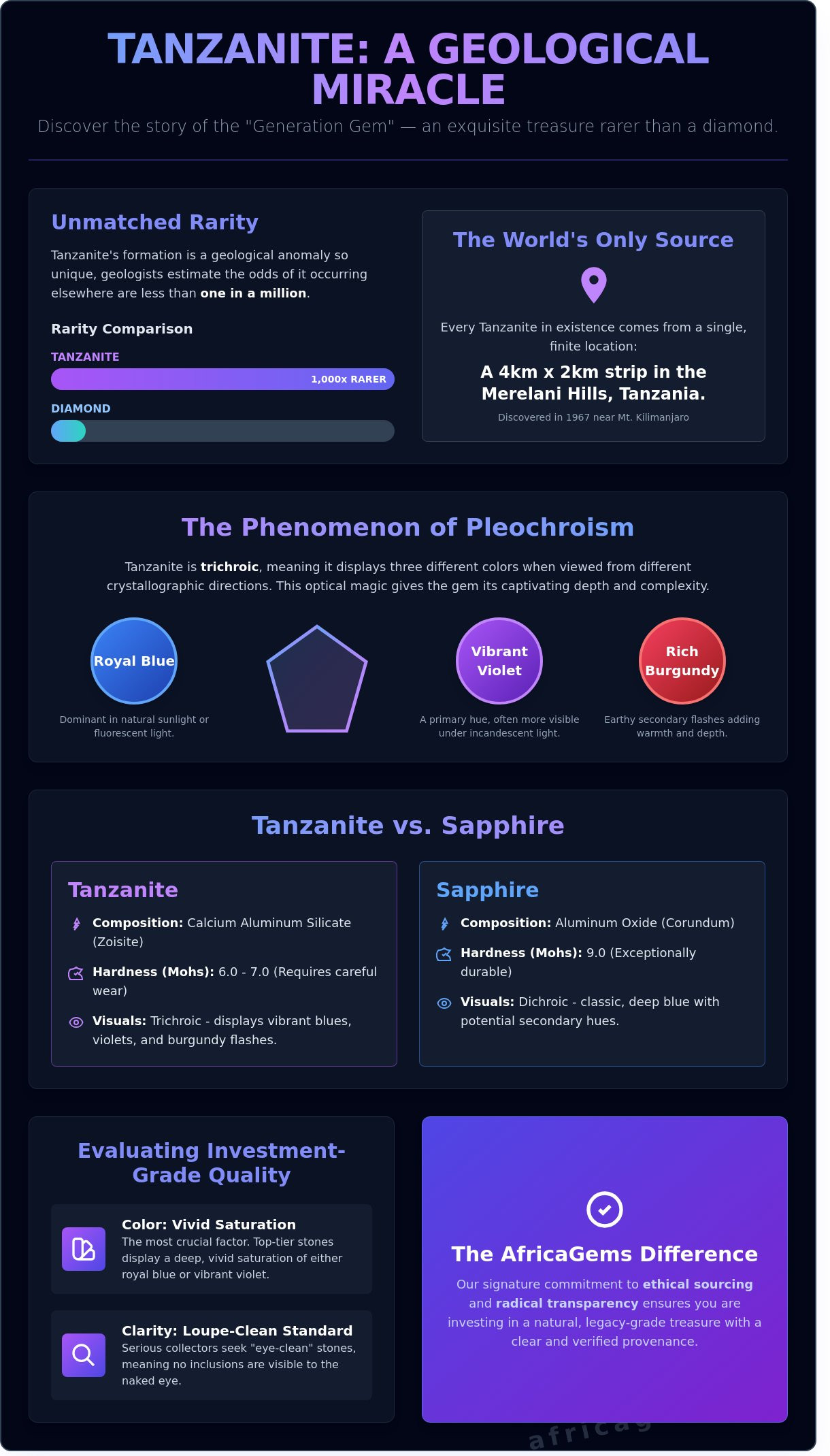
Geologists estimate that the odds of tanzanite forming anywhere else on Earth are less than one in a million. This exquisite blue-violet gemstone is found in only one place on the planet: a small four-kilometer strip in the Merelani Hills of Tanzania. Since its discovery in 1967, it has captivated collectors with a vibrant pleochroism that few other minerals can match. You likely recognize its breathtaking saturation, but you might also feel the weight of its "generation gem" status. It's a rare privilege to own a stone that is 1,000 times rarer than a diamond.
It's natural to feel hesitant when you see varying shades of violet and blue across different screens. You want to ensure you're investing in a natural, ethically sourced specimen rather than a heavily treated or mislabeled stone. We'll show you how to master the 4Cs specifically for this rare mineral and how to identify top-tier saturation with confidence. This guide breaks down the technical gemology of the Merelani mines and provides the radical transparency you need to secure a legacy-grade treasure. You'll gain the insider knowledge required to evaluate loupe-clean clarity and understand the AfricaGems standards for ethical sourcing.
Key Takeaways
- Uncover the geological miracle of the 1967 discovery near Mount Kilimanjaro and why this treasure remains exclusive to a single, finite location on Earth.
- Master the science of pleochroism to understand how a single stone projects an exquisite spectrum of royal blue, vibrant violet, and rich burgundy.
- Discover why tanzanite is celebrated as a "generation gem" with a rarity that makes it significantly more elusive than traditional diamonds.
- Learn to evaluate investment-grade quality using the 4Cs, focusing on vivid color saturation and the rigorous "eye-clean" clarity standards of the serious collector.
- Gain confidence through the AfricaGems Difference, our signature commitment to ethical sourcing and radical transparency in the gemstone trade.
What is Tanzanite? The Discovery of a Geological Miracle
Tanzanite represents a geological anomaly that defies the standard rules of mineralogy. It is the exquisite blue-to-violet variety of the mineral zoisite, a species that typically occurs in opaque greens or browns. This gemstone exists in only one place on Earth, making it a true collector's treasure. Its story began in July 1967 when Ali Juuyawatu, a Masai tribesman, discovered translucent blue crystals on the surface of the ground near the foothills of Mount Kilimanjaro. This chance encounter introduced the world to a mineral that had remained hidden for 585 million years.
The gemstone didn't stay a local secret for long. Henry B. Platt, the former president of Tiffany & Co., recognized its potential as a rival to the finest sapphires. He famously remarked that "blue zoisite" sounded too much like "suicide" and renamed the stone after its country of origin. Tiffany & Co. launched a massive marketing campaign in 1968, positioning the gem as the most beautiful blue stone discovered in 2,000 years. For a detailed overview of its chemical properties and historical timeline, you can consult the entry for Tanzanite on Wikipedia. This stone's allure lies in its remarkable crystal structure, which exhibits intense pleochroism, allowing it to show different colors when viewed from different angles.
The Merelani Hills: The World’s Only Source
Every tanzanite ever mined comes from a singular, tiny strip of land in the Merelani Hills of northern Tanzania. This mining district is remarkably small, measuring roughly 4km in length and 2km in width. This geographic isolation defines its scarcity, as the specific tectonic conditions required to create the gem haven't been found anywhere else. Extraction is a grueling process. Miners must navigate deep-shaft systems that reach depths of over 800 meters. These challenging conditions, combined with the finite nature of the deposit, contribute to the stone's status as a generational investment.
Tanzanite vs. Blue Sapphire: Key Differences
- Chemical Composition: Tanzanite is a calcium aluminum silicate (zoisite), while sapphire belongs to the corundum family (aluminum oxide).
- Hardness and Durability: Sapphire sits at a 9 on the Mohs scale, making it exceptionally tough. In contrast, tanzanite rates between 6 and 7. It's a stone for the connoisseur who understands the need for a protective setting and careful wear.
- Visual Distinction: While sapphires provide a classic, deep blue, tanzanite offers a unique "trichroic" experience. You'll see vibrant violets and secondary flashes of red or burgundy that are never present in a sapphire.
Choosing this gem isn't just about color; it's about owning a piece of a vanishing geological event. The vibrant violet-red flashes seen in high-grade specimens provide a visual depth that sapphire simply cannot replicate. It's this combination of rarity and optical brilliance that cements its place in the world of high-end gemology.
The Phenomenon of Pleochroism: Tanzanite’s Spectrum of Color
The magic of tanzanite lies in its optical complexity. This gemstone is famously trichroic, meaning light splits into three different directions as it passes through the crystal structure. You can observe three distinct colors: deep royal blue, vibrant violet, and a rich, earthy burgundy, depending on the angle of view. A lapidary's skill is tested during the initial stages of cutting. They must orient the crystal axes to showcase the most desirable hue. If they align the blue axis with the table of the stone, the result is a blue-dominant gem. If they choose the violet axis, the stone will appear more purple.
Light sources dramatically shift the stone's appearance throughout the day. Natural sunlight or fluorescent light highlights the cool, regal blues. In contrast, evening incandescent light or candlelight pulls the warmer violet and pinkish-red flashes to the surface. Understanding these nuances is easier when referencing GIA's Tanzanite Quality Factors, which provide the global standard for evaluating these unique optical properties. This color-shift is why a stone might look like a sapphire in the morning and an amethyst by dinner.
The Spectrum of Blues and Violets
Gemologists use specific shorthand to describe color dominance: "vB" for Violetish Blue and "bV" for Bluish Violet. The capital letter indicates the primary hue. Serious collectors usually hunt for "vB" stones with deep, vivid saturation. These gems possess a "velvety" finish that creates a sense of depth. This visual texture isn't about a lack of clarity; it's a rare interaction of light that makes the color feel three-dimensional and lush. The more intense the saturation, the more valuable the stone becomes, as light reflects more powerfully off the internal facets.
The Truth About Heat Treatment
About 95 percent of all tanzanite undergoes mild heating to approximately 600 degrees Celsius to reveal its signature palette. In its raw state, the mineral often appears in a muddy mix of brownish-yellow, green, and blue. Heating removes the brown "mask" and stabilizes the blue and violet tones. This process is permanent, stable, and fully accepted within the gemstone trade.
Rare "unheated" stones do exist, often found in a fascinating yellow-green trichroic state, but they rarely achieve the electric intensity of their heated counterparts. We prioritize radical transparency regarding these treatments. It's vital to distinguish between this standard heating and unethical surface coatings that can wear off over time. If you want to see the difference that professional cutting and high-grade saturation make, you can view our collection of certified stones to find a gem that resonates with your personal style.
The "Generation Gem": Understanding Rarity in 2026
Tanzanite isn't just rare. It's geologically unique. While diamonds are unearthed across several continents, every single crystal on the planet originates from a small, four-kilometer strip of land at the base of Mount Kilimanjaro. This singular source is why experts frequently describe tanzanite as 1,000 times rarer than diamond. It's a geological fluke. The Smithsonian National Museum of Natural History notes that the specific conditions required to create this blue-violet variety of zoisite were so intense that the likelihood of finding another deposit elsewhere is virtually zero. It's a one-in-a-million miracle.
We call it the "Generation Gem" because current projections suggest the Merelani mines will be exhausted within our lifetime. This isn't marketing hyperbole. It's a finite countdown. For collectors in 2026, this means you're likely the last generation able to purchase new stones directly from the primary source. Once the mines go quiet, the secondary market will be the only remaining avenue, likely driving prices to levels comparable to the rarest colored diamonds or Paraiba tourmalines.
Mining Longevity and Market Scarcity
Recent data from the Tanzanian Ministry of Minerals indicates that as mining depths increase, the cost of extraction rises and the yield of high-quality crystals diminishes. In 2018, the construction of a 24-kilometer perimeter wall around the mines tightened supply chains to eliminate smuggling. This regulation ensures stones are ethically sourced, but it also means the global supply is strictly controlled. You can explore the technical data in our guide: How Rare Is Tanzanite?.
Investment Potential for Collectors
The market specifically prizes "Block D" specimens. This specific mining area historically produced the most vivid, deeply saturated trichroic crystals. As these high-grade pockets vanish, large, eye-clean stones exceeding five carats are becoming harder to find. These specimens don't just hold value; they appreciate as the scarcity premium takes hold. For current market valuations, consult our Tanzanite Price Per Carat guide.
Some collectors worry that such rarity makes the stone too precious to wear. That's a misconception. While tanzanite requires more care than a sapphire, a well-designed setting protects the stone perfectly. It's a gem for the bold. It's meant to be an heirloom, not a relic hidden in a safe. Owning one today means holding a piece of Earth's history that won't be available to the next generation. It's a legacy you can actually see and feel.
Evaluating Quality: The 4Cs of Tanzanite
Understanding tanzanite quality requires moving beyond basic retail definitions. While the traditional 4Cs provide a necessary framework, this gem's unique zoisite chemistry demands a more nuanced approach from the collector. Serious enthusiasts look for stones that exhibit a perfect balance of saturation and light performance, ensuring the gem remains vibrant in various lighting conditions. At AfricaGems, we prioritize stones that meet the highest gemological benchmarks to ensure long-term value and beauty.
Judging Color Saturation
Color is the most critical factor in determining a stone's worth. High-end specimens are graded using professional standards like vB 6/6 (vivid Blue) or bV 6/6 (vivid Violet), indicating the highest possible saturation and tone. While pale lavender stones are abundant, investment-grade gems possess a deep, midnight blue or intense royal purple hue. Vivid saturation serves as the primary driver of market value for investment-grade tanzanite. You should watch for windowing, where light leaks through the back of the gem, or extinction, which creates lifeless black patches in the stone. A masterfully colored stone maintains its rich glow even in low-light environments.
Clarity and Inclusions
Tanzanite is classified as a GIA Type I gemstone, meaning it's expected to be eye-clean to the naked eye. For high-value loose stones, a loupe-clean grading at 10x magnification is the preferred standard for connoisseurs. Common inclusions like tiny graphite crystals or microscopic needles can disrupt the path of light, reducing the stone's natural brilliance. If a gem has visible feathers or fractures, it becomes more vulnerable to damage during the setting process. Superior clarity ensures that internal light reflections remain sharp, allowing the gem to sparkle with maximum intensity and fire.
The cut of a tanzanite is a technical challenge due to its pleochroism. A master cutter must decide whether to orient the crystal to showcase a deep blue or a rich violet face-up. This decision often impacts the final carat weight; blue-dominant cuts can result in a 20% to 30% higher weight loss from the rough crystal compared to violet-dominant orientations. Size also plays a role in visual depth. Because of how zoisite absorbs light, smaller stones under 2.00 carats rarely achieve the same saturation as a 10.00 carat specimen. Larger stones provide the physical volume necessary to display that legendary, velvet-like intensity that defines the top 1% of all mined material.
Ready to find a stone that meets these rigorous standards? Explore our collection of investment-grade tanzanite to see the AfricaGems difference in person.
Designing with Tanzanite: The AfricaGems Difference
Choosing a gemstone is an investment in both beauty and ethics. Since 1984, AfricaGems has prioritized a transparent supply chain for every tanzanite in our collection. We source our gems directly from licensed mines in the Merelani Hills of Tanzania, ensuring each stone is conflict-free and follows strict fair-trade protocols. Unlike mass-market retailers, we provide radical transparency regarding heat treatments. Most stones undergo heating to stabilize their color; we disclose this detail for every individual listing without exception. Buying a loose stone gives you a significant advantage over pre-set commercial jewelry. It allows you to inspect the gem for inclusions and cut quality under a loupe before it's hidden by a mounting. Every purchase is backed by the Marc Sarosi guarantee, offering personal accountability that ensures you receive the exact quality promised.
Caring for Your Tanzanite Jewelry
With a Mohs hardness of 6.5 to 7, this gem requires thoughtful handling. If you choose a ring, we recommend protective settings like bezels or sturdy prongs to shield the edges. Pendants are often safer for daily wear since they don't encounter the same impact as rings. You should never place your jewelry in an ultrasonic or steam cleaner. The high-frequency vibrations can trigger the gem's natural cleavage planes, leading to permanent fractures. Use warm water and mild soap instead. When storing your collection, keep your tanzanite in a separate soft pouch. Harder gems like blue sapphires can easily scratch its surface if they rub together in a jewelry box.
Custom Creations for a Unique Gem
Our custom jewelry design services focus on maximizing the pleochroism of your stone. This unique optical property means the gem shows different colors from different angles. We hand-select stones that exhibit vibrant violet flashes to ensure your piece stands out in any lighting. Metal choice plays a vital role in the final aesthetic. White gold or platinum enhances the cool, velvety blues of the stone. Conversely, 18k yellow gold provides a rich contrast that makes the violet hues pop. The AfricaGems promise is simple: we provide hand-selected stones that maintain their brilliance for a lifetime. We treat every client like a serious collector, providing the technical data needed to make an informed, confident decision.
Secure Your Legacy with the World’s Rarest Blue Gemstone
Owning a piece of the Merelani Hills means holding a geological miracle that industry experts predict’ll become significantly more elusive by 2026. You've learned how pleochroism creates that signature shifting hue and why the 4Cs determine a stone's true investment value. At AfricaGems, we apply over 40 years of gemstone expertise to ensure every specimen in our vault meets the most rigorous standards for clarity and color saturation. We provide full gemological disclosure on every single stone. There aren't any secrets here, only the radical transparency you deserve when making a high-value acquisition.
Each gem is ethically sourced directly from its singular origin in Tanzania, ensuring your purchase supports responsible mining practices and local communities. Choosing a masterpiece is a personal journey that requires a knowledgeable mentor. Marc Sarosi stands behind every selection, offering the security and professional authority you need to invest with total confidence. It's time to explore a curated selection where technical excellence meets breathtaking natural beauty. Browse our exquisite collection of Loose Tanzanite Gemstones and discover a treasure that'll define your collection for generations to come.
Frequently Asked Questions
Is tanzanite a good investment in 2026?
Tanzanite remains a compelling choice for collectors because it's approximately 1,000 times rarer than diamonds. Experts from the Tanzanian government and independent geologists estimate the Merelani mines will be exhausted within 20 years. This finite supply creates a "generational gemstone" scenario. As we approach 2026, the dwindling supply of high-grade rough material continues to support its long-term value proposition for serious connoisseurs.
Can I wear a tanzanite ring every day?
You can wear tanzanite daily if you choose a protective setting and exercise caution. It ranks 6 to 7 on the Mohs scale, which means it's softer than sapphire or diamond. Avoid wearing your ring during strenuous activities like gardening or gym sessions. A bezel setting offers the best protection for the stone's edges. This ensures your investment stays pristine for years to come.
How can I tell if a tanzanite is real or a synthetic imitation?
The most reliable way to identify genuine tanzanite is by observing its pleochroism. Natural stones show three distinct colors; blue, violet, and burgundy; when viewed from different axes. Most imitations like synthetic forsterite or colored glass don't exhibit this complex color shift. You should always insist on a certificate from a reputable lab like the GIA to confirm the stone's authenticity and treatment status.
What is the most valuable color for a tanzanite stone?
A deeply saturated, vivid blue with flashes of violet is the most valuable color profile. According to GIA standards, stones with a saturation level of 5 or 6 are the rarest. These top-tier gems represent less than 1 percent of the total mine output. While lighter lilac shades are beautiful, the intense "d-block" blues command the highest premiums among global gemstone investors and enthusiasts.
Is all tanzanite heat-treated?
Approximately 95 percent of all tanzanite undergoes mild heat treatment to remove brownish axis colors. This stable process happens at temperatures between 370 and 600 degrees Celsius. It's an industry-standard practice that reveals the stone's hidden blue and violet beauty. While unheated "fancy" tanzanites exist, they're extremely rare. At AfricaGems, we provide full disclosure on all treatments to maintain total transparency with our clients.
Why is tanzanite only found in Tanzania?
Tanzanite's existence is a geological accident that occurred 585 million years ago during the Pan-African Event. The specific tectonic pressure and chemical mix of vanadium happened only in a 14 square kilometer area in the Merelani Hills. Geologists haven't found this unique combination anywhere else on the planet. This makes the gemstone a true "single-source" treasure, localized entirely within the shadow of Mount Kilimanjaro.
What is the difference between Block D and other tanzanite mines?
Block D is famous for producing the highest volume of large, intensely colored crystals compared to Blocks A, B, or C. This specific section of the Merelani Hills has yielded the most iconic "vivid" stones in history. While the other blocks produce beautiful gems, Block D is the gold standard for connoisseurs seeking investment-grade saturation. Its reputation for quality makes it the most sought-after origin within the mining district.
How should I clean my tanzanite jewelry safely?
Clean your jewelry using only warm water, mild dish soap, and a soft toothbrush. You must avoid ultrasonic or steam cleaners because the vibrations and heat can cause the stone to shatter. Tanzanite has perfect cleavage, meaning it can split if subjected to thermal shock or hard impacts. Dry your piece gently with a lint-free cloth. This simple routine keeps your gemstone sparkling without risking structural damage.