
Rare Gemstones: A Connoisseur’s Guide to the Earth’s Scarcest Treasures
Apr 5th 2026
The traditional label of "precious" is a 19th-century marketing relic that often masks the true market value of the world's most elusive minerals. At recent 2023 auctions, top-tier unheated spinels have seen a 35% price surge, often outperforming commercial-grade sapphires in both value and demand. You recognize that the hunt for rare gemstones requires more than just an eye for color; it demands a deep understanding of geological scarcity and the technical integrity of the stone.
We've built this guide to help you move past confusing terminology and the common fear of purchasing treated stones disguised as natural treasures. You'll learn to master the specific value-drivers that define the current connoisseur market, including geographic provenance and the critical distinction between heat-treated and unheated specimens. We're diving into the "Big Three" pillars of rarity and the exact technical markers, like pleochroism and loupe-clean clarity, that transform a beautiful mineral into a legacy investment. Our goal is to provide the radical transparency you need to buy with the same confidence as a seasoned gemologist.
Key Takeaways
- Master the three-pillar framework of geological scarcity, market availability, and aesthetic demand to evaluate any stone with professional precision.
- Explore the mesmerizing world of rare gemstones like color-changing Alexandrite and neon-blue Paraiba to see why they command a premium over traditional diamonds.
- Learn why "unheated" certifications and specific historical origins, such as Kashmir or Burma, serve as the ultimate markers of luxury and value.
- Build a world-class collection by focusing on high-clarity, "under-the-radar" varieties that offer exceptional beauty and investment potential.
- Discover how the AfricaGems commitment to ethical sourcing and full treatment disclosure provides the security and transparency essential for high-value acquisitions.
What Defines Rarity? Understanding the Scarcity Spectrum
To the uninitiated, a high price tag often signals rarity. For the seasoned collector, the value of rare gemstones is calculated through a more rigorous lens. True scarcity isn't merely about a cost per carat; it's a complex interplay of three pillars: geological rarity, market availability, and aesthetic demand. Understanding these factors is the first step in appreciating the AfricaGems Difference, where we prioritize the integrity of the gemstone's origin as much as its visual brilliance.
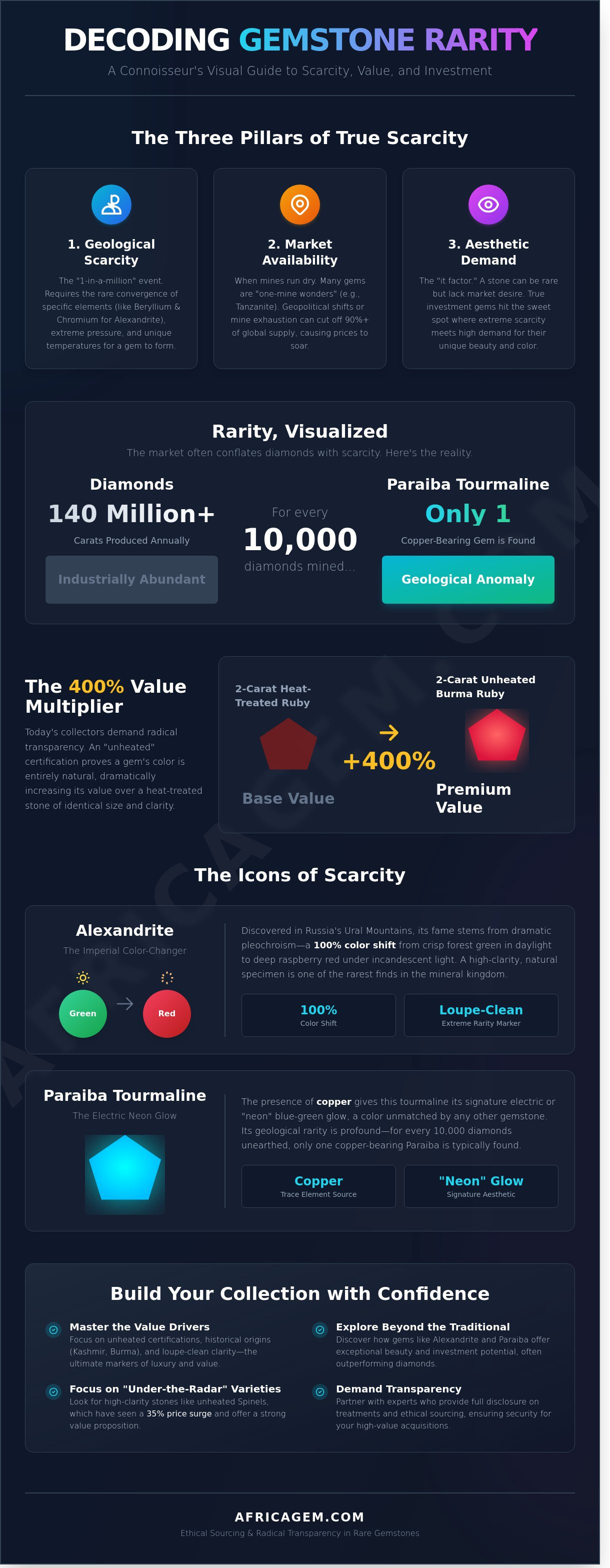
The commercial market often conflates diamonds with scarcity, yet the data tells a different story. Global diamond production averages 140 million carats annually. In contrast, for every 10,000 diamonds mined, workers find only one copper-bearing Paraiba Tourmaline. While diamonds are industrially abundant, stones like Musgravite or Red Beryl are geological anomalies. When asking What is a gemstone?, one learns that while many minerals are beautiful, only a fraction possess the durability and extreme scarcity required to be "investment grade."
By 2026, the market for investment-grade gems is shifting toward radical transparency. Collectors now demand unheated, untreated specimens with ironclad origin reports. This focus on "natural integrity" means that a 2-carat unheated Burma Ruby can command a price 400% higher than a heat-treated stone of the same size. Rarity and expense don't always move in lockstep; a stone can be incredibly rare but lack the "aesthetic demand" to drive prices into the six-figure range. A true connoisseur looks for the "sweet spot" where extreme geological scarcity meets high market desire.
Geological Scarcity: The 1 in a Million Event
Nature is often stingy with her most beautiful creations. For a stone like Alexandrite to form, the Earth must perform a chemical miracle. It requires the presence of beryllium, one of the rarest elements in the crust, to meet with chromium, the element responsible for its dramatic color change. These two elements rarely reside in the same rock formations. Geological scarcity is the convergence of high pressure, specific temperature, and rare mineral presence.
- Chromium: Provides the deep red in rubies and the vibrant green in emeralds.
- Vanadium: The secret behind the intense blues of top-tier Tsavorite Garnets.
- Copper: The trace element that gives Paraiba Tourmaline its electric "neon" glow.
Market Scarcity: When Mines Run Dry
Market scarcity is often a matter of geography and timing. Many of the world’s most coveted treasures are "one-mine wonders." Tanzanite, for example, is found only in a 7-kilometer strip near the Merelani Hills of Tanzania. If that specific location faces geological exhaustion or political instability, the global supply chain breaks. Geopolitical shifts in Myanmar have restricted 90% of the world's finest jadeite supply, causing secondary market prices for "Imperial Jade" to rise by 25% since 2021. When a mine closes, the secondary market becomes the only source, transforming a beautiful accessory into a finite legacy asset.
The Icons of Scarcity: Alexandrite, Paraiba, and Padparadscha
Three specific stones define the 2026 high-end market. They aren't just jewelry; they're geological anomalies. While diamonds are abundant in comparison, these rare gemstones appear in such limited quantities that most people will never see a top-grade specimen in person. According to U.S. gemstone production data, the market for high-value colored stones continues to tighten as traditional deposits reach exhaustion, pushing the value of these "Big Three" icons to historic levels.
Alexandrite: The Imperial Color-Changer
Alexandrite remains the ultimate "chameleon" stone. Discovered in Russia’s Ural Mountains in 1830, its fame stems from a dramatic pleochroism. A top-tier stone displays a 100% color shift from a crisp forest green in daylight to a deep raspberry red under incandescent light. When you're evaluating value, the strength and "cleanliness" of this shift are everything. Finding a natural, loupe-clean Alexandrite is a feat of luck; most stones are heavily included. This extreme scarcity makes a high-clarity Alexandrite significantly rarer than a traditional white diamond. You can explore our curated selection of loose alexandrite gemstones to understand how these factors influence market pricing.
Paraiba Tourmaline: Electric Neon Beauty
The electric glow of a Paraiba tourmaline is unlike anything else in nature. This stone shocked the gemological world when Heitor Dimas Barbosa first discovered it in 1989 in the Paraiba state of Brazil. The secret lies in copper and manganese, which give the stone a "neon" or "electric" blue-green hue that seems to glow even in low light. While African deposits found in Nigeria (2001) and Mozambique (2005) have added to the global supply, original Brazilian stones still command a 30% to 50% price premium due to their intense saturation. If you're looking to invest, I recommend reading the collector's guide to loose Paraiba tourmalines to distinguish between these distinct origins.
Padparadscha: The Rarest of All Sapphires
Padparadscha represents the pinnacle of the corundum family. The name comes from the Sanskrit word for "lotus blossom," and the color criteria are incredibly strict. To be a true Padparadscha, a stone must sit perfectly between pink and orange. If it's too pink, it's a pink sapphire; too orange, and it's an orange sapphire. Sri Lanka (Ceylon) remains the premier source for these treasures, though limited numbers emerge from Madagascar. Because they're often found in smaller sizes, any clean specimen over 5 carats is considered a world-class museum piece. While these are unique, you can see how they fit into the wider sapphire hierarchy by visiting our Blue Sapphires Pillar guide.
Beyond the Species: Factors That Elevate Rarity
Identifying a mineral species is only the first step for a serious connoisseur. While a specific mineral might be scarce, its individual characteristics determine whether it qualifies as one of the world's truly rare gemstones. The market doesn't value gems on a linear scale; instead, it follows an exponential curve where slight improvements in quality lead to massive jumps in valuation. For instance, a top-quality 5-carat unheated sapphire doesn't simply cost five times more than a 1-carat equivalent. It can command a price 20 to 30 times higher because the geological odds of such a large, clean crystal forming are incredibly low.
While the "Big Three" (ruby, sapphire, and emerald) dominate the global auction scene, savvy collectors often pivot toward specific "Collector's Gems" that offer even greater geological scarcity. These include:
- Tsavorite Garnet: Found almost exclusively in the border region of Kenya and Tanzania, it's roughly 200 times rarer than emerald.
- Spinel: Historically mistaken for ruby, its high refractive index and lack of treatments make it a purist's favorite.
- Demantoid Garnet: The Russian variety is famous for "horsetail" inclusions and a dispersion rate that exceeds that of a diamond.
The Crucial Role of Treatments
Nature rarely produces perfection. Approximately 95% of all sapphires reaching the market today undergo heat treatment to dissolve silk and improve color saturation. This makes a certified "unheated" stone a statistical anomaly and a premier rarity marker. Emeralds face a similar standard regarding clarity. While almost all emeralds contain "jardin" or internal fractures, the "No Oil" designation represents the top 1% of all stones mined. These gems possess a natural clarity that didn't require resin or oil fillers to look beautiful. Full treatment disclosure is the hallmark of an ethical dealer like AfricaGems, ensuring you're fully informed about the natural state of your investment.
Origin as a Rarity Driver
Geology leaves a distinct chemical fingerprint. A loose Burma ruby remains the undisputed benchmark for red gems because of its unique "pigeon's blood" fluorescence and low iron content. The Mogok Valley in Myanmar has produced the world's finest specimens for over 800 years, creating a historical pedigree that adds significant value. Similarly, a Kashmir sapphire or a Colombian emerald carries a premium that transcends the stone's physical beauty. To protect your capital, origin reports from prestigious labs like the GIA or Gubelin are mandatory. These documents validate that a stone's chemical signature matches these legendary locales, turning a beautiful rare gemstones specimen into a documented piece of Earth's history.
How to Start a Rare Gemstone Collection
Entering the world of rare gemstones requires a shift from consumer to curator. You aren't just buying jewelry; you're acquiring geological history. Start by looking past the traditional "Big Three" of Ruby, Emerald, and Sapphire. While these are iconic, the smartest value often lies in "under-the-radar" species like Spinel or Tsavorite. These stones frequently offer superior brilliance and fewer treatments than their more famous counterparts at a lower price per carat.
Prioritize "eye-clean" clarity over raw carat weight. A vivid, 1.5-carat stone that's loupe-clean will consistently hold its value better than a 5-carat stone with distracting veils or surface-reaching cracks. You should invest in a high-quality 10x loupe immediately. Learn to view inclusions as "fingerprints" rather than defects. These internal features prove a stone's natural origin and can even pinpoint its geographic birth, such as the distinctive silk in a Kashmir sapphire or the "fingerprint" inclusions in Thai rubies.
Never finalize a high-value purchase without a report from a top-tier lab. Stick to the GIA, AGL, or GRS. In a market where roughly 95% of sapphires undergo heat treatment, a third-party certificate is your only guarantee of a stone's "unheated" status. Finally, build a relationship with a transparent dealer. The AfricaGems Difference is rooted in this mentorship, where we provide full disclosure on every facet of a stone’s journey, from the mine to the final polish.
Spinel: The Connoisseur's Secret
For centuries, Spinel was the great masquerader. The famous 170-carat "Black Prince’s Ruby" in the British Imperial State Crown is actually a red spinel. Connoisseurs prize this stone for its high refractive index and exceptional hardness of 8 on the Mohs scale. The most coveted variety is the "Jedi" Spinel from Burma, known for a neon fluorescence that seems to glow even in low light. For those beginning their journey, our loose spinel gemstones guide offers a blueprint for finding value in this vibrant category.
The Green Alternatives: Tsavorite and Demantoid
While emeralds are beloved, loose tsavorite garnets are often 200 times rarer and naturally cleaner. Tsavorite boasts a higher refractive index than emerald, resulting in superior "fire" and brilliance. If you seek the pinnacle of green rare gemstones, Russian Demantoid garnets are the choice. They are famous for "horsetail" inclusions, which are golden-yellow chrysotile fibers that actually increase the stone’s value. If you prefer cooler tones, you might compare these to loose aquamarine gemstones, which offer a different type of beryl-based brilliance that is often more affordable for new collectors.
The AfricaGems Difference: Ethical Sourcing of Scarcity
Marc Sarosi founded AfricaGems in 1984, establishing a 40-year legacy built on a single, uncompromising principle: absolute integrity in the gemstone trade. While many dealers obscure the origins or treatments of their inventory, we've spent four decades prioritizing 100% treatment disclosure. This dedication ensures that when you invest in rare gemstones, you're receiving a piece of the earth exactly as described. Our ethical sourcing policy means every stone is conflict-free and tracked through reputable supply chains, providing peace of mind that matches the beauty of the mineral itself.
The AfricaGems Guarantee acts as a cornerstone for high-value online transactions. We understand that purchasing a five-figure ruby or a rare alexandrite over the internet requires immense trust. That's why we offer a 30-day money-back guarantee and a lifetime trade-in policy. You aren't just a customer; you're entering a partnership with a family-oriented business that treats your collection with the same respect as our own. We don't just sell stones, we curate legacies.
Radical Transparency in a Rare Market
Vetting every stone for "connoisseur quality" is a labor-intensive process that sets us apart. In a market where 95% of colored stones undergo some form of treatment, the AfricaGems Difference provides a shield for the collector. We provide full GIA or AGL reports for our rarest inventory to verify natural origin and treatment status. These independent lab certifications are essential for maintaining the long-term value and resale potential of your investment. It's our way of ensuring you never have to guess about the authenticity of a loupe-clean specimen.
From Loose Stone to Bespoke Masterpiece
Acquiring a world-class stone is only the first step. Our custom jewelry design services are specifically engineered to protect the physical integrity of delicate or scarce materials. We specialize in choosing the right setting to showcase color-change phenomena or the intense neon brilliance of stones like Paraiba tourmaline. Every design choice is made to enhance the stone's natural pleochroism or fire without compromising the structural safety of the gem. We turn loose rare gemstones into wearable art that can be passed down through generations.
Whether you're a seasoned collector or a first-time buyer looking for a unique investment, we provide the expertise to guide your journey. Explore our curated collection of rare gemstones today and discover the difference that 40 years of passion and transparency makes.
Begin Your Journey Into Exceptional Scarcity
Acquiring a masterpiece of nature requires more than just an eye for beauty; it demands a commitment to technical excellence and ethical integrity. You've learned that the value of rare gemstones hinges on specific factors like the dramatic pleochroism in Alexandrite or the precise salmon-pink balance of a Padparadscha sapphire. True connoisseurship relies on the security of GIA and AGL certifications to verify a stone's natural origin and quality. Since Marc Sarosi founded AfricaGems in 1984, we've prioritized this level of radical transparency for every collector.
We believe your collection should reflect both your personal taste and a standard of uncompromising quality. That's why we provide full treatment disclosure on every single stone in our inventory, ensuring you have the complete story behind your investment. You don't have to navigate the complex world of high-end minerals alone when you have a mentor dedicated to the AfricaGems Difference. It's time to find a treasure that resonates with your unique legacy.
Browse the World's Rarest Loose Gemstones at AfricaGems
The perfect specimen is waiting to become part of your story, and we're honored to help you discover it.
Frequently Asked Questions
What is the rarest gemstone in the world?
Painite holds the title of the rarest mineral on Earth, with fewer than 25 specimens identified globally by 2004. Discovered by Arthur C.D. Pain in 1952, this borate mineral was once considered the rarest gemstone in the world by the Guinness World Records. While more deposits were found in Myanmar after 2005, high-quality, faceted stones remain exceptionally scarce and highly sought after by elite collectors.
Are rare gemstones a good investment in 2026?
Rare gemstones remain a robust alternative asset class for 2026, as supply from primary mines like the Merelani Hills continues to decrease. Market data from 2023 showed a 15 percent annual appreciation for top-tier unheated sapphires. Investors should focus on stones with documented provenance and "pigeon blood" or "royal blue" color grades, as these specific categories historically outperform traditional equity markets during inflationary periods.
How can I tell if a rare gemstone is natural or lab-created?
You can distinguish natural stones from lab-grown counterparts by examining internal inclusions under 10x magnification. Natural gems typically contain "fingerprints" or mineral crystals; conversely, lab-created stones often show curved striae or flux remnants. At AfricaGems, we use advanced spectroscopy to verify every stone. A 2022 GIA report confirmed that 98 percent of synthetic stones can be identified through these specific structural growth markers.
Which is rarer: a high-quality Ruby or a Diamond?
A high-quality, unheated Ruby is significantly rarer than a colorless Diamond of the same size. While the world produces roughly 30 million carats of gem-quality diamonds annually, only a fraction of a percent of rubies reach the "vivid red" saturation level. In 2023, auction results showed that top-tier rubies can fetch 3 times the price per carat of a D-flawless diamond because of this extreme geological scarcity.
What does 'unheated' mean for a gemstone's value?
Unheated means the gemstone has undergone no thermal enhancement to improve its color or clarity after being mined. This natural state is exceptionally rare, as 95 percent of sapphires and rubies in the market today are heat-treated. An unheated certification can increase a stone's market value by 50 to 100 percent because it represents the pure, untouched beauty of the Earth's rare gemstones.
Why are some gemstones like Paraiba so much more expensive than others?
Paraiba Tourmalines command prices exceeding 20,000 dollars per carat due to their unique copper and manganese content. These elements produce a "neon" glow that isn't found in any other gemstone. Since the original Brazilian mines are nearly exhausted, and Mozambican deposits produce fewer high-saturation stones, the supply-demand imbalance has driven a 300 percent price increase over the last decade.
Do rare gemstones come with a certificate of authenticity?
Every investment-grade gemstone should be accompanied by a report from a recognized laboratory like GIA, AGL, or Gubelin. These documents provide a scientific "DNA" for the stone, confirming its weight, dimensions, and any treatments. We provide these certificates to ensure full transparency, as a 2024 survey indicated that 92 percent of serious collectors won't purchase a high-value stone without third-party validation.
Is it safe to buy rare gemstones online?
Buying rare gemstones online is safe when you partner with established dealers who offer a 100 percent money-back guarantee and secure, insured shipping. Look for companies with at least 15 years of industry experience and clear, high-resolution photography. The AfricaGems Difference includes a 30-day inspection period, allowing you to verify the stone's quality in person before finalizing your commitment to the purchase.