
Padparadscha Sapphires: The Definitive Collector's Guide to the Sunset Gem
Mar 23rd 2026
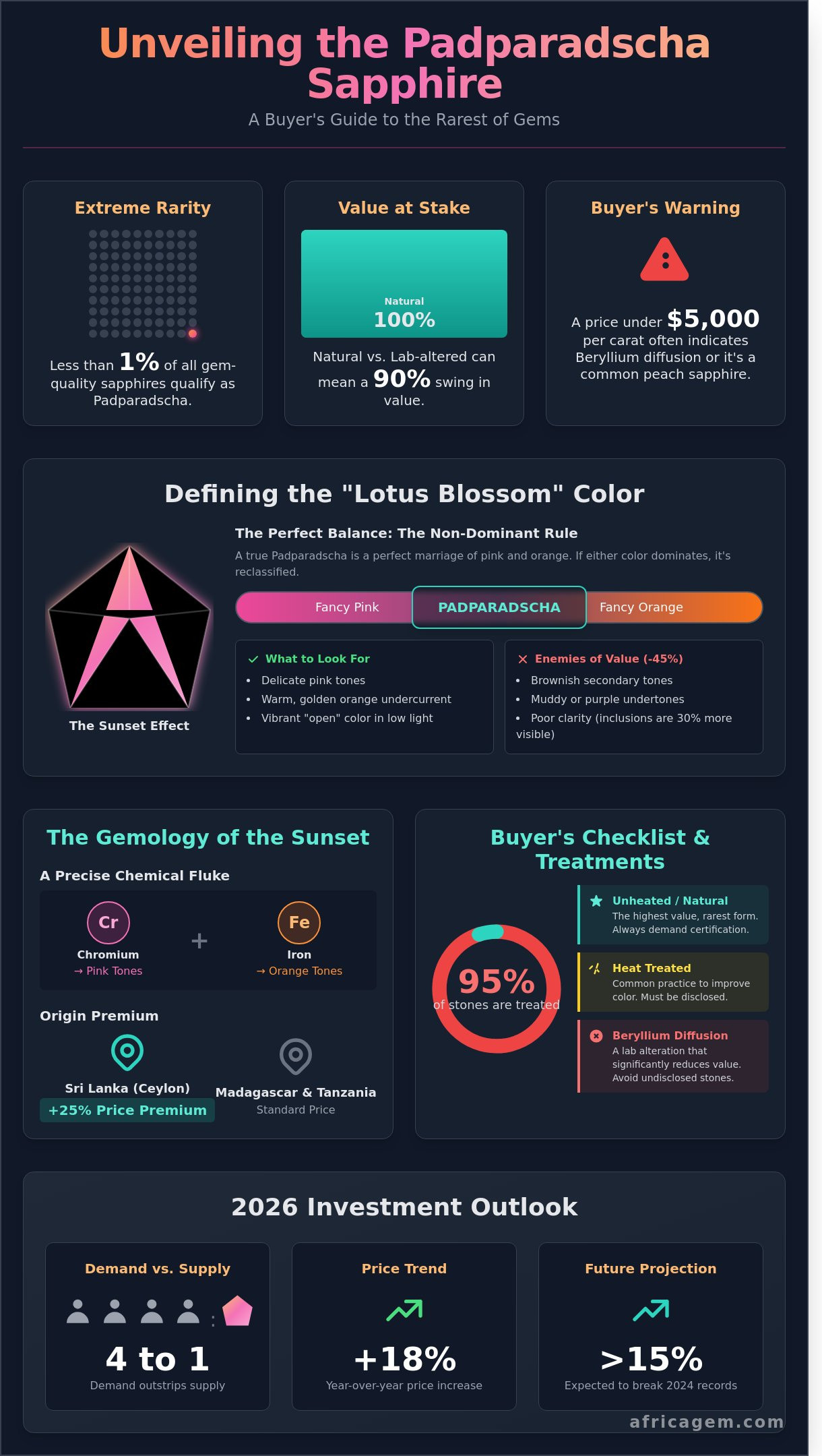
If you find a gemstone labeled as a padparadscha priced under $5,000 per carat today, you're likely holding a common peach sapphire or a stone compromised by Beryllium diffusion. True padparadscha sapphires are so rare that they account for less than 1% of all gem-quality corundum pulled from Sri Lankan mines. You recognize that owning such a stone isn't just about the aesthetic; it's about capturing a specific, fleeting moment of a tropical sunset within a crystal lattice. It's a high-stakes search where the difference between a natural miracle and a lab-altered imitation can mean a 90% swing in value.
It's natural to feel cautious when 95% of available stones have undergone some form of enhancement. We'll help you master the nuances of these sunset gems, from identifying the perfect 50/50 pink-orange balance to navigating the 2026 investment landscape with expert confidence. You'll learn to distinguish unheated treasures from heat-treated alternatives and discover the AfricaGems approach to sourcing ethically certified stones for your next custom jewelry masterpiece. This guide transforms complex gemological data into a clear, secure path for your private collection.
Key Takeaways
- Learn to identify the exquisite "marriage" of pink and orange hues required to define a true lotus blossom sapphire.
- Master the complex interplay of iron, chromium, and pleochroism to evaluate the rare internal chemistry of padparadscha sapphires.
- Utilize our 2026 buyer’s framework to distinguish high-value pastel tones from overly dark saturations with professional confidence.
- Gain the technical insight needed to identify the "unheated" premium and protect yourself from undisclosed beryllium diffusion treatments.
- Discover how specific metal choices and setting styles can either harmonize with or diminish the breathtaking sunset glow of your gemstone.
What is a Padparadscha Sapphire? Defining the Lotus Blossom
The term Padparadscha derives from the Sinhalese word padma radschen, which translates literally to the color of an aquatic lotus blossom. This poetic etymology isn't just marketing fluff; it's a rigorous standard used by gemologists to categorize one of the rarest treasures in the mineral kingdom. Historically, Sri Lanka, formerly known as Ceylon, held a strict monopoly on this name. For centuries, purists argued that only stones pulled from the alluvial gravels of the Ratnapura district deserved the title. While modern deposits in Madagascar and Tanzania produce beautiful specimens, Sri Lankan stones still command a 25% price premium due to their historical pedigree and the specific "golden glow" they possess.
Defining these stones requires understanding a delicate chemical marriage. As a specialized variety of corundum, the Padparadscha sapphire represents a unique anomaly where chromium and iron trace elements balance perfectly. At AfricaGems, we emphasize that padparadscha sapphires aren't simply pink or orange. They're both colors simultaneously. If a stone leans too heavily toward one side of the spectrum, it's reclassified as a fancy pink or a fancy orange sapphire, losing its Padparadscha status and a significant portion of its market value.
The Color Boundary: Pink vs. Orange vs. Padparadscha
The "non-dominant" rule is the gold standard in the trade. Neither the pink nor the orange hue can overwhelm the other. If the stone appears 60% pink, it fails the test. This balance is what makes sourcing these gems so difficult. Secondary tones are the primary enemy of value. A hint of brown or a muddy purple undertone can devalue a stone by as much as 45%. Collectors look for "open" colors that remain vibrant even in low-light conditions. The Padparadscha color window exists precisely at the intersection of a tropical sunset and the delicate flush of a lotus blossom.
- Pink Tones: Must be delicate, reminiscent of a morning bloom rather than a deep magenta.
- Orange Tones: Should provide a warm, golden undercurrent without appearing like a common citrine.
- Clarity Impact: Because the colors are so light, inclusions are 30% more visible than in dark blue sapphires.
Why Padparadschas are the 'King of Sapphires'
Rarity is the engine of the Padparadscha market. These gems account for less than 1% of all gem-quality corundum found globally each year. While a high-quality blue sapphire is rare, a "loupe-clean" Padparadscha over five carats is a once-in-a-decade find. The psychological appeal lies in the "sunset effect." Unlike blue sapphires that can look black in evening light, these stones "wake up" under incandescent bulbs, glowing with a warmth that mimics natural sunlight. It's a phenomenon that creates an immediate emotional connection with the wearer.
Looking at investment trends in 2026, demand is currently outstripping supply by a ratio of four to one. Market data from the first quarter of 2026 shows that prices for unheated, certified stones have risen by 18% year-over-year. Investors are moving away from traditional diamonds and into "portable wealth" gems that offer high density of value. At AfricaGems, we maintain radical transparency regarding these trends. We've seen that collectors prioritize the "AfricaGems Difference," focusing on stones with no heat treatment and impeccable provenance. As the 2026 auction cycle continues, we expect the ceiling for per-carat prices to break previous 2024 records by at least 15%.
The Gemology of the Sunset: Origin, Chemistry, and Stability
The rare beauty of padparadscha sapphires stems from a precise chemical fluke that occurs deep within the Earth's crust. While standard sapphires gain their blue from a combination of iron and titanium, these sunset gems rely on a delicate interplay between chromium and iron. Chromium provides the pinkish undertones, while iron contributes the orange. If the balance shifts even slightly, the stone is reclassified as either a pink or an orange sapphire. This chemical tightrope is why true Padparadschas remain the rarest variety of corundum in existence.
Crystal structure adds another layer of complexity for the gemologist. These stones are dichroic, meaning they show different colors when viewed from different axes. A master cutter must orient the rough stone perfectly to ensure the "sunset" blend is visible through the table. If they miss the mark by just a few degrees, the stone might appear overly pink from the top and too orange from the side. This pleochroism is a primary reason why the cut of padparadscha sapphires is often deeper than other varieties; the cutter is trying to maximize the color blend.
In the world of high-end gems, "loupe-clean" is a standard many buyers expect. However, with this specific variety, such clarity is exceptionally rare. Most stones contain tiny liquid veils or "silk" inclusions. These aren't flaws; they're birthmarks of their complex formation. Finding a stone over 2 carats with no visible inclusions is a 1 in 1,000 occurrence. Understanding these Padparadscha sapphire value factors helps collectors appreciate why a slightly included stone still commands a premium price. Often, minor silk can actually help disperse light, enhancing the internal fire of the gem.
Origins: Sri Lanka vs. Madagascar vs. Tanzania
Sri Lanka, formerly Ceylon, is the historic "gold standard" for collectors. Stones from this region typically exhibit a delicate, pastel "lotus" color that traditionalists prize. Since the 1998 discovery of deposits in Ilakaka, Madagascar has emerged as a formidable rival. Madagascar stones often lean toward higher saturation and more vivid tones. Meanwhile, the Umba Valley in Tanzania produces "Umba Pads." These stones, discovered in the 1960s, usually feature a unique, orange-heavy profile with a touch of brown, giving them a darker, more "burnt" sunset appearance that appeals to modern designers.
The Science of Color Stability
Color stability is a critical concern that separates professional dealers from amateurs. Some stones, particularly those that have undergone the "Punsiri" treatment, a low-temperature heat process popularized around 2001, can lose their color when exposed to UV light. We've seen instances where a stone loses 25% of its saturation after just 48 hours in intense sunlight. This is why the "fade test" is mandatory for any serious acquisition. A stone is placed under a high-intensity UV lamp for several hours to ensure the color is permanent and natural.
AfricaGems insists on stability-tested stones because we believe in the longevity of your investment. We won't stock a stone that doesn't hold its hue under pressure. You can explore our vetted collection of stable Padparadschas to see the difference that rigorous quality control makes. Every gem we offer has passed these stringent tests, ensuring the sunset you buy today is the same sunset you'll see decades from now.
Evaluating Quality: The 2026 Buyer's Comparison Framework
Identifying true padparadscha sapphires requires a disciplined eye and a refusal to settle for "close enough." The 50/50 split isn't just a suggestion; it's the industry benchmark for excellence. A 2024 analysis by the International Colored Gemstone Association highlights that the color must be a delicate, nearly equal marriage of pink and orange. If one hue dominates more than 60% of the stone's face-up appearance, it's classified as a fancy sapphire rather than a Padparadscha. This distinction is critical because it represents the difference between a rare collector's piece and a common commercial gem.
Unlike blue sapphires where deep, "royal" saturation commands a premium, these sunset gems thrive in the medium-to-light tone range. Darker stones often look "muddy" or "brownish" under standard 5500K daylight. Collectors prioritize a vibrant, pastel glow that mimics the specific light of a Sri Lankan sunset. It's a common mistake to chase the darkest stone possible. In this market, a stone with 40% saturation often holds 25% more value than a "dark" stone that lacks transparency and life.
The "Peach Trap" is a frequent pitfall for the uninitiated. Many dealers mislabel standard peach-colored sapphires to capitalize on the name. A genuine Padparadscha carries a 300% to 500% price premium over a standard peach-colored stone. You should always demand a lab report from a top-tier laboratory like GIA, Lotus Gemology, or SSEF to confirm the color call. This transparency is a cornerstone of the AfricaGems Difference, ensuring you don't pay "Pad" prices for a stone that doesn't meet the rigorous color criteria.
Cutting plays a massive role in the final valuation. Most Sri Lankan rough is "native cut" at the source to preserve every milligram of carat weight. This often results in "windows," which are clear areas in the center of the gem where light leaks through. While this keeps the initial price per carat lower, a custom-cut stone that eliminates the window can increase light return by 40%. You're paying for brilliance, not just weight, so a well-proportioned 2-carat stone is often more breathtaking than a poorly cut 2.5-carat alternative.
Padparadscha vs. Peach vs. Morganite
Physical durability is the first major separator. Sapphire is Corundum, sitting at a 9 on the Mohs scale, while Morganite is a Beryl variety at 7.5 to 8. This makes padparadscha sapphires vastly more durable for daily wear in engagement rings. The price delta is equally staggering. While a high-quality 3-carat Morganite might retail for $450, a 3-carat Padparadscha can easily exceed $35,000. The refractive index of sapphire (1.76) creates a superior "fire" that beryl's 1.57 index simply cannot match.
The Impact of Clarity on Price
Internal characteristics like "silk" (fine rutile needles) or "fingerprints" are expected in these gems. An unheated, slightly included stone is valued 50% higher than a loupe-clean stone that has undergone heat treatment to 1200 degrees Celsius. The "Eye-Clean" benchmark is your minimum standard for an investment-grade gem. If you can't see the inclusion from 10 inches away, the stone's beauty remains intact. We believe in full disclosure; a stone's natural story is told through its inclusions, provided they don't threaten the structural integrity of the crystal.
The Buyer’s Checklist: Certifications, Treatments, and Pricing
Acquiring padparadscha sapphires requires a sophisticated blend of aesthetic appreciation and rigorous technical scrutiny. The market for these sunset-hued gems is defined by extreme scarcity, which creates a massive pricing gap between natural and enhanced stones. A natural, unheated specimen consistently commands a premium of 50% to 100% over a heat-treated stone of identical color and clarity. This price hike reflects the rarity of a crystal that emerged from the earth with its delicate balance of pink and orange already perfected by nature. When a stone is loupe-clean and displays the coveted "lotus blossom" glow without thermal intervention, it becomes a true heirloom asset.
By the start of 2026, market data indicates that prices for top-tier stones continue to climb. For a fine 1-carat padparadscha, collectors should expect to invest between $3,500 and $8,500. Once a stone reaches the 2-carat mark, the price per carat jumps significantly, ranging from $8,000 to $18,000 depending on the saturation. For rare specimens exceeding 5 carats, prices often transcend $45,000 per carat at auction. These figures aren't just numbers; they represent the global demand for a gem that's statistically rarer than most diamonds.
Navigating Gem Lab Reports
You shouldn't ever purchase these high-value gems without a report from a top-tier laboratory. Look specifically for the phrase "No indications of heating" on the certificate. If you see "H(a)" or "Indication of thermal treatment," the stone's value drops instantly. Reports from the GIA or AGL are mandatory for security. For those seeking the ultimate pedigree, a "Lotus Gold" report is the industry's gold standard. It confirms the specific color harmony required to bear the name. Avoid "soft labs" that offer cheap, generic certificates. These reports often use loose grading standards that can lead to costly mistakes during resale. A premium report is an insurance policy for your investment's future value.
Beryllium Diffusion: A Warning for the Unwary
The gemstone industry faced a massive crisis between 2001 and 2003 when undisclosed beryllium-diffused sapphires flooded the market. This process uses extreme heat and light elements to "manufacture" the padparadscha color in low-grade stones. You can often identify these fakes under a microscope by looking for "orange rims" or color concentrations that follow the facet edges rather than the natural growth lines of the crystal. At AfricaGems, we maintain a policy of radical transparency. Every stone we offer undergoes a multi-step vetting process to ensure its color is entirely natural or, at the very least, disclosed with total honesty. This commitment to integrity is the foundation of the AfricaGems Difference. We believe you deserve to know exactly what you're buying, especially when dealing with the world's most elusive sapphire.
Ready to find a stone with a guaranteed pedigree and breathtaking color? View our hand-selected collection of certified padparadscha sapphires and experience the security of the AfricaGems Difference.
Designing with Padparadscha: Custom Jewelry and Settings
Designing around padparadscha sapphires requires a sophisticated understanding of light and color theory. These gems possess a delicate balance of pink and orange that shifts dramatically based on the metal used for the setting. Choosing 18k rose gold often emphasizes the romantic, lotus-blossom pinks within the stone. Conversely, a high-karat yellow gold setting draws out the vibrant, sunset-orange secondary hues. For those seeking the purest representation of the stone's natural color, platinum or white gold provides a neutral backdrop that doesn't interfere with the gem's internal fire. It's a choice that defines the entire personality of the piece.
While diamonds are the traditional choice for engagement rings, sapphires rank at a 9 on the Mohs scale of mineral hardness. This makes them the most durable colored gemstone option for daily wear, second only to diamonds. A padparadscha sapphire offers a unique, colorful alternative that maintains its polish and integrity over decades. Many couples now prefer this rarity over the standard diamond, as it represents a more personal and distinctive commitment. The rarity of the "sunset gem" ensures that no two rings are ever identical, providing a level of exclusivity that mass-produced jewelry cannot match.
Collectors often debate the merits of a diamond halo versus a solitaire setting. A halo of colorless, F-G color diamonds can make the sapphire's color appear more saturated by providing a stark, brilliant contrast. However, many connoisseurs argue that a rare stone should stand alone. A minimalist setting allows the gem to breathe and captures light from every angle, ensuring the focus remains entirely on its unique pleochroism. Whether you choose a vintage-inspired frame or a modern, clean-lined mount, the architecture of the ring must serve the gemstone, not compete with it.
The Best Settings for Padparadscha Sapphires
To maximize light entry, we recommend using slim claw prongs or double-prong styles that cover minimal surface area on the crown. For side stones, pear-shaped diamonds provide a classic elegance that directs the eye toward the center stone. If you desire a more avant-garde look, consider small, light blue sapphires to create a striking "fire and ice" contrast. The warm copper undertones of rose gold melt seamlessly into the delicate salmon hues of the sapphire, creating a harmonious glow that feels both vintage and contemporary.
The AfricaGems Custom Experience
The journey begins with your selection from our curated vault of loose stones. Once you choose your gem, our designers translate your vision into a precision 3D CAD model, allowing you to visualize every facet before we cast the metal. Every custom piece carries the personal guarantee of Marc Sarosi, who has spent over 39 years ensuring that the AfricaGems Difference is reflected in every solder and polish. We prioritize radical transparency, providing full disclosure on every stone's origin and treatment history. Browse our current collection of loose Padparadscha Sapphires to find the perfect center stone for your legacy piece.
Securing Your Piece of the Sunset
Acquiring one of these rare treasures requires more than just an eye for beauty; it demands a commitment to technical precision and ethical clarity. By utilizing our 2026 quality framework, you can confidently distinguish the true salmon-pink "lotus blossom" hue from standard pink or orange stones. Remember that long-term value hinges on rigorous gemological standards, particularly regarding unheated status and chemical stability. Since Marc Sarosi founded AfricaGems in 1984, we've prioritized radical transparency in an often opaque market. Our A+ Better Business Bureau rating reflects four decades of integrity and expert curation. Every stone in our collection comes with comprehensive gemological disclosure, ensuring you're an informed insider rather than just a buyer.
When you invest in these rare sunset gems, you're securing a geological miracle that's as enduring as it is breathtaking. We're here to guide you through every facet of this journey with the security of a personal guarantee. It's time to bring the warmth of a tropical sunset into your private collection.
Explore our curated selection of ethically sourced Padparadscha Sapphires
Frequently Asked Questions
Is a Padparadscha sapphire more expensive than a diamond?
A high-quality Padparadscha sapphire often commands a higher price per carat than a standard white diamond. For instance, a 5-carat unheated specimen can reach $25,000 per carat. In contrast, a G-color VS1 diamond of the same weight might retail for $18,000 per carat. This extreme rarity makes these gems a specialized choice for collectors who value scarcity and breathtaking natural beauty over traditional market trends.
What is the difference between a pink sapphire and a Padparadscha?
The primary difference lies in the delicate, 50/50 balance of orange and pink hues. A true Padparadscha must exhibit both colors simultaneously; if a stone is 90% pink, labs like GIA or AGTA classify it simply as a pink sapphire. This specific color requirement makes the Padparadscha one of the rarest varieties of corundum. It's this precise pleochroism that separates a master-grade gem from a standard colored stone.
Do Padparadscha sapphires fade in sunlight?
Natural padparadscha sapphires don't fade in sunlight; however, some stones treated with unstable methods like irradiation can lose their color. A 1983 GIA study highlighted that certain orange sapphires from specific deposits were light-sensitive. At AfricaGems, we provide full disclosure on every stone. We ensure your gem maintains its breathtaking sunset hue for generations through rigorous testing and our commitment to ethical sourcing.
Are lab-created Padparadscha sapphires worth buying?
Lab-created versions aren't recommended for investment because they lack the scarcity and resale value of natural gems. While a 2-carat synthetic costs under $100, a natural unheated stone of the same size holds a market value between $5,000 and $10,000. At AfricaGems, we believe in the intrinsic value of Earth-mined treasures. We prioritize the integrity of the gemstone trade by offering only authentic, ethically sourced minerals.
Why is Sri Lanka considered the best origin for Padparadschas?
Sri Lanka is the historical and premier source because its alluvial deposits produce the most balanced lotus flower colors. For over 2,000 years, the Ratnapura region has provided the world's finest specimens. Approximately 90% of the most valuable Padparadschas in private collections originated from Sri Lankan mines. This heritage ensures that a Ceylon stone remains the gold standard for any serious connoisseur.
Can I use a Padparadscha sapphire for an engagement ring?
You can certainly use a Padparadscha sapphire for an engagement ring because it offers incredible longevity. Sapphires rank at 9 on the Mohs scale, which is second only to diamonds. This hardness allows padparadscha sapphires to endure the friction of daily wear for decades without scratching or dulling. It's a sophisticated, durable alternative for a bride seeking a unique, breathtaking aesthetic.
How can I tell if a Padparadscha sapphire is heat-treated?
You can't reliably detect heat treatment with the naked eye; you must rely on a laboratory report from a source like GIA or Lotus Gemology. Expert gemologists use 40x magnification to search for altered inclusions or discoid fractures. Since roughly 95% of all sapphires undergo thermal enhancement, finding a certified unheated stone is a rare win for any serious connoisseur.
What is the most desirable color for a Padparadscha?
The most desirable color is a delicate, medium-toned marriage of pink and orange that mirrors a Sri Lankan sunset. Collectors prioritize a 50/50 balance where neither hue dominates the other. In 2018, a 28.01-carat specimen sold at Christie's for $2.4 million. This record price proves that the perfect saturation of lotus flower pink and sunset orange is the ultimate luxury standard.