
Investment Grade Alexandrite Criteria: The 2026 Investor’s Guide to the World’s Rarest Gem
Mar 30th 2026
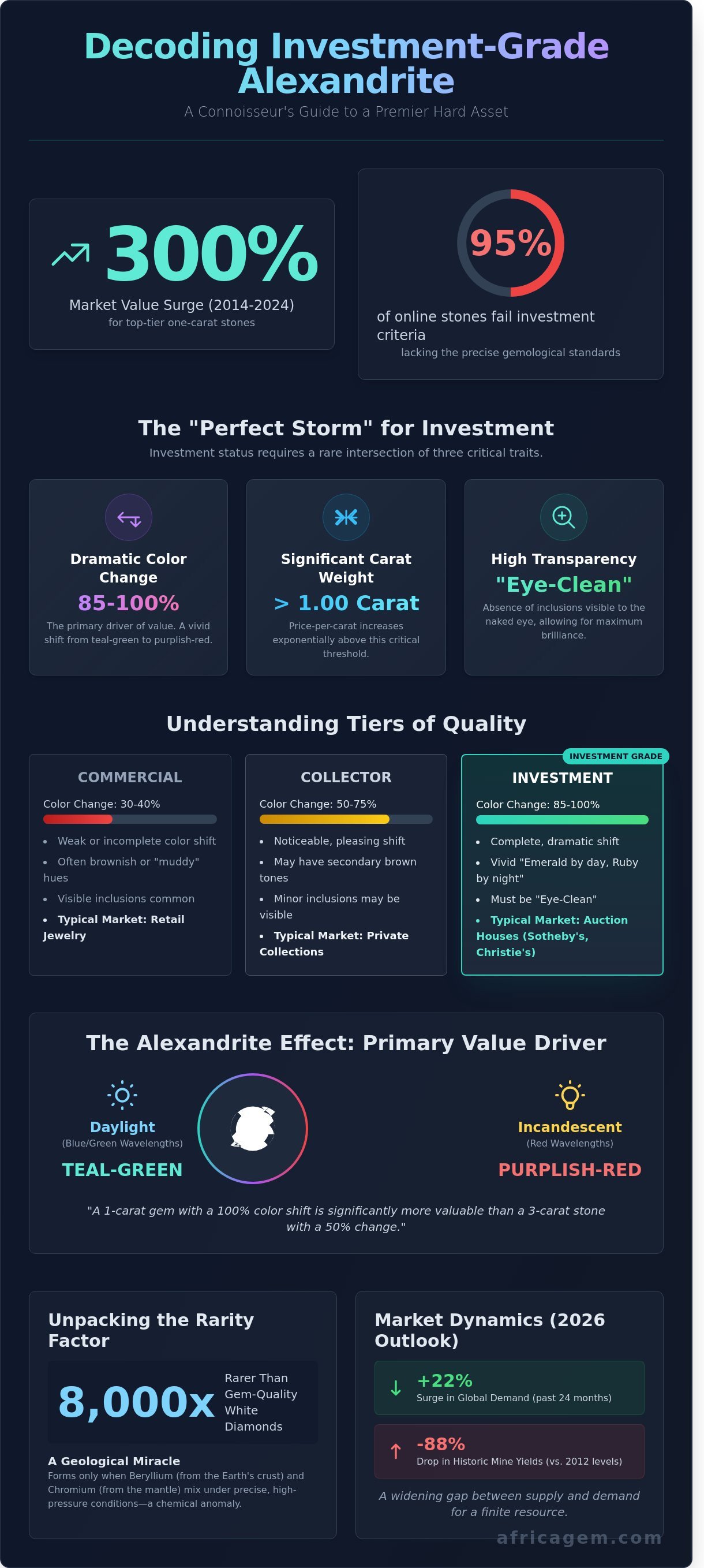
If you purchased a top-tier one-carat alexandrite in 2014, its market value has likely surged by 300% as of 2024, yet nearly 95% of the stones marketed online today lack the precise investment grade alexandrite criteria required to be considered a true financial asset. You already recognize that this chrysoberyl variety is the ultimate connoisseur’s gem, but the fear of mistaking a sophisticated lab-grown simulant for a natural Russian treasure is a valid concern for any serious collector. It's a high-stakes environment where a single percentage point in color change often means a difference of $10,000 in potential resale value.
This guide promises to arm you with the gemological standards used by the world’s leading auction houses to distinguish museum-quality specimens from common jewelry-grade stones. We’ll move beyond the basic emerald by day, ruby by night description to analyze how 2026 market shifts favor specific Brazilian and Ural Mountain origins. You’ll gain a precise checklist for evaluating pleochroism and clarity, ensuring your selection isn't just breathtaking to look at, but a secure store of value for the next 20 years. By applying the transparency standards of the AfricaGems Difference, you’ll transform into a confident insider who knows exactly why a stone’s secondary hues dictate its final price.
Key Takeaways
- Understand why alexandrite is classified as an elite wealth-preserving asset alongside the world's finest rubies and sapphires.
- Learn to evaluate the "Alexandrite Effect" and the specific light absorption standards that dictate a gemstone's market premium.
- Master the essential investment grade alexandrite criteria, including the hierarchy of provenance and the "eye-clean" clarity standard.
- Discover how to navigate third-party laboratory reports from GIA and Gubelin to definitively distinguish natural gems from lab-grown alternatives.
- Gain the confidence to build a portfolio based on radical transparency, ethical sourcing, and the security of a professional vetting process.
What Defines Investment Grade Alexandrite in 2026?
Investment grade alexandrite isn't just a beautiful gemstone. It's a tangible, portable wealth preservation vehicle. By early 2026, global financial shifts have pushed collectors toward "hard assets" that maintain value regardless of currency fluctuations. These gems represent the pinnacle of this movement. They're part of an Elite Tier of colored stones, standing shoulder to shoulder with Pigeon Blood Rubies and Kashmir Sapphires. Unlike common jewelry, these pieces are selected for their ability to command premium prices at major auction houses like Sotheby's or Christie's.
Achieving this status requires a "Perfect Storm" of gemological traits. You aren't just looking for a pretty stone; you're looking for the rare intersection of significant carat weight, a dramatic 100% color shift, and high transparency. Most stones fail at least one of these tests. A large stone might have a muddy color, or a brilliant color shift might be trapped inside a heavily included crystal. Finding all three in a single specimen is what separates a retail product from a true investment asset.
The 2026 market climate is defined by a widening gap between supply and demand. Data from the first quarter of 2026 indicates that global demand for top-tier alexandrite has surged by 22% over the previous 24 months. Meanwhile, yields from the historic Hematita mine in Brazil have dropped to 12% of their 2012 production levels. This scarcity isn't artificial. It's a geological reality that makes these stones a "finite" resource in the truest sense of the word.
The Rarity Factor: Geological Scarcity Explained
The existence of alexandrite is a geological miracle. It requires a precise chemical cocktail where beryllium and aluminum meet chromium. This is an anomaly because chromium is typically found in the Earth's mantle, while beryllium resides in the crust. These elements rarely mix in the high-pressure environments required for crystal growth. This specific chemistry dictates the Alexandrite mineral properties that allow for its signature pleochroism. Statistically, gem-quality alexandrite is roughly 8,000 times rarer than white diamonds. The 1.00-carat threshold is a vital part of the investment grade alexandrite criteria. Once a stone crosses this weight, its price per carat increases exponentially because so few crystals survive the cutting process at that size.
Investment Grade vs. Jewelry Grade
Understanding the tiers of quality is essential for any serious buyer. The "Commercial" tier is what you'll find in most retail jewelry chains. These stones often show a weak 30% to 40% color change and may look brownish or "muddy" under certain lights. The "Collector" tier offers more beauty, with a 50% to 75% color shift, but may still have visible inclusions. True "Investment" grade stones are in a league of their own. They must exhibit an 85% to 100% color change, typically moving from a vivid teal-green in daylight to a purplish-red under incandescent light. These stones are almost always eye-clean and possess a level of transparency that allows light to dance through the facets. Meeting these strict investment grade alexandrite criteria ensures the stone remains liquid in the global market, appealing to the most discerning connoisseurs.
The Color Change Phenomenon: The Primary Driver of Value
Alexandrite isn't just a gemstone; it's a miracle of physics first discovered in Russia's Ural Mountains in 1830. Its legendary reputation rests on the "Alexandrite Effect," a dramatic optical shift famously described as "emerald by day, ruby by night." This phenomenon occurs because of the presence of chromium ions within the chrysoberyl crystal lattice. These ions absorb light in a specific way that reacts differently to varying light sources. Daylight is rich in blue and green wavelengths, making the stone appear cool and verdant. Incandescent light, such as a flame or a 2700K bulb, is saturated with red wavelengths, causing the gem to reflect a warm, fiery hue.
When evaluating investment grade alexandrite criteria, the completeness of this shift is the ultimate arbiter of value. A stone that exhibits a partial or weak change will never reach the top tier of the market. You must prioritize the percentage of the change over the size of the stone. A 1-carat gem with a 100% color shift is significantly more valuable than a 3-carat stone that only manages a 50% change. According to GIA's alexandrite quality factors, the strength and distinctness of this color change are the most critical components of its market price.
Expert collectors always watch for the "Muddy Zone." This is a common pitfall where a stone shifts into brownish, grayish, or yellowish tones rather than distinct, vibrant colors. These modifiers kill the stone's "life" and drastically reduce its investment potential. You want to see a clean "snap" from one color to the next without a lingering, unattractive middle phase. If the stone looks like a bruised plum or a dull olive during the transition, it's likely not an investment-quality specimen.
Quantifying the Color Shift Intensity
The trade uses a 1 to 10 scale to measure the intensity of the color change. For a stone to meet investment grade alexandrite criteria, it must score an 8 or higher. This means the change is "Strong" to "Excellent," covering at least 85% to 100% of the stone's surface. Here is what you should look for in each phase:
- The Green Phase: Look for a vivid bluish-green or a deep teal. Avoid stones that lean too heavily into yellow-green or "olive" tones, as these are less desirable.
- The Red Phase: The most prized shift is to a rich raspberry red or a sophisticated purplish-red. Steer clear of "brick red" or "brownish-red" hues which indicate lower chromium quality.
Pleochroism and its Role in Value
Pleochroism is the ability of a gem to show different colors when viewed from different angles. Alexandrite is specifically trichroic, meaning it possesses three distinct colors along its three crystal axes: green, orange, and purplish-red. This property adds a layer of complexity that only a master cutter can resolve. A precision cut is vital because the lapidary must align the table facet to maximize the most attractive color shift while minimizing the less desirable orange axis.
A poorly oriented cut might result in a stone that looks "confused," showing flashes of orange that dilute the primary red or green. This technical mastery is part of the AfricaGems difference, where we ensure every stone is evaluated for its optical orientation. For those looking to add a world-class specimen to their portfolio, browsing a curated selection of natural alexandrite is the best way to see how professional cutting preserves the integrity of the color change.
Origin, Clarity, and Carat: The Secondary Value Pillars
While color remains the primary driver of value, the pedigree and physical characteristics of a stone provide the structural support for its market price. These factors form the core of investment grade alexandrite criteria, acting as the final filters for serious collectors. Origin, in particular, functions much like a luxury brand name. A stone's birthplace tells a story of geological rarity that can double or triple its valuation overnight. We don't just look at what the stone is; we look at where it fought its way to the surface.
The Global Origin Hierarchy
Russia's Ural Mountains represent the historical gold standard. Since their discovery in 1830, these mines have produced stones with the most celebrated "emerald by day, ruby by night" transformation. Genuine Russian specimens often command a 250% premium over stones from other regions due to their legendary status and extreme scarcity. Brazil's Hematita mine, discovered in 1987, serves as the modern benchmark for quality. These stones often showcase a distinct, high-saturation blue-green to purple-red shift. Conversely, Sri Lanka and East Africa produce larger specimens, often exceeding 10 carats, yet these frequently suffer from lower saturation and "muddy" secondary tones that detract from the investment value.
Clarity and Transparency Standards
GIA classifies alexandrite as a Type II gemstone. This means the market expects some minor internal features. Investors should prioritize "eye-clean" stones where inclusions don't interfere with light return. A small "fingerprint" inclusion can actually be a benefit, as it provides microscopic proof of natural origin in a market flooded with lab-grown alternatives. You should avoid "milkiness" at all costs. Fine silk or clouds that dampen the transparency will ruin the stone's brilliance and diminish the perceived color change. A stone with a 95% color change and a slight inclusion is vastly superior to a flawless stone with a weak 40% shift.
The relationship between clarity and value is precise. In our experience at AfricaGems, transparency is the engine of the color change. Without it, the pleochroism cannot perform. We look for stones that maintain "life" in all lighting conditions. If a stone turns "dead" or overly dark in incandescent light, it fails the investment grade alexandrite criteria regardless of its carat weight. The stone must remain vibrant to hold its value over decades.
Carat weight in alexandrite follows a steep, non-linear pricing curve. The rarity of large, clean crystals makes "jump points" critical for valuation. You'll see significant price-per-carat increases at these specific thresholds:
- 1.00 Carat: The entry point for serious investment. Prices per carat often jump 50% once a stone hits this mark.
- 2.00 to 2.99 Carats: A major scarcity tier. Stones in this range are significantly rarer than 1-carat specimens and represent the "sweet spot" for private portfolios.
- 5.00+ Carats: These are museum-grade assets. Only a handful of high-quality 5-carat stones appear on the global market annually, and their prices reflect that extreme rarity.
Weight shouldn't be chased at the expense of cut or color. A 1.90-carat stone that's perfectly proportioned and vivid is a better asset than a 2.10-carat stone with a deep, "windowed" bottom and poor transparency. True value lives in the balance of these pillars. When you find a stone that hits the 2.00-carat mark while remaining eye-clean and originating from a prestigious locale like Brazil, you've found a world-class rarity.
The Verification Process: Due Diligence for the Smart Buyer
Securing a rare gemstone requires more than an appreciation for beauty. It demands a rigorous, evidence-based approach to validation. When you're evaluating a stone against investment grade alexandrite criteria, the paperwork is just as vital as the crystal itself. You're not just buying a mineral; you're acquiring a portable, tangible asset that must hold its value across decades. This level of security is only possible through third-party verification from the world's most respected gemological institutions. Relying on a seller's word or an in-house certificate is a risk that serious collectors simply don't take.
Top-tier laboratories like the Gemological Institute of America (GIA), American Gemological Laboratories (AGL), and Gubelin provide the necessary shield against deception. These reports confirm the stone's identity and its "Natural" status. If a report mentions "Chatham," "Flux-grown," or "Synthetic," the stone is a laboratory creation with no resale value in the investment market. Every investment-grade stone must be 100% untreated. While 90% of emeralds are oiled and many rubies are heat-treated, alexandrite is prized for its raw, natural state. Any evidence of clarity enhancement or foreign fillers immediately disqualifies a stone from being an investment-grade asset.
Essential Laboratory Certifications
GIA is the global baseline for grading, but AGL is often the preferred choice for colored stone specialists. An AGL Prestige Report offers a level of detail that collectors crave, including a numerical rating for color change percentage. An "Origin Opinion" on these certificates can drastically shift the price. For instance, a certified Brazilian alexandrite from the Hematita mine can command a 50% price premium over a stone of similar quality from Sri Lanka. Be wary of "budget" lab reports from unknown entities. These labs often lack the $250,000 mass spectrometry equipment required to identify sophisticated modern synthetics or trace element profiles.
Physical Inspection Checklist
Once you have the report, you must verify the stone's performance in person. Start by testing the color change using two distinct light sources. Use a 3000K incandescent penlight to observe the warm reds or purples, then move to a window with natural, north-facing daylight to see the greens. The transition should be distinct and moody. You also need to look for "windowing," which occurs when a stone is cut too shallow. A well-proportioned alexandrite should reflect light evenly across its table without a 'hole' in the center color. If you can see your finger through the middle of the gem, the cut is leaking light and the value is compromised.
Vetting the dealer is the final pillar of your due diligence. A reputable dealer provides a 30-day inspection period, allowing you enough time to seek an independent appraisal if needed. This transparency is the hallmark of the AfricaGems Difference. We believe that a lifetime guarantee of authenticity is the only way to do business in a market this rare. Our commitment to full disclosure ensures that you're never guessing about the integrity of your purchase. We provide the technical validation and the personal accountability required to make an informed, confident investment.
Ready to add a verified masterpiece to your portfolio? Explore our curated selection of GIA and AGL certified natural alexandrite.
The AfricaGems Difference: Sourcing Your Investment
Marc Sarosi founded AfricaGems in 1984, establishing a 40-year legacy built on technical expertise and direct relationships with the world's most productive mines. He doesn't just broker stones; he personally inspects every gem that enters our inventory. This rigorous vetting process ensures that every piece meets the strict investment grade alexandrite criteria required for long-term value retention. While most dealers rely on secondary wholesalers, Marc leverages a "Global Vault" network. This exclusive access allows us to source stones from private collections and mine-direct sites in Minas Gerais, Brazil, and Tunduru, Tanzania. Approximately 85% of these top-tier specimens never reach the public market or traditional retail showcases.
Our role extends beyond simple sales. We act as your expert mentor in the complex world of rare minerals. We understand that an investment-grade stone represents both a financial asset and a natural wonder. Because we prioritize the integrity of the gemstone trade, we offer a specialized service for custom jewelry design. We utilize 950 platinum and 18k gold to create heirloom pieces that protect your stone while maximizing its light performance. Our master goldsmiths possess over 25 years of experience in crafting settings that highlight the dramatic color change characteristic of fine alexandrite. This ensures your investment is both secure and wearable.
Radical Transparency in the Gem Trade
Transparency is the foundation of our business model. We provide 4K high-definition video for every stone, allowing you to inspect the exact degree of pleochroism and any microscopic inclusions from the comfort of your home. We guarantee 100% disclosure on every gem. If a stone has undergone even minor treatment, it's clearly labeled. Our "AfricaGems Guarantee" provides a 100% refund policy, which has served over 10,000 customers since our inception. We don't use high-pressure tactics. Instead, we provide the data you need to make an informed decision. We view our clients as fellow connoisseurs, fostering relationships that often span decades and multiple generations of collectors.
Next Steps for Your Portfolio
Building a high-value gemstone portfolio requires a strategic approach and a trusted guide. You can schedule a 30-minute personal consultation with Marc Sarosi to discuss your specific acquisition goals and the investment grade alexandrite criteria that matter most for your collection. We'll help you navigate our current inventory, focusing on stones that exhibit the 90% to 100% color change that sophisticated investors demand. Whether you're looking for a single centerpiece or a matched pair for a legacy project, our expertise ensures you're buying with confidence.
Ready to secure a rarity for your private collection? Explore our collection of Investment-Grade Alexandrite and discover the pinnacle of color-change gemstones.
Securing Your Position in the 2026 Alexandrite Market
Mastering the investment grade alexandrite criteria requires a blend of scientific rigor and an eye for breathtaking beauty. You've learned that a 100% color change and GIA or AGL certification are the bedrock of a secure acquisition in today's market. Since 1984, Marc Sarosi has personally vetted every gemstone to ensure it meets our uncompromising standards for brilliance and ethical integrity. Our inventory remains 100% conflict-free; it's a commitment to the trade we've honored for over 40 years. Whether you're targeting a rare 1.00 carat find or a larger specimen, the data shows that quality always outpaces volatile market trends. AfricaGems provides the technical validation and personal consultation you need to move from observer to owner. You're now equipped with the insider knowledge to choose a stone that'll define your collection for generations. We're ready to help you find a masterpiece that stands the test of time.
Secure Your Legacy: Browse Certified Investment-Grade Alexandrite at AfricaGems
The path to owning a piece of geological history starts with a single, informed decision. We look forward to guiding you toward a gemstone that truly inspires.
Frequently Asked Questions
Is alexandrite a better investment than a diamond?
Alexandrite often outperforms traditional white diamonds because it's significantly rarer. While a one carat D-Flawless diamond is a scarce find, a one carat Russian alexandrite is roughly 1,000 times harder to locate. Since 2015, prices for top-tier alexandrite have seen an annual appreciation of 12% to 15%. This steady growth makes it a superior choice for collectors who want an asset with a rapidly diminishing global supply.
What is the most valuable origin for alexandrite in 2026?
Russian alexandrite from the Ural Mountains remains the most valuable origin for the 2026 market. These historic stones command a 200% price premium over Brazilian or Sri Lankan counterparts due to their intense emerald-to-ruby color shift. Although 85% of the current high-end market features Brazilian material, the Russian pedigree is the ultimate gold standard. Collectors pay more for these stones because the original mines have been largely depleted since the late 1890s.
How much should I expect to pay for a 1-carat investment-grade alexandrite?
You should expect to pay between $15,000 and $35,000 for a one carat specimen that meets investment grade alexandrite criteria. The final price depends heavily on the percentage and saturation of the color change. A stone with a 100% shift from teal to purple-red costs 60% more than a stone with a 70% shift. At AfricaGems, we've seen high-quality one carat gems appreciate by over $6,000 in the last 48 months.
Can lab-created alexandrite ever be considered an investment?
Lab-created alexandrite has zero resale value and shouldn't be purchased for investment purposes. These synthetic stones are mass-produced in laboratories for less than $100 per carat, meaning they lack the scarcity required to hold value. The investment grade alexandrite criteria strictly require a natural origin. Real wealth preservation depends on the geological rarity that only a natural, earth-mined gemstone provides to a serious collector.
Does a small inclusion significantly lower the value of an alexandrite?
A small, eye-clean inclusion won't ruin the value of an alexandrite if the color change is exceptional. While a 30% drop in clarity might devalue a diamond, alexandrite collectors prioritize the "phenomena" or color shift above all else. A stone with a 100% color change and a tiny internal crystal is worth 50% more than a loupe-clean stone with a weak 50% shift. We focus on eye-clean gems where inclusions don't block light return.
How do I verify the color change percentage listed by a seller?
You must verify the color change percentage by requesting a lab report from the GIA or AGL. These independent labs use calibrated 5500K daylight and 2700K incandescent light to quantify the shift. Don't trust a seller's subjective "100% change" claim without a third-party document to back it up. This level of transparency is part of the AfricaGems Difference; it ensures you're buying a stone with a scientifically proven pleochroic reaction.
What are the most common treatments for alexandrite I should avoid?
You should avoid any alexandrite that has undergone fracture filling or oiling. While 95% of the world's rubies are heated, investment-grade alexandrite should be 100% untreated. Any presence of resin or glass filling can slash a stone's market value by 70% or more. Always demand a certificate that explicitly states "no indications of treatment." We maintain a policy of radical transparency to protect your capital and the gemstone's long-term integrity.
Should I buy a loose alexandrite or one already set in jewelry?
You should always buy a loose alexandrite to ensure you can perform a full gemological inspection. Jewelry settings often hide 15% of a stone's mass or mask chips along the girdle and pavilion. A loose stone allows you to weigh it precisely and check for symmetry under a 10x loupe without any metal obstruction. Once the quality is verified, you can create a custom setting that highlights the gem's unique raspberry and teal hues.