
How Rare Is Tanzanite? The Science and Market Reality of a 'Generation Gem'
Apr 4th 2026
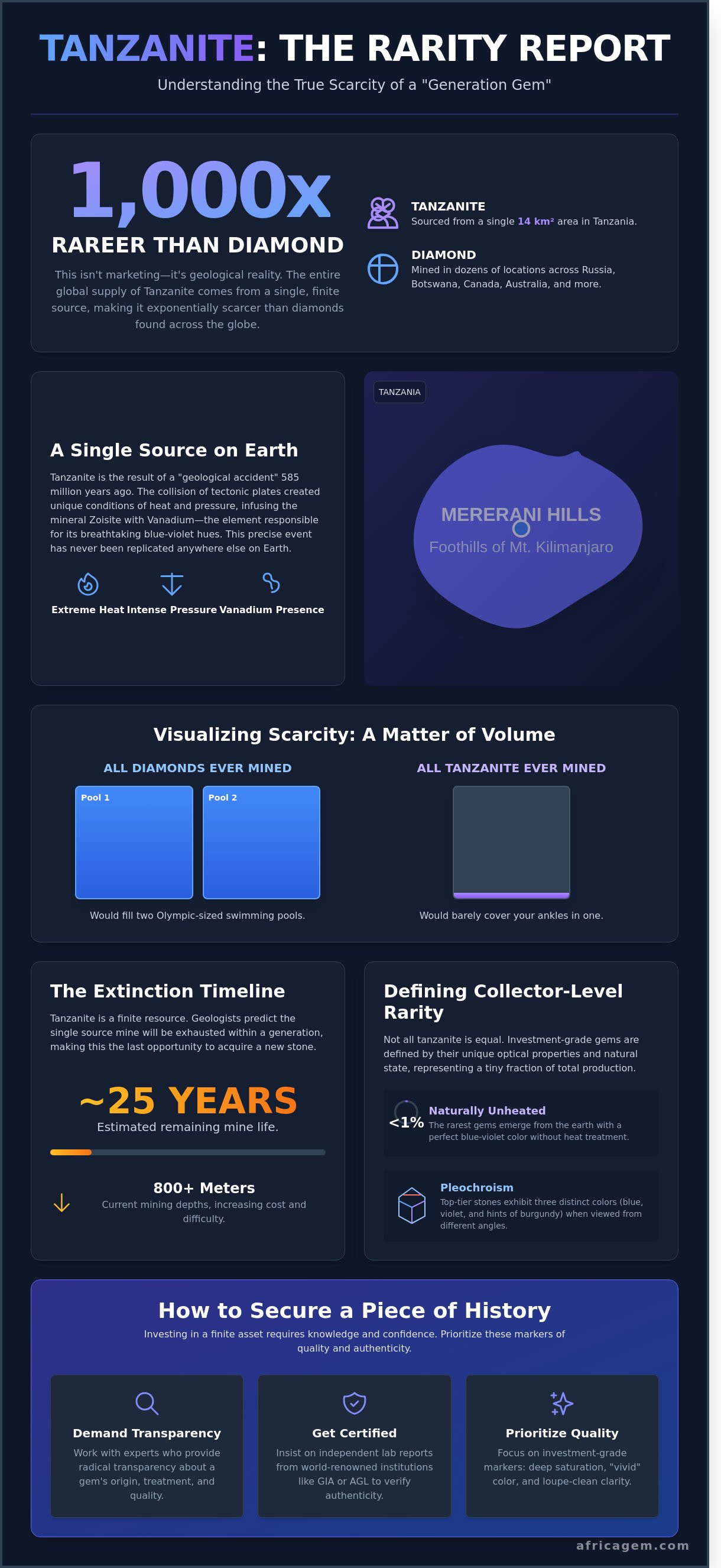
If you were to gather every diamond ever mined into one place, they would fill two Olympic-sized swimming pools; yet, the entire global supply of tanzanite would barely cover your ankles in just one. This single-source treasure is 1,000 times rarer than diamond, existing only within a narrow 14-square-kilometer strip at the foothills of Mount Kilimanjaro. You probably recognize that the window to own this geological miracle is closing, and it's frustrating to face conflicting reports about unheated rarity or the actual extinction timeline of the mines. You want to know exactly how rare is tanzanite before committing to a high-value purchase.
At AfricaGems, we believe in radical transparency to help you navigate these complex market realities. We'll show you how a unique event 585 million years ago created the intense pleochroism we see today and why experts predict the Mererani hills will be exhausted within 25 years. We'll clarify the science of heat treatments and identify the specific investment-grade markers that define a true heirloom. By the end of this guide, you'll have the technical confidence to identify a finite asset that's as secure as it is breathtaking.
Key Takeaways
- Explore the 585-million-year-old "geological accident" that makes the Mererani hills the only location on Earth where this exquisite blue-violet Zoisite is found.
- Analyze the market reality of how rare is tanzanite using 2026 data to understand why this "generation gem" is considered 1,000 times rarer than a diamond.
- Gain a professional perspective on the "extinction timeline" as increasing mine depths in Tanzania create a finite window for collectors to acquire high-quality stones.
- Learn to identify "collector-level" rarity by understanding the science of pleochroism and the elusive 1% of gems that emerge naturally blue without heat treatment.
- Discover how to strategically secure your investment by prioritizing radical transparency and independent lab certifications from the GIA or AGL.
What Makes Tanzanite Rare? The Geological Miracle of Mererani
Tanzanite is the blue-violet variety of the mineral Zoisite, found exclusively in a small region of Tanzania. To truly grasp how rare is tanzanite, you have to look back 585 million years. During this period, massive tectonic plates collided to form the East African Rift, creating a unique environment of extreme heat and pressure. This "geological accident" transformed ordinary zoisite into something extraordinary. The entire global supply comes from a single 8-square-kilometer strip in the Mererani Hills, located at the foothills of Mt. Kilimanjaro. This geographic confinement means the stone is roughly one thousand times rarer than a diamond.
This singular source makes the mineral remarkably finite. Geologists estimate that the current mines may only have 20 to 30 years of production left. The AfricaGems Difference lies in our rigorous selection process for these disappearing treasures. We don't just look for any Tanzanite; we hunt for the top 1% of geological specimens. This involves analyzing the stone’s pleochroism and ensuring it's loupe-clean, a standard many commercial dealers overlook in their haste to move inventory.
The Role of Vanadium in Tanzanite's Formation
Vanadium is the secret element that grants this gem its signature blue and violet hues. For how rare is tanzanite to be fully understood, one must realize that vanadium must be present in the crystal lattice under very specific metamorphic conditions. This chemical signature requires a precise balance of pressure and temperature that hasn't been found anywhere else on Earth. Naturally occurring stones with perfectly balanced saturation are incredibly scarce. Most raw zoisite is brown or green; the vivid blue-violet variety is a true freak of nature. We prioritize stones that exhibit this rare chemical harmony, focusing on deep, saturated tones that represent the pinnacle of the species.
Historical Context: The 1967 Discovery
In July 1967, a tailor named Manuel de Souza stumbled upon transparent blue crystals in the Mererani foothills. He initially mistook them for a new sapphire deposit. After gemological testing proved it was a previously unknown variety of zoisite, Tiffany & Co. recognized its potential. They launched a massive marketing campaign in 1968, naming the stone after its country of origin to emphasize its singular source. Because it's only been on the market for 57 years, it remains somewhat undervalued. It hasn't had the centuries of market establishment enjoyed by ruby or emerald. This "Generation Gem" status offers a unique window for collectors to acquire a world-class stone before the primary source is exhausted.
Tanzanite vs. Diamond: Is It Really 1,000 Times Rarer?
The industry often claims that tanzanite is 1,000 times rarer than diamond. While that sounds like a marketing flourish, the 2026 production data supports the gravity of this statement. Diamonds are found in dozens of locations across Russia, Botswana, Canada, and Australia. In contrast, every single tanzanite crystal ever unearthed comes from a single 8-square-kilometer strip in the Merelani Hills of Tanzania. This localized occurrence creates a physical rarity that diamonds, despite their high price points, simply don't possess.
When analyzing how rare is tanzanite, we have to distinguish between marketing rarity and geological scarcity. The diamond market is a masterpiece of controlled distribution where supply is metered out to maintain price stability. Tanzanite doesn't have that luxury of global reserves. Its availability is dictated by the physical limits of a single hill. As mining depths exceed 800 meters in 2026, the cost and difficulty of extraction are rising sharply, making the discovery of high-grade material an increasingly rare event.
Supply Chain and Global Distribution
The supply chain for tanzanite is far more fragile than the robust, multi-national diamond infrastructure. Because the entire world's supply originates from one mining district, any local regulatory change or geological shift has an immediate impact on global availability. This volatility is why finding investment-grade loose tanzanite gemstones is becoming a priority for serious collectors. High-grade tanzanite, characterized by deep saturation and "vivid" color, represents less than 1% of the total yield from Merelani.
- Geographic Range: Diamonds (Global) vs. Tanzanite (One 4km x 2km area).
- Production Volume: Annual diamond production reaches roughly 120 million carats, whereas tanzanite production is a mere fraction of that.
- Quality Scarcity: Top-tier tanzanite requires a perfect storm of Pleochroism and Treatment to reach its legendary velvet blue-violet hue, a combination rarely found in the rough.
The Probability of a Second Source
Geologists estimate the odds of finding another tanzanite deposit at less than one in a million. The specific conditions that created these crystals—a unique tectonic collision involving massive heat and pressure 585 million years ago—are statistically improbable to have occurred elsewhere. This makes tanzanite a single-source gem, much like Larimar from the Dominican Republic or Ammolite from Canada. Diamonds are a recurring geological miracle of the earth's mantle, but tanzanite is a singular accident that occurred only once. If you're looking to secure a piece of this finite history, you can view our curated selection of ethically sourced stones. We're currently approaching the "Generation Gem" threshold, where experts predict the primary deposits will be exhausted by 2046, meaning the next generation will likely only see these stones in museums or private estates.
The 'Extinction' Timeline: Mining Realities in 2026
The Mererani Hills of Tanzania remain the only place on Earth where this blue-violet treasure is found. By 2026, the physical landscape of these mines has shifted dramatically. Shafts in Block C and Block D now reach depths exceeding 800 meters, with some advanced tunnels approaching the 1,000-meter mark. This vertical descent changes the fundamental calculus of how rare is tanzanite. Extraction is no longer a matter of simple digging; it's a high-stakes industrial feat requiring massive investment in ventilation, water pumping, and structural reinforcement.
The Tanzanian government has tightened its grip on this national heritage to ensure the wealth stays within its borders. Since the completion of the 24-kilometer perimeter wall in 2018, every gram of Tanzanite is monitored. Current regulations prohibit the export of raw, unprocessed stones weighing over 2 grams, a move designed to bolster local cutting and polishing industries. While this protects the economy, it creates a bottleneck for global supply, making high-quality, precision-cut gems even more difficult for international collectors to acquire.
The "extinction" narrative often suggests the mines will be empty within a decade. The geological reality is more complex. While researchers estimate the total ore body may sustain mining for another 20 to 25 years, the yield of top-tier material is plummeting. We aren't necessarily facing a total disappearance of the mineral, but we are witnessing the sunset of "Grade AAA" availability. For the serious investor, the rarity isn't just about the existence of the stone, but the vanishing window to own a specimen with world-class saturation.
The Impact of Mining Depth on Rarity
As mines go deeper, the overhead costs skyrocket. Corporate entities now dominate because artisanal miners cannot afford the safety technology required at 900 meters. These extreme depths often result in smaller yields of large, clean crystals, as the pressure and heat of deep-earth mining increase the risk of fractures during extraction. This scarcity of large, loupe-clean specimens is the primary driver behind current tanzanite price per carat trends. According to the Gemological Institute of America (GIA), the unique pleochroism and single-source origin of the stone make these supply constraints globally significant.
Ethical Sourcing and the 'Maasai' Connection
AfricaGems remains steadfast in its commitment to the Tanzanite Protocol, a set of standards ensuring stones are conflict-free and ethically handled. This isn't just corporate policy; it's a pillar of the AfricaGems Difference. The local Maasai community, the traditional stewards of the Mererani land, now benefits more directly from the trade through infrastructure and education funded by legitimate mining royalties. We prioritize stones with a clear chain of custody, ensuring that your investment supports fair trade practices and local Tanzanian craftsmanship. This transparency provides the security collectors need when navigating the market for such a finite resource.
Pleochroism and Treatment: Defining 'Collector Level' Rarity
The allure of Tanzanite goes beyond its single-source origin in the Merelani Hills. To truly grasp how rare is tanzanite, you have to look at its crystalline structure. Tanzanite is one of the few gemstones on Earth that is naturally trichroic. This means as light travels through the crystal lattice, it vibrates at different angles to reveal three distinct colors: sapphire blue, deep violet, and a rich burgundy or cherry red. In the finest specimens, these colors dance together, creating a depth of tone that no other gemstone can replicate.
While the market is filled with beautiful blue stones, the "Investment Grade" checklist is rigorous. Only a small fraction of production meets the criteria for true collector status. This includes:
- Color Saturation: Deep, vivid tones that don't "black out" in low light.
- Clarity: Specimens must be loupe-clean, meaning no visible inclusions at 10x magnification.
- Precision Cutting: Master cutters often sacrifice up to 60 percent of the rough stone's weight to align the axes perfectly for maximum color brilliance.
Understanding Trichroism and Light Performance
Light performance is the heartbeat of a rare gem. Master lapidaries don't just cut for size; they cut for the soul of the stone. By orienting the table of the gem to favor the blue or violet axis, they determine the final personality of the piece. High-end collectors prioritize this optical precision over raw carat weight. A perfectly cut 5-carat stone often commands a higher price per carat than a poorly cut 10-carat stone because of its superior light return and color intensity.
The Unheated Tanzanite Market
Heat treatment is a standard, stable practice in the industry. It mimics the natural geothermal processes of the Earth by heating the stones to approximately 600 degrees Celsius to remove brown "masking" tones. However, roughly 1 percent of Tanzanite emerges from the ground already blue. These unheated gems are the pinnacle of rarity. Collectors seek them out for their unique "multi-color" flashes, which often include subtle greens or teals that heated stones lack. This natural occurrence highlights exactly how rare is tanzanite in its untouched, pristine state. When you're looking for these elite pieces, always insist on a lab certificate from a reputable authority like the GIA to verify their unheated status. This transparency is a cornerstone of the AfricaGems Difference.
Explore the exceptional depth and brilliance of our hand-selected, investment-grade Tanzanite collection today.
Investing in Rarity: How to Secure a Piece of History
Acquiring a tanzanite today isn't just a purchase; it's a strategic entry into a closing window of geological history. Because this stone comes from a single 14-square-kilometer strip at the foothills of Mount Kilimanjaro, the supply is strictly finite. Experts estimate the Merelani mines may reach depletion within the next 15 to 20 years. This reality makes current market prices an opportunity for collectors to secure a "generation gem" before it moves exclusively into the high-premium secondary auction market.
To ensure your investment holds its value, prioritize independent lab certification. AfricaGems insists on reports from the Gemological Institute of America (GIA) or American Gemological Laboratories (AGL). These documents provide an objective analysis of color, clarity, and treatment, removing the guesswork from high-value transactions. Understanding how rare is tanzanite requires recognizing that while many stones exist, investment-grade specimens represent less than 1% of total output.
Marc Sarosi personally hand-selects every stone in our inventory, applying 30 years of gemological expertise to filter out mediocre cuts and muddy colors. He looks for "loupe-clean" clarity and the specific pleochroic properties that define top-tier zoisite. You aren't just buying a mineral; you're acquiring a wearable heirloom curated by a specialist who understands the nuances of the Tanzanian supply chain. This personal oversight ensures that every stone meets the rigorous AfricaGems standard for brilliance and saturation.
What to Look for in a 2026 Tanzanite Purchase
Market trends for 2026 indicate a widening price gap between commercial grades and investment-grade stones. Focus your search on "vivid" or "deep" saturations. These stones exhibit the intense velvety blues and violets that lighter "lilac" shades can't match. Size is also a critical value driver. While 1-carat stones remain available, 5-carat plus specimens are becoming increasingly difficult to source as mining operations descend to deeper, more dangerous levels. For a deeper dive into the technicalities of a secure purchase, read our guide on buying gemstones online.
The AfricaGems Guarantee
The AfricaGems Difference is built on radical transparency and a 30-day money-back guarantee. We provide full disclosure on all treatments, ensuring you know exactly what you're adding to your portfolio. Our commitment to ethical sourcing means every stone is conflict-free and supports the legitimate mining communities in the Manyara Region. When you're ready to own a piece of this geological miracle, explore our curated collection of loose tanzanite and secure a stone that truly reflects how rare is tanzanite in the global market.
Securing Your Legacy in the Mererani Hills
Tanzanite isn't just another gemstone; it's a geological miracle confined to a single 8-square-mile strip in the Mererani Hills. When you consider how rare is tanzanite, remember it's 1,000 times scarcer than diamond. With mining experts projecting the depletion of high-quality deposits by 2026, the opportunity to own a primary source stone is rapidly vanishing. This finite reality makes every loupe-clean, unheated specimen a literal piece of history that won't be available forever.
Since 1984, Marc Sarosi has built AfricaGems on a foundation of radical transparency and professional authority. Our A+ BBB rating and strict full disclosure policy ensure you're never guessing about the integrity of your investment. We offer free GIA certification on select high-value stones to provide the technical validation a serious collector requires. Don't miss the chance to secure a gem that future generations will likely only see in museums.
Secure Your Investment: Shop Certified Loose Tanzanite at AfricaGems
We look forward to helping you find a breathtaking stone that perfectly captures the spirit of this extraordinary African treasure.
Frequently Asked Questions
Is tanzanite rarer than diamond?
Tanzanite is approximately 1,000 times rarer than diamond because it's found in only one location on Earth. While diamonds are mined in over 10 countries, tanzanite originates solely from a 7-kilometer strip in the Merelani Hills. This extreme geographical limitation answers how rare is tanzanite for collectors who prioritize geological scarcity. It's a single-source gemstone that scientists believe won't be found anywhere else.
Will tanzanite ever be found in other parts of the world?
Geologists believe the chances of finding tanzanite in another location are less than one in a million. The stone formed 585 million years ago during the Pan-African Orogeny under conditions so specific they're considered a geological fluke. You won't find these unique metamorphic conditions, which combined intense tectonic pressure with rare vanadium deposits, in any other known mountain range.
How many years of tanzanite mining are left?
Most experts estimate that the Merelani mines have between 20 and 25 years of production remaining. As miners descend deeper than 800 meters, the costs and risks of extraction increase significantly. We're currently living through the final decades of the first-hand market, which is why we call it a Generation Gem. Once these veins are empty, the only source will be the secondary resale market.
Does heat treatment make tanzanite less rare?
Heat treatment doesn't decrease rarity because nearly 99% of all tanzanite requires it to remove brown axis colors. This stable, permanent process reveals the breathtaking blue and violet pleochroism the stone is famous for. If you find a naturally blue, unheated stone with loupe-clean clarity, you're looking at a specimen that represents less than 0.5% of all production.
What is the rarest color of tanzanite?
The rarest and most valuable color is a vivid, saturated blue with distinct red flashes of pleochroism. Collectors often look for a 70% blue and 30% violet ratio, typically found in the famous D-Block mining area. These stones are far harder to source than the lighter, lavender-toned varieties that dominate most commercial jewelry stores.
Is tanzanite a good investment in 2026?
Tanzanite is an excellent choice for 2026 because the dwindling supply and rising extraction costs provide a strong floor for pricing. High-quality stones have shown an average annual value increase of 8% over the last decade. For the best security, investors should target loupe-clean stones over 5 carats, as these larger sizes are disappearing from the market the fastest.
Why is tanzanite only found in Tanzania?
Tanzanite exists only in Tanzania because of the massive tectonic shifts that created the Great Rift Valley. This event brought together the precise levels of heat and pressure needed to crystallize zoisite into this specific blue variety. The presence of vanadium, the element responsible for the color, was concentrated in this 14-square-kilometer area near Mount Kilimanjaro and nowhere else.
Are large tanzanite stones harder to find now?
Large, investment-grade stones are becoming increasingly difficult to acquire as the mines reach greater depths. Over the past 12 years, the recovery of crystals weighing more than 10 carats has declined by approximately 40%. When we source these exquisite pieces today, they often come from private collections rather than new production, highlighting why how rare is tanzanite is such a critical question for modern buyers.