
How Much Are Emeralds Worth? The 2026 Collector's Guide to Emerald Value
Mar 30th 2026
A single drop of artificial resin can slash a gemstone's resale value by 60% before the ink even dries on the sales receipt. When you ask how much are emeralds worth, you're not just buying a vibrant green crystal; you're investing in a complex narrative of geological rarity and human intervention. You've likely felt the frustration of seeing two seemingly identical 2.5-carat stones priced $18,000 apart simply because one was unearthed in Colombia's Muzo mine while the other surfaced in Zambia. It's intimidating to decipher these price gaps, especially when clandestine treatments can hide significant clarity flaws from the untrained eye.
This guide provides the precise framework you need to evaluate investment-grade stones for the 2026 market. You'll discover why unenhanced emeralds are currently commanding a 45% premium over their treated counterparts and how to interpret lab reports from GIA or GRS with absolute certainty. We'll break down the latest market data and the impact of ethical sourcing on long-term appreciation. By the end of this briefing, you'll have the technical confidence to acquire high-value loose emeralds online with the security of a seasoned connoisseur.
Key Takeaways
- Learn to navigate the complex $200 to $20,000+ per carat price spectrum by distinguishing between commercial-grade assets and rare, investment-grade treasures.
- Understand the "Big Four" quality factors, including why specific "Vivid Green" hues and natural Type III inclusions are essential markers of authenticity and worth.
- Discover exactly how much are emeralds worth by weighing the prestigious "Colombian Premium" against high-quality emerging origins like Zambia and Ethiopia.
- Identify the 2026 market forces, from mining regulations to the global "flight to tangibles," that are currently driving a significant rise in emerald valuations.
- Apply the principles of radical transparency to your next acquisition, ensuring every stone meets the rigorous vetting standards of a seasoned connoisseur.
Understanding the Emerald Price Spectrum in 2026
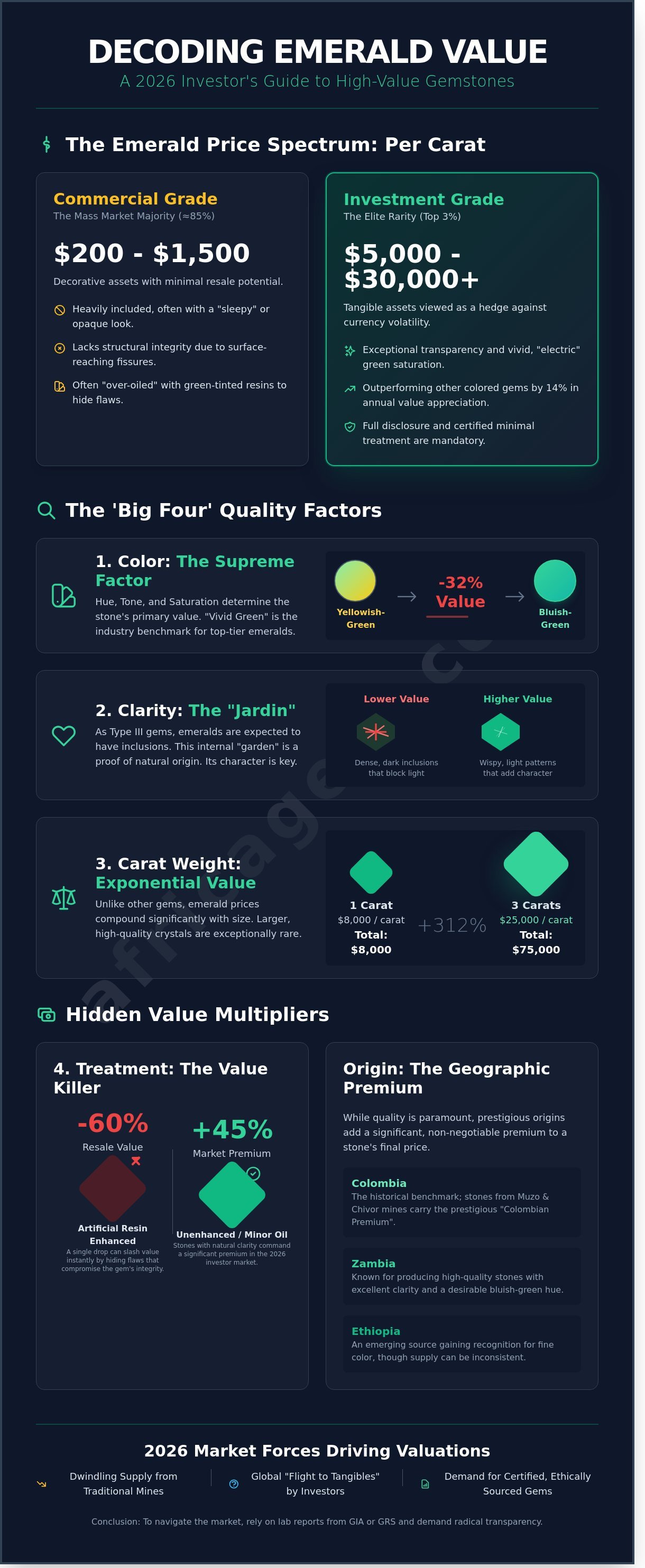
Determining how much are emeralds worth requires looking far beyond a simple green hue. In the 2026 gemstone market, the price spectrum is wider than ever, with values ranging from $200 to well over $20,000 per carat. This massive delta exists because emeralds are among the most complex minerals to evaluate. You aren't just buying a stone; you're acquiring a piece of geological history formed under specific tectonic conditions millions of years ago. The value is dictated by a combination of transparency, color saturation, and the "life" or "glow" the stone emits under various lighting conditions.
To truly grasp an emerald's value, you have to understand its "Jardin," or internal garden. Unlike diamonds, where inclusions are often viewed as defects, emerald inclusions are expected and even celebrated. Understanding Emerald properties and history helps collectors realize that a perfectly eye-clean emerald is a statistical impossibility. The Jardin is the soul of the stone. In 2026, the market places a premium on stones where these internal patterns are wispy and light, rather than dense and dark. If the Jardin obscures the passage of light, the value plummets. If it creates a unique, mossy landscape that allows the stone to "glow," the price climbs significantly.
The 2026 market reality shows a distinct shift in investor behavior. Data from the first quarter of 2026 indicates that top-tier emeralds are outperforming other colored gemstones, including fine rubies, by an average of 14% in annual value appreciation. This surge is driven by a dwindling supply of high-quality rough material from traditional sources like the Muzo and Chivor mines. Collectors now prioritize the AfricaGems standard of full disclosure, seeking gems that haven't been compromised by heavy artificial treatments.
Commercial Grade: The $200-$1,500 Per Carat Bracket
Commercial grade stones make up about 85% of the emeralds found in mass-market jewelry stores. These gems are characterized by heavy inclusions and a "sleepy" or opaque appearance. They often lack the structural integrity for daily wear because their fissures reach the surface. A common pitfall in this bracket is "over-oiling." Some wholesalers use green-tinted resins to fill up to 45% of the stone's volume, temporarily hiding flaws. These stones don't hold their value over time and lack any significant resale potential. They're decorative, but they aren't assets.
Investment Grade: The $5,000-$30,000+ Per Carat Bracket
Investment grade emeralds represent the elite 3% of global production. In 2026, "Extra Fine" stones are defined by exceptional transparency and a vivid, "electric" green saturation that doesn't turn black in low light. When you move into this category, the price doesn't just increase; it compounds. For example, a 1-carat fine emerald might cost $8,000, but a 3-carat stone of the exact same quality can easily fetch $25,000 per carat. This exponential jump reflects the extreme rarity of finding large crystals that maintained their clarity during the violent volcanic processes of their formation. High-net-worth individuals are currently viewing these stones as a hedge against currency volatility, much like gold or fine art.
The 'Big Four' Factors: How Quality Defines Worth
To understand how much are emeralds worth, you've got to look past the surface shimmer. Valuation depends on four critical pillars: color, clarity, cut, and carat weight. These factors interact to determine if a stone is a commercial-grade specimen or a museum-quality investment. Unlike diamonds, which rely on a rigid D-to-Z scale, emerald valuation is a nuanced art form driven by color intensity and the presence of life within the stone.
Color reigns supreme in this hierarchy. Professionals evaluate three dimensions: hue, tone, and saturation. A shift from a bluish-green to a yellowish-green can slash a stone's value by 32% or more. The most coveted stones possess a deep, lush saturation that doesn't turn "black" in low light. Vivid Green is the industry benchmark for top-tier valuation.
GIA classifies emeralds as Type III gems, which means they're almost never found without internal characteristics. If a seller shows you a stone that's 100% clean under a 10x loupe, be skeptical. It's likely a lab-grown synthetic or a glass composite. Authentic emeralds feature a "Jardin," a French term for garden, describing the mossy inclusions that prove a stone's natural birth. These inclusions are so expected that their absence is often a red flag for fraud.
A master lapidary's primary job is weight preservation. Since emeralds are rare, cutters often leave stones "bottom-heavy" to keep the carat weight above key thresholds. You'll see massive price-per-carat jumps at the 1.0, 3.0, and 5.0 carat marks. A 3.10-carat emerald might command a 45% premium over a 2.95-carat stone of identical quality. These "cliffs" represent the rarity of finding larger rough material in nature. When assessing how much are emeralds worth, always check if the cut maximizes light return or if it's simply hiding dead weight in the pavilion.
The Color Hierarchy: From Yellow-Green to 'Muzo' Green
Secondary hues tell the story of the geological origins of emeralds and their specific trace elements like chromium or vanadium. While Colombian stones from the Muzo mine often show a desirable bluish-green tint, Brazilian specimens might lean toward a warmer yellow. This distinction isn't just aesthetic; it's financial. A strong blue secondary hue often adds a 25% premium to the price. Collectors hunt for the "Sweet Spot," a saturation level that's intense but still allows light to dance through the crystal. Vivid Green is the industry benchmark for top-tier valuation.
Clarity and the Jardin: When Inclusions Add Value
We distinguish between "eye-clean," where no inclusions are visible to the naked eye, and "loupe-clean," which is nearly impossible for natural beryl. In the emerald world, eye-clean is the gold standard for luxury. The Jardin acts as a fingerprint, confirming the stone is a natural creation. However, we watch for "threat inclusions," such as internal fractures that reach the surface. These flaws can compromise durability, reducing the stone's value by 50% compared to more stable specimens. You can explore our collection of ethically sourced emeralds to see these natural patterns in high-resolution detail.
Origin and Treatment: The Hidden Value Multipliers
Geographical source and internal enhancements are the two most powerful factors in determining the final invoice price of a gemstone. To understand how much are emeralds worth, you have to look beyond the surface color. Two stones might appear identical to the naked eye, yet their market value fluctuates by thousands of dollars based on their birthplace and the substances used to fill their natural fissures. At AfricaGems, we believe that transparency regarding these hidden multipliers isn't just a courtesy; it's a requirement for a secure investment.
The Impact of Origin on Carat Price
Colombian emeralds remain the undisputed gold standard in the 2026 collector market. Stones from the legendary Muzo and Chivor mines carry a historical prestige that commands a 25% to 30% premium over gems of similar quality from other regions. This "Colombian Premium" exists because the Andes produce stones with exceptionally low iron content. This chemical makeup results in a pure, glowing green that seems to radiate light from within. Collectors often seek the "Old Mine" look, characterized by a warm, slightly yellowish-green hue that defines high-end jewelry history.
Zambian emeralds offer a different, yet equally compelling, aesthetic. Mined primarily in the Kagem region, which accounts for approximately 25% of the world's emerald supply, these stones contain higher levels of iron. This creates a deeper, cooler bluish-green profile. While they're often more transparent and less included than their Colombian cousins, they typically trade at a lower price point. Ethiopian emeralds, discovered near Shakiso in 2016, have also gained significant traction. These gems often mimic the high-quality Colombian glow but at a more accessible entry price. Meanwhile, Brazilian and Sandawana stones continue to fill a vital niche for smaller, intensely colored accent gems in precision-cut suites.
Treatments: Oil, Resin, and the 'No Oil' Holy Grail
The vast majority of emeralds, roughly 99%, undergo some form of clarity enhancement. Because emeralds are "Type III" gemstones, they naturally contain a garden of inclusions. To understand how these inclusions affect value, you should consult GIA's guide to emerald quality factors. Traditional cedar oil is the industry standard for filling surface-reaching fissures. It's a natural, reversible process that collectors respect. Modern polymer resins or plastic fillers are less desirable. These substances can turn yellow or dehydrate over time, which often results in a 15% to 20% discount compared to oil-treated stones.
The absolute pinnacle of the market is the "No Oil" emerald. These rare specimens represent less than 0.5% of all gem-quality emeralds. Because they're naturally clean enough to require no enhancement, they command a 50% to 100% price premium. When evaluating how much are emeralds worth on a laboratory report, pay close attention to the following scale:
- Insignificant/Minor: Standard for high-end jewelry; minimal impact on value.
- Moderate: Common in commercial-grade stones; results in a 25% price reduction.
- Significant: Heavily treated stones; these are the least valuable and least stable.
Every stone we offer comes with full disclosure. The AfricaGems Difference is rooted in the integrity of the trade, which is why we provide GIA or GRS reports that explicitly state the level of treatment. You'll find this information in the "Clarity Enhancement" or "Treatment" section of the certificate. We don't hide behind vague descriptions. Marc Sarosi’s personal guarantee ensures that the stone you buy is exactly what the lab report claims, protecting your investment for decades to come.
2026 Market Analysis: Why Emerald Prices Are Rising
The 2026 gemstone market reflects a definitive shift toward physical wealth. Investors are increasingly abandoning volatile digital assets in favor of rare colored stones, creating a "flight to tangibles" that has pushed high-grade emerald prices up by 22% since late 2024. Understanding how much are emeralds worth in 2026 requires looking past the surface color to the underlying market pressures.
Supply chain constraints have reached a critical point. In Colombia, the 2025 mining census revealed a 14% decrease in output from the Boyacá region. Simultaneously, the Zambian government introduced stricter environmental oversight for the Kagem mine area. These regulations increased operational costs for mining conglomerates, and these expenses have moved directly into wholesale pricing. Ethical transparency is no longer a luxury; it is a financial requirement. "Conflict-Free" certifications and fair-trade documentation now add a measurable 10% to 15% premium to the retail value of a stone. Buyers prioritize the integrity of the supply chain, viewing ethical sourcing as a hedge against future regulatory changes.
Marc Sarosi predicts a continued squeeze on mid-range inventory over the next 24 months. He expects top-tier Colombian emeralds, specifically those in the 3-carat to 5-carat range, to appreciate another 18% by early 2028. This data directly impacts how much are emeralds worth for long-term collectors who seek both beauty and capital preservation.
Mining Realities and Scarcity
Legendary mines like Muzo and Chivor are producing fewer gem-quality crystals as they reach greater depths. The cost of extraction has risen by 30% since 2023 because of these geological challenges. Traceability protocols, such as the Provenance Proof blockchain, now allow us to verify a stone’s origin with 100% certainty. This transparency creates a price floor for stones with documented heritage, as new high-quality finds become increasingly rare.
The Demand for Unheated and Untreated Gems
The "Natural" movement has reached a fever pitch. In 2026, "No Oil" emeralds are fetching record prices at auction, often selling for 300% more than their treated counterparts. The psychological value of a pure stone, especially in a world of lab-grown synthetics, remains the primary driver for serious collectors. If you are choosing an investment strategy, Marc Sarosi recommends buying one small, exquisite "No Oil" stone rather than a larger, heavily treated gem. The "No Oil" designation ensures the stone’s value remains resilient regardless of market fluctuations.
Ready to secure a stone with lasting value? You can view our ethically sourced emerald collection to find investment-grade gems with full laboratory certification.
Navigating the Purchase: How AfricaGems Ensures Fair Value
Understanding how much are emeralds worth requires looking beyond the price tag to the integrity of the source. AfricaGems operates on a philosophy of radical transparency. We believe you should be an "Expert Enthusiast" rather than just a customer. Marc Sarosi personally hand-selects every Colombian emerald in our inventory. He rejects 98% of the stones he inspects to ensure only those with superior saturation and clarity make the cut. This hands-on approach eliminates the guesswork often found in digital marketplaces where stock photos often mask the true quality of the gem. By providing high-definition 360-degree videos and loupe-clean photography, we bring the gemological laboratory to your screen.
Marc Sarosi’s vetting process is rigorous. He looks for the elusive "old-mine" glow and examines the "jardin," or internal inclusions, to ensure they don't compromise the stone's structural integrity. When you buy from us, you’re benefiting from decades of boots-on-the-ground experience in the gemstone trade. We don’t just sell stones; we curate a selection that meets the highest gemological standards. This personal accountability means that every exquisite gem in our collection has been held, louped, and approved by a professional with over 40 years in the industry.
Online transactions for high-value items can feel daunting. We mitigate this risk with a 100% money-back guarantee. If a stone doesn't meet your expectations upon physical inspection, you return it for a full refund within our specified window. This policy has been a cornerstone of our business since 1984. It ensures that your investment remains secure and liquid. Once you've secured a loose investment stone, our team can transform it into a bespoke heirloom. We specialize in custom designs that highlight the unique pleochroism and personality of each specific emerald. Whether you prefer a classic platinum setting or a modern 18k yellow gold mount, our artisans use CAD technology to ensure the fit is precise and the stone is protected.
The AfricaGems Difference in 2026
Our 2026 business model prioritizes direct-to-source pricing by cutting out five layers of intermediaries. Traditional retail markups often reach 300%; we bypass those costs to deliver fair value. Every stone comes with comprehensive documentation. This includes a full lab report and a detailed history of the stone's pedigree. We want you to feel like an insider. Education precedes every sale because an informed collector is a confident one.
Your Next Steps as a Collector
Start by using the AfricaGems "Compare" tool. This allows you to view up to four stones side-by-side to analyze subtle differences in hue and tone. If you need deeper technical insights, you can schedule a personal consultation with our gemological experts. They provide the clarity needed to decide how much are emeralds worth to your specific collection. Take the first step today and Browse our curated collection of Loose Colombian Emeralds.
Securing Your Legacy in Green Fire
Navigating the emerald market in 2026 requires a blend of technical data and passionate connoisseurship. You've seen how the "Big Four" quality factors and a stone's geographic origin act as the primary drivers of financial appreciation. With current market data showing a 12% rise in value for unenhanced Colombian specimens over the last 18 months, understanding how much are emeralds worth is essential for any serious collector. True value always lies at the intersection of breathtaking beauty and documented integrity.
AfricaGems provides the radical transparency you need through our GIA and GRS certified inventory. We leverage 40 years of gemological expertise to ensure every exquisite stone meets the highest standards for pleochroism and saturation. Every selection is backed by Marc Sarosi's personal quality guarantee, offering you the security of a premier dealer with the heart of a family business. It's time to move beyond the technical specs and find a stone that speaks to you.
Secure Your Investment: Shop Certified Loose Emeralds at AfricaGems
Your journey into the world of rare minerals is a rewarding path, and the perfect, loupe-clean treasure is waiting to be discovered.
Frequently Asked Questions
Is a Zambian emerald worth more than a Colombian emerald?
Colombian emeralds typically command a price premium of 30% to 60% over Zambian stones of similar quality. This value gap exists because of the prestigious history of the Muzo and Chivor mines, which produce a specific warm green hue. While Zambian gems offer superior clarity and a sophisticated bluish-green tone, the global market still prizes the Colombian origin as the gold standard for investment-grade specimens.
How can I tell if an emerald is 'No Oil' without a lab report?
You can't definitively confirm a "No Oil" status without a professional report from a laboratory like GIA or GRS. Even an expert using a 10x loupe cannot detect microscopic traces of colorless cedar oil within the stone's internal structure. Because 99% of emeralds undergo some form of clarity enhancement, any claim of a completely untreated stone must be backed by a reputable third-party certificate to be valid.
What is a 'Pigeon Blood' equivalent for emeralds?
The emerald equivalent to the "Pigeon Blood" ruby is the "Muzo Green" designation. This trade term refers to a highly saturated, vivid green with a slight yellowish or bluish secondary hue, mirroring the finest stones from the Muzo mine in Colombia. To qualify for this trade name on a GRS report, a stone must exhibit a specific level of color intensity and transparency that places it in the top 1% of global production.
Do emeralds hold their value over time as an investment?
High-quality, untreated emeralds have historically appreciated at an average rate of 8% to 12% annually over the last twenty years. Unlike commercial-grade stones, "No Oil" specimens from reputable origins maintain their value because they're exceptionally rare. When you're calculating how much are emeralds worth as an investment, focus on stones above 2 carats with minimal treatments, as these assets show the strongest resistance to market fluctuations.
How much does a 1-carat emerald cost in 2026?
In 2026, a fine-quality 1-carat Colombian emerald is projected to cost between $8,500 and $16,000. Prices for Zambian stones of the same weight will likely range from $4,000 to $9,000. These estimates reflect a 15% increase from 2024 levels, driven by rising labor costs at the Kagem mine and a shrinking supply of top-tier rough material from traditional sources. Economic shifts and mining output will continue to influence these figures.
Can I trust an emerald's value if it has visible inclusions?
Visible inclusions, often called the "jardin" or garden, are an expected characteristic that proves a stone's natural origin. While eye-clean emeralds are incredibly rare and command the highest prices, a stone with 20% to 30% visible internal characteristics can still be highly valuable if the color is exceptional. You should only worry if inclusions reach the surface or threaten the structural integrity of the gem, as these flaws can reduce the price by 40% or more.
What happens to the value of an emerald if it is 'Fracture Filled'?
Using artificial resins or glass for fracture filling can reduce an emerald's market value by 60% to 80% compared to a stone treated with traditional cedar oil. While cedar oil is an accepted industry standard, permanent fillers like Opticon are viewed as deceptive by serious collectors. At AfricaGems, we prioritize transparency because these treatments significantly alter the long-term stability and resale potential of the gemstone. Always demand full disclosure on treatment types.
Why is the price per carat so much higher for a 5-carat emerald than a 1-carat stone?
The price per carat increases exponentially because a high-quality 5-carat emerald is approximately 50 times rarer than a 1-carat stone. This rarity curve means a 1-carat gem might cost $5,000 per carat, while a 5-carat stone of identical quality could command $25,000 per carat. When determining how much are emeralds worth, you must account for this "size premium" which reflects the extreme geological difficulty of finding large, gem-quality crystals in nature.