
Genuine Tanzanite Loose Gemstones: The Connoisseur’s Guide to Authenticity and Value
May 15th 2026
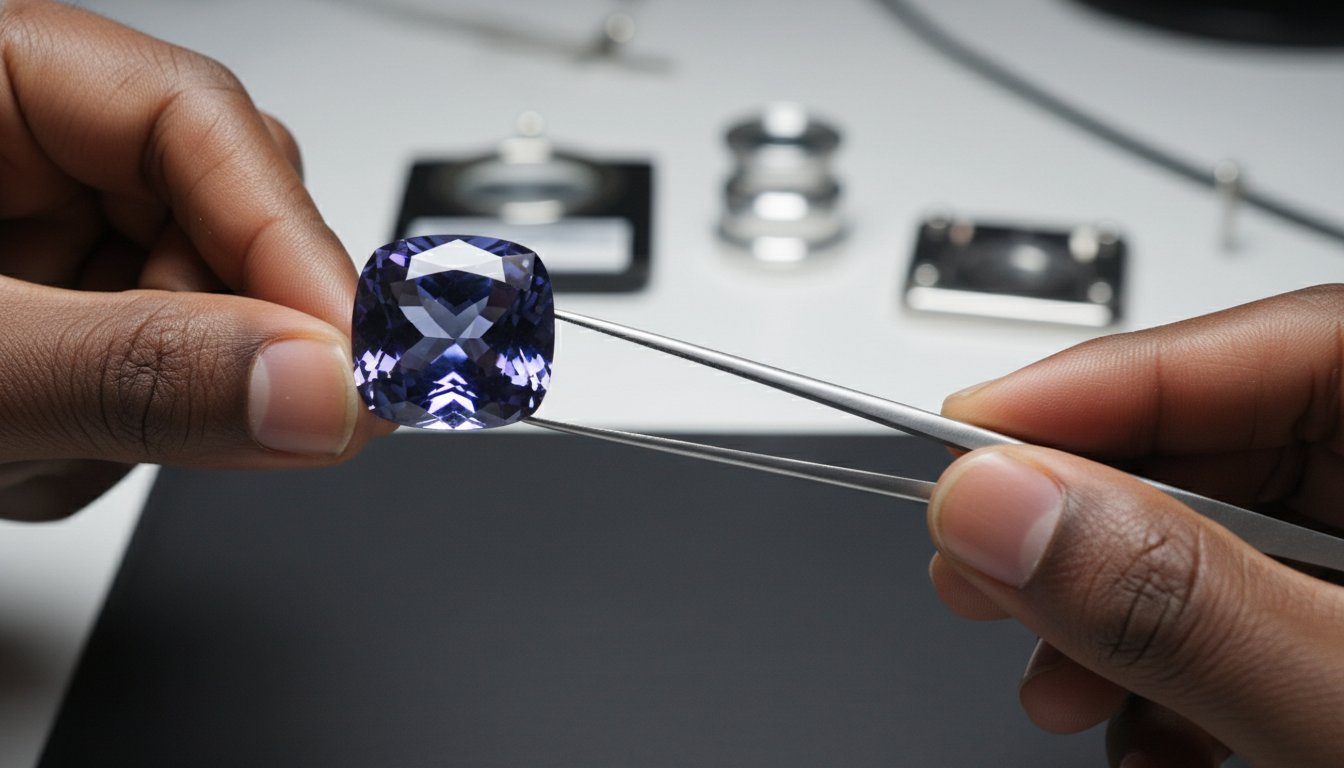
With the Merelani Hills expected to be depleted within the next twenty five years, every genuine tanzanite loose gemstone represents a finite piece of geological history that is a thousand times rarer than a diamond. It's natural to feel a sense of urgency mixed with caution when pursuing such a scarce treasure. You want the deep, velvety saturations that define the finest specimens, but you're likely worried about confusing grading systems or the risk of purchasing a lab-grown imitation disguised as natural material.
I'll show you how to move past that uncertainty and evaluate these stones with the precision of a professional. You'll gain the knowledge to distinguish between standard commercial grades and true investment quality while understanding how the 2026 Tanzanian export regulations on rough stones impact the global market. We'll explore the technical signatures of authenticity, the reality of heat treatments, and the essential steps to securing a certified gemstone that will hold its beauty and value for generations. By the end of this guide, you'll have the technical clarity needed to acquire a legacy-grade treasure with total confidence.
Key Takeaways
- Identify why the geological rarity of the Merelani Hills makes tanzanite a finite asset that is significantly scarcer than traditional diamonds.
- Master the professional grading of a genuine tanzanite loose gemstone by distinguishing between violet-Blue and blue-Violet hues to ensure top-tier saturation.
- Navigate the complexities of heat treatments and learn to spot sophisticated imitations like Nanosital to protect your collection from synthetic alternatives.
- Evaluate the 2026 market landscape, understanding how new export regulations and projected mine depletion are reshaping tanzanite’s long-term investment potential.
- Leverage AfricaGems’ commitment to radical transparency and expert curation to acquire ethically sourced, investment-grade treasures with complete confidence.
What Defines a Genuine Tanzanite Loose Gemstone?
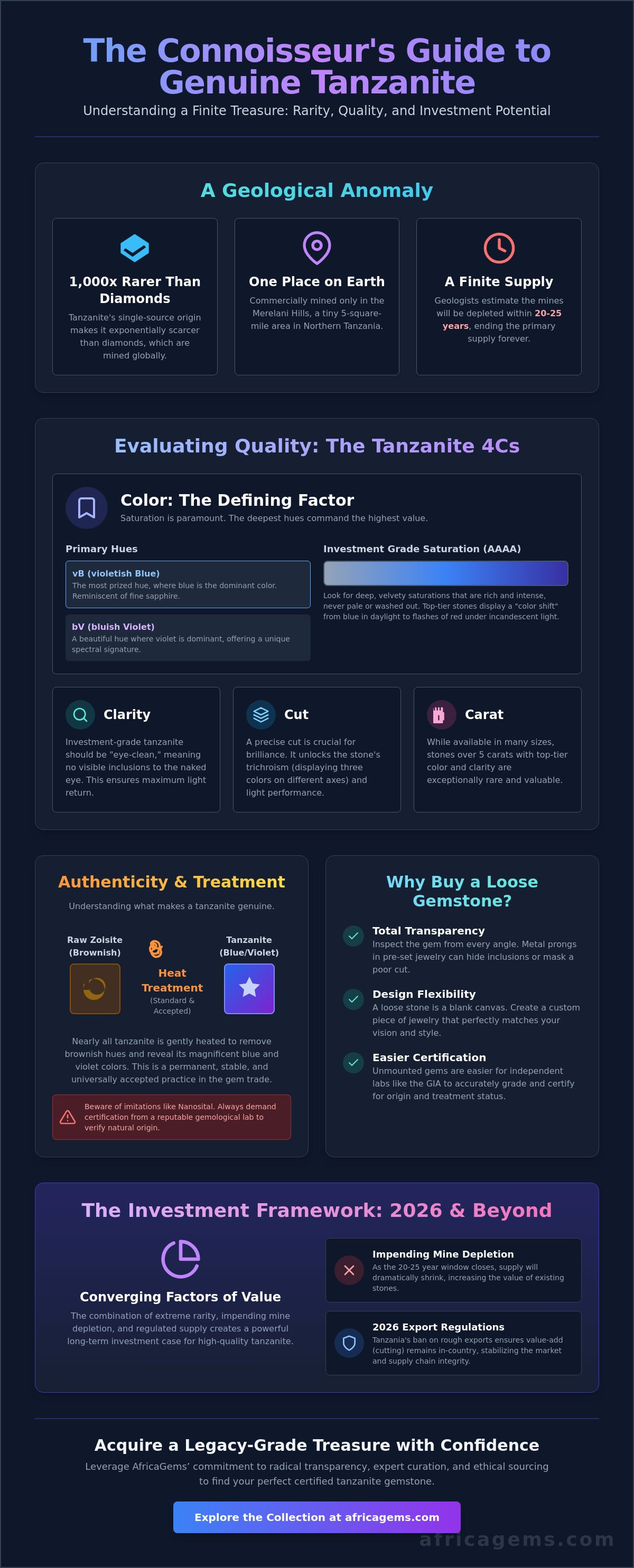
Tanzanite isn't just a gemstone; it's a geological anomaly. Known scientifically as the blue-violet variety of the mineral zoisite, it owes its existence to a specific set of circumstances found only in one place on Earth. Acquiring a genuine tanzanite loose gemstone means owning a piece of a story that began nearly 600 million years ago. Unlike sapphire or emerald, which are found across multiple continents, tanzanite is tethered to a small five-square-mile strip of land in northern Tanzania. This geographic isolation makes it one of the most exclusive materials in the world.
For a deeper dive into the chemical and historical background, this Tanzanite gemstone overview provides essential context for the collector. As we move through 2026, the market is shifting. Mines are reaching depths where extraction becomes technically complex and costly. Geologists estimate the remaining supply might only last another 20 to 25 years before the Merelani Hills are exhausted. This finite nature distinguishes a genuine natural stone from lab-created alternatives or imitations. While lab-grown options exist, they lack the intrinsic value and the unique light-shifting properties of the natural mineral.
To help you visualize the selection process, watch this blueprint for buying:
The Geological Miracle of the Merelani Hills
The Merelani Hills are the only commercial source of this mineral. The unique tectonic pressure and heat that occurred during the formation of the Great Rift Valley created the perfect environment for vanadium to enter the zoisite crystal lattice. It's a fact of geology that tanzanite is roughly 1,000 times rarer than diamonds. Today, the Tanzanian government maintains a 16% non-dilutable interest in mining projects and enforces strict local content rules. These 2026 regulations, including the ban on rough exports, ensure that every stone leaving the country supports the local cutting and polishing industry, protecting the integrity of the supply chain.
Why Buy Loose Stones vs. Pre-Set Jewelry?
Selecting a loose stone is the hallmark of a true connoisseur. When a gem is already in a setting, metal prongs can easily hide small inclusions or mask a shallow cut that affects brilliance. By evaluating a genuine tanzanite loose gemstone before it's mounted, you can inspect the color balance and light performance from every angle. It also provides the ultimate flexibility. You can work with AfricaGems for custom jewelry design services to create a piece that perfectly matches your vision. Loose stones are also significantly easier to send to independent laboratories for the certifications that verify their natural origin and treatment status.
Evaluating Quality: The Connoisseur’s 4Cs for Tanzanite
Evaluating a genuine tanzanite loose gemstone requires a shift in perspective from traditional diamond grading. While the 4Cs remain the foundation, tanzanite connoisseurs prioritize color saturation and light performance above all else. According to the GIA on Tanzanite Quality, the most coveted stones are those that balance intense saturation with a perfect cut. You'll encounter two primary color codes: "vB" for violetish Blue and "bV" for bluish Violet. While both are stunning, the market typically places a higher premium on "vB" stones where the primary blue hue is dominant, reminiscent of the finest Royal Blue sapphires.
Identifying Investment Grade Saturation
Deep, inky saturations are the hallmark of a legacy-tier gem. Premium dealers often use AAAA or AAA+ terminology to distinguish these rare specimens from standard commercial stock. An investment-grade stone should never appear pale or washed out, even in large sizes. It's also vital to observe the stone under different lighting. A top-tier tanzanite will display a rich, velvety blue in daylight and transform with vibrant red flashes when viewed under incandescent light. This "color shift" is a primary indicator of high-value material.
The Science of Pleochroism and Trichroism
Authenticity is written into the crystal's physical structure. Tanzanite is naturally trichroic, meaning it displays three different colors across its crystal axes: blue, violet, and a distinct burgundy or red. This optical property serves as a built-in security feature against fakes. "Tanzanite's trichroism is its color-shifting fingerprint." If you rotate a stone and it remains a static, singular color from every angle, you're likely looking at a synthetic or a common imitation like colored glass. This three-color signature is nearly impossible for lab-grown materials to replicate perfectly.
Clarity expectations for tanzanite are uncompromising. Unlike emeralds, which often feature "gardens" of inclusions, a high-value tanzanite should be "eye-clean." Any visible veils or cracks within the stone will significantly disrupt the light path and lower the value. This clarity must be paired with an expert cut. You must watch for "windowing," a pale, see-through area in the center of the gem that occurs when the pavilion is too shallow. Similarly, "extinction" refers to black, lifeless patches where the cut is too deep. Both flaws are deal-breakers for serious collectors.
Finally, keep in mind the carat weight thresholds. Because large, high-quality crystals are increasingly rare, prices don't rise linearly; they jump significantly at the 3ct, 5ct, and 10ct marks. As the Merelani mines deepen, finding a saturated, eye-clean stone over 5 carats is becoming a notable event. You can see these quality markers in our current collection of loose tanzanite gemstones, where each stone is selected for its exceptional cut and color integrity.
Authenticity Check: Natural vs. Treated and Imitations
Distinguishing between an industry-standard enhancement and a deceptive imitation is a critical skill for any serious collector. When you hold a genuine tanzanite loose gemstone, you're almost certainly looking at a stone that has undergone gentle heating. This process is standard for roughly 95% of the market. It replicates the natural geothermal heat that would have occurred over millions of years, transforming raw, brownish zoisite into the vibrant blues and violets we admire. This treatment is permanent and stable. It doesn't diminish the stone's value in the eyes of major gemological institutions.
You must stay vigilant against sophisticated fakes that go beyond simple heating. Materials like Nanosital, a high-tech glass-ceramic, and synthetic spinel are frequently used to mimic tanzanite's appearance. These imitations often lack the trichroic signatures we've established as a hallmark of the species. According to a Tanzanite market analysis, the scarcity of top-grade material has also given rise to the "coated tanzanite" scam. In this scenario, a thin chemical film is applied to the surface of low-grade zoisite to artificially boost saturation. This coating is temporary and can easily scratch, revealing the pale material underneath. For any stone over two carats, laboratory reports from the GIA or AGTA are non-negotiable to ensure the integrity of your investment.
Unheated Tanzanite: The Rare Collector’s Holy Grail
While heating is accepted, unheated tanzanite that is naturally blue from the earth is the ultimate prize. These stones are exceptionally rare because they were heated by natural volcanic activity while still in the ground. They command a significant price premium and require documented provenance to verify their status. You can see how these rare specimens compare to other geological wonders in our Rare Gemstones guide. Owning an unheated stone means owning a one-in-a-million geological accident that required no human intervention to reach its peak beauty.
The Red Flash Myth: What It Really Means
You've likely heard of the "red flash" as a sign of quality. These flashes are an optical effect caused by high vanadium content combined with an exceptional cut. They aren't a separate treatment. Instead, they're a reward for high-quality heating and precision faceting. Be cautious of sellers who over-saturate their photography to fake this effect. A genuine red flash is subtle and appears as you move the stone under incandescent light. It shouldn't look like a static, neon-red glow in a still photo. True connoisseurs look for this internal fire as a sign of a masterfully cut genuine tanzanite loose gemstone that possesses superior crystal chemistry.
Tanzanite Investment Framework: 2026 Market Analysis
The "Tanzanite Generational Theory" suggests we're currently living through the final decades of primary extraction for this mineral. Unlike blue sapphires, which benefit from diverse deposits across several continents, tanzanite remains a single-source treasure. As mines in the Merelani Hills reach unprecedented depths, the cost of extraction rises while the yield of top-tier crystals diminishes. This creates a supply-side pressure that favors the patient collector. A genuine tanzanite loose gemstone acquired today sits at a unique intersection of geological rarity and market maturity.
The 2026 regulatory environment in Tanzania has further stabilized the market. With the government’s 16% non-dilutable interest and the ban on rough exports, the flow of stones is more controlled and ethically transparent than ever before. For those looking to secure an asset, the "sweet spot" for investment currently lies in eye-clean stones between 5 and 10 carats. These sizes are large enough to be rare, yet they remain liquid enough for future resale to private collectors or high-end jewelers. Specimens in this range offer the most compelling balance of scarcity and demand.
Carat vs. Value: The Exponential Price Curve
In the world of rare gems, size doesn't just add value; it multiplies it. A single 10-carat genuine tanzanite loose gemstone is significantly more valuable than ten 1-carat stones of the same quality. It's because large, high-clarity crystals are geological miracles that occur with far less frequency. When you move into the AAAA saturation levels, the price per carat climbs steeply once you cross the 5-carat threshold. Additionally, matched pairs for earrings carry a significant premium, often 15% to 25% higher, due to the difficulty of finding two stones with identical hue, tone, and saturation. Matching these optical properties requires a massive inventory and a master's eye for color.
The Role of Certification in Resale Value
Your path to a secure investment begins with radical transparency. An AfricaGems certificate of authenticity provides immediate peace of mind by documenting our family-operated sourcing and selection process. For significant stones, a third-party report from GIA or AGTA is the gold standard. These documents must explicitly state "Origin: Tanzania" and provide full disclosure of any heat treatments. This level of documentation is essential for future resale because it transforms a beautiful object into a verifiable asset. Full disclosure isn't just an ethical choice; it's a financial safeguard that protects the integrity of your collection for the next generation.
To explore specimens that meet these rigorous investment criteria, browse our curated selection of investment-grade loose tanzanite.
Sourcing Genuine Tanzanite with AfricaGems
Marc Sarosi’s approach to the gemstone industry is built on a foundation of personal accountability and decades of specialized expertise. When you acquire a genuine tanzanite loose gemstone from AfricaGems, you aren't simply purchasing inventory; you're benefiting from a selection process that prioritizes the highest standards of the trade. Marc’s legacy is rooted in his role as an Expert Enthusiast who understands that a high-value transaction requires more than just a beautiful product. It demands radical transparency regarding the stone's journey from the Merelani Hills to your hand.
Our commitment to ethical sourcing ensures that every gem supports the local Tanzanian communities and adheres to the strict 2026 mining regulations. We provide full disclosure on all enhancements, ensuring you understand exactly how your stone achieved its vivid saturation. If you envision your selection as the centerpiece of a unique heirloom, our custom jewelry design services allow you to collaborate with master craftsmen to create a setting that honors the stone's rarity.
The AfricaGems Advantage: Hand-Selected Brilliance
Every gemstone in our vault has been vetted for its precision cut, eye-clean clarity, and depth of color. This "Connoisseur’s Eye" is what separates a commercial-grade stone from an investment-grade treasure. We recognize that purchasing a genuine tanzanite loose gemstone online requires a high degree of trust. To provide total security, we offer a 30-day no-questions-asked return policy. Every high-value shipment is fully insured and delivered via secure, free shipping, ensuring your legacy piece arrives in pristine condition. This methodical approach builds buyer confidence through information density and a commitment to quality.
From Loose Stone to Legacy Piece
A loose tanzanite is a canvas for personal expression. Whether you choose to keep it as a vaulted asset or transform it into a bespoke pendant or ring, its value remains anchored in its authenticity. For those who wish to explore the deeper historical and cultural significance of this blue-violet treasure, our Tanzanite Pillar offers an exhaustive look at its discovery and geological heritage. We invite you to browse our current curated selection and discover the perfect specimen for your collection. Your journey into the world of rare materials starts with a partner who values integrity as much as beauty.
Securing Your Legacy with Rare Blue Splendor
The window to acquire these single-source treasures is narrowing as the Merelani mines reach deeper, more complex stages of extraction. You now possess the connoisseur’s toolkit to identify the trichroic signatures of authenticity and navigate the 2026 market landscape with clarity. Selecting a genuine tanzanite loose gemstone is a strategic decision to own a piece of history that geologists believe may be exhausted within a generation. By prioritizing eye-clean clarity and the deep saturation of top-tier stones, you ensure your collection remains a benchmark of quality.
At AfricaGems, we pair over 40 years of gemstone expertise with a commitment to radical transparency. Every stone is ethically sourced directly from the Merelani Hills and is available with full GIA or AGTA certification to validate its origin and treatment status. This approach transforms a digital gallery into a personal consultation with a trusted mentor. We invite you to take the final step in your journey by exploring an inventory curated for those who demand uncompromising standards.
Browse Our Curated Collection of Genuine Loose Tanzanite and secure a rare, investment-grade treasure today.
Frequently Asked Questions
Is loose tanzanite a better investment than a pre-set ring?
Purchasing a genuine tanzanite loose gemstone is generally superior for investment purposes because it allows for an unhindered, 360 degree inspection of the stone's clarity and cut. Pre-set jewelry can mask "windowing" or hide inclusions under prongs. A loose stone also simplifies the process of obtaining an independent laboratory report from GIA or AGTA, which is vital for verifying the gem's long-term value.
How can I tell if a tanzanite is genuine at home?
Identifying authenticity at home relies on observing the stone's pleochroism. Genuine tanzanite is naturally trichroic, meaning it should display shifts between blue, violet, and occasionally burgundy flashes when viewed from different angles. If the stone appears as a static, single color regardless of the orientation or lighting, it's likely a synthetic imitation like Nanosital or common colored glass.
What is the difference between AAA and AAAA tanzanite?
The distinction lies primarily in color saturation and rarity. AAAA represents the top 1% of all mined material, characterized by an exceptionally deep, "inky" blue or violet hue that remains vibrant in all lighting conditions. AAA stones are still high-quality and eye-clean but possess a slightly lighter saturation. As the Merelani mines deepen, the supply of AAAA material is becoming increasingly scarce.
Does heat treatment decrease the value of a tanzanite gemstone?
Standard heat treatment doesn't decrease value; it's an accepted industry practice for approximately 95% of the market. This stable enhancement simply completes the color-change process that nature started millions of years ago. While unheated stones command a significant rarity premium, a high-quality heated genuine tanzanite loose gemstone remains the global benchmark for investment-grade beauty and market liquidity.
Why is tanzanite only found in one place in the world?
Tanzanite’s existence is the result of a geological miracle that occurred 585 million years ago during the formation of the Great Rift Valley. The specific combination of tectonic heat, pressure, and chemical elements like vanadium only aligned in a small five-square-mile strip of the Merelani Hills. This single-source status is why the stone is considered roughly 1,000 times rarer than a diamond.
What is the most valuable color for a genuine tanzanite?
The most prized color is a deeply saturated violetish Blue, often graded as "vB" in professional systems. While bluish Violet stones are also highly desirable, the market historically places the highest premium on specimens that mimic the velvet-blue saturation of the finest sapphires. The presence of internal red flashes under incandescent light is a further indicator of a stone's superior crystal chemistry and value.
Is tanzanite durable enough for an everyday engagement ring?
Tanzanite is a relatively delicate gem with a hardness of 6.5 to 7 on the Mohs scale. It's suitable for everyday wear if placed in a protective setting like a bezel or sturdy prongs. You should avoid wearing tanzanite during strenuous activities or exposing it to ultrasonic cleaners. These machines use vibrations that can cause the stone to fracture along its natural cleavage planes.
How much should I expect to pay per carat for a high-quality tanzanite in 2026?
Pricing in 2026 depends heavily on the exponential price curve, where the cost per carat jumps significantly at the 3ct, 5ct, and 10ct marks. Investment-grade specimens with VVS clarity and top-tier saturation have seen steady inflation due to new Tanzanian export regulations on rough stones. You should review current market listings for specific saturation levels to understand the current price-to-quality ratio for top-tier material.