
Common Signs of a Synthetic Emerald: The Expert Guide to Identification
Apr 20th 2026
Last October, a seasoned collector presented a vibrant 4.5-carat stone for appraisal, only to discover that its flawless "garden" was actually a series of tell-tale flux fingerprints. It's a heartbreaking moment that happens more often than you'd think in a market where lab technology evolves every 12 months. You've likely felt that same hesitation when browsing online, wondering if a deal is too good to be true or if you're misinterpreting the complex jargon of hydrothermal versus flux growth. Identifying the common signs of a synthetic emerald is no longer just for gemologists; it's a vital skill for anyone who values the integrity of their collection.
We're going to transform that uncertainty into the confidence of a connoisseur by showing you the specific internal and optical markers that distinguish natural treasures from their lab-grown counterparts. You'll learn how to use a 10x loupe to spot the subtle visual red flags that most buyers miss. This guide covers everything from chevron growth patterns to the precise moments when a GIA or AGL lab report becomes non-negotiable for your security.
Key Takeaways
- Master the art of reading the "jardin" to distinguish natural internal landscapes from the suspicious perfection of lab-grown specimens.
- Learn to differentiate between true synthetic beryl and simple simulants to ensure you are investing in a gem with the correct chemical pedigree.
- Recognize the common signs of a synthetic emerald through advanced optical testing, including the subtle shifts in pleochroism that reveal a stone's true origin.
- Navigate the marketplace with confidence by identifying "too good to be true" price points and decoding the deceptive terminology used to describe man-made stones.
- Secure your collection by understanding which world-class gemological laboratories provide the definitive certification required for a high-value emerald acquisition.
Defining the Synthetic Emerald: Chemistry vs. Origin
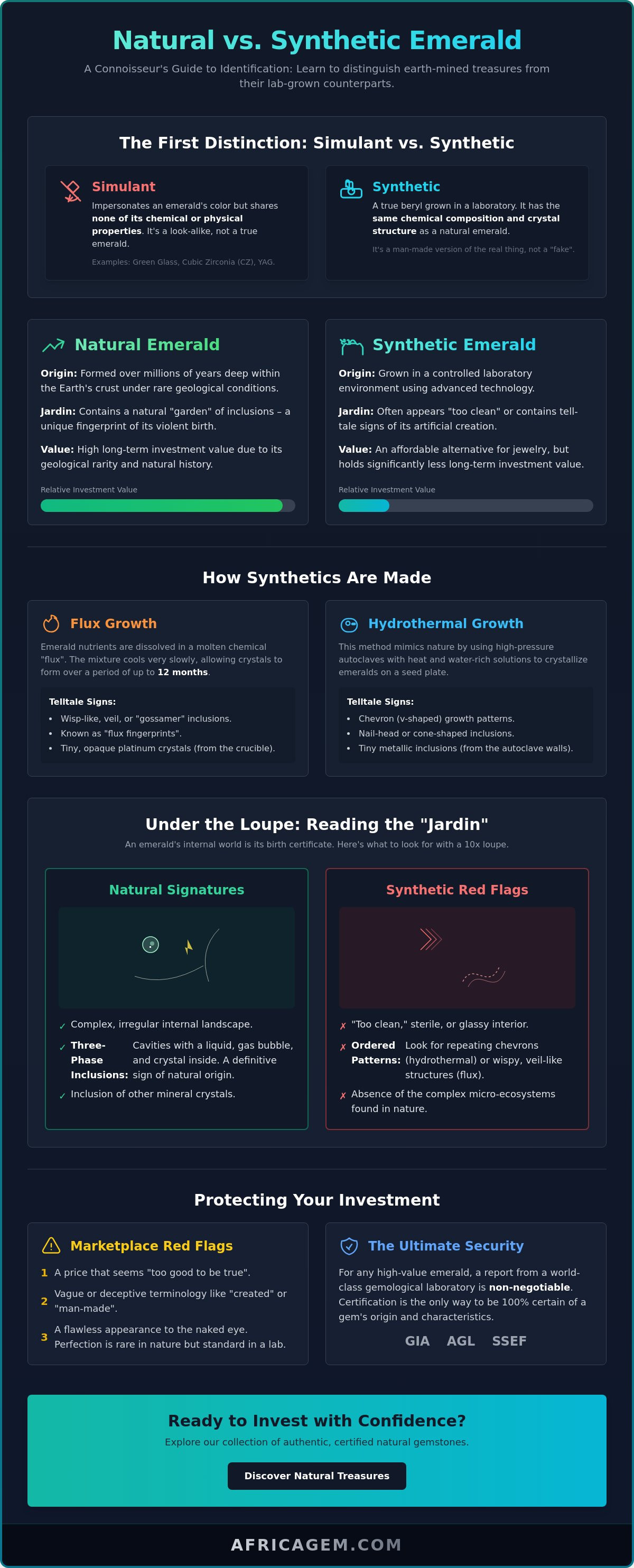
Understanding the distinction between a simulant and a synthetic is the first step for any serious collector. Simulants, such as green glass or cubic zirconia, merely impersonate the color of an emerald without sharing its physical properties. A synthetic emerald is a true lab-grown beryl. It possesses the same crystal structure and chemical makeup as its earth-mined counterpart. Because the Synthetic emerald composition is virtually identical to natural stones, visual identification becomes a sophisticated challenge for the unaided eye. These gems aren't fakes in the traditional sense; they're man-made versions of the real thing.
To better understand the visual differences between these stones, watch this helpful video demonstrating microscopic identification:
The evolution of these gems began in earnest in 1938 when Carroll Chatham successfully grew the first commercial flux emeralds. Since that breakthrough, technology has advanced to create stones that are often cleaner and more vibrant than most natural specimens. At AfricaGems, we believe transparency is the bedrock of value. Disclosing the origin of a stone isn't just a legal requirement. It's a commitment to the integrity of the gemstone trade. Knowing the common signs of a synthetic emerald helps you appreciate the incredible rarity of stones formed by the earth over millions of years.
The Two Main Methods of Synthesis
Manufacturers primarily use two techniques to create these gems. Flux growth involves dissolving nutrients in a molten chemical flux. This process is slow, often taking up to 12 months for crystals to form. Hydrothermal growth uses high-pressure autoclaves to mimic the heat and water-rich environments found deep in the Earth's crust. The specific growth method used determines which common signs of a synthetic emerald you'll find under a microscope, such as unique chevron growth patterns or tiny metallic inclusions.
Natural vs. Synthetic: The Value Gap
Natural emeralds are geological miracles. They require specific conditions that rarely occur together in nature, which is why fine specimens command such high prices. While lab-grown emeralds offer an affordable alternative for modern jewelry, they don't hold the same long-term investment value as rare, earth-mined beryl. For those seeking the pinnacle of rarity and history, our Emerald Gemstone: The Connoisseur’s Guide explores why natural stones remain the undisputed king of green gems.
Reading the Jardin: Internal Signs of a Synthetic Emerald
In the world of fine gems, we call an emerald’s internal world its "Jardin," or garden. This intricate network of inclusions isn't a defect; it's a birthmark of authenticity. Natural emeralds are born in violent geological environments where minerals like chromium and vanadium meet beryl. This process is rarely tidy. When you examine a stone through a 10x loupe, you should see a complex landscape of fissures and crystals. One of the common signs of a synthetic emerald is an internal environment that feels sterile or "too clean." If a stone appears flawless to the naked eye and lacks character under magnification, your professional instincts should tingle. Perfection in nature is a 1 in 1,000,000 occurrence; perfection in a lab is the standard.
Using a 10x loupe properly requires patience. You're looking for life, not just clarity. Natural stones often contain "three-phase inclusions," which are tiny cavities holding a liquid, a gas bubble, and a solid crystal. These are the signatures of the Earth. If you find a stone that lacks these micro-ecosystems and instead displays a glassy, vacant interior, it's a red flag. Identifying these common signs of a synthetic emerald early in your inspection protects your investment and maintains the integrity of your collection.
Flux-Grown Indicators: Veils and Platinum
Flux-grown synthetics are created by dissolving nutrients in a molten chemical flux. As the mixture cools over a period of 10 months, emerald crystals form. This method often leaves behind wisp-like veils that look like gossamer or smoke frozen in time. Unlike the chaotic, jagged fractures of a natural stone, these veils follow specific flow patterns. You might also spot tiny metallic platelets. These are microscopic bits of platinum that flaked off the crucible during the growth cycle. Natural emeralds don't contain platinum. Seeing a sharp, triangular or hexagonal metallic flake is a definitive indicator of laboratory intervention. For those seeking the security of nature, reviewing GIA's guide to emerald quality helps distinguish these man-made traits from natural inclusions.
Hydrothermal Indicators: Chevrons and Nail-Heads
The hydrothermal process mimics the Earth's heat and pressure but at an accelerated pace. This rapid growth creates "chevron" or V-shaped growth lines. These look like subtle, rhythmic pulses within the crystal structure. Another signature is the "nail-head spicule." These are tiny, pointed tubes that look like a nail or a needle, often containing a small crystal at the head. You won't find these in stones from the Chivor or Muzo mines. The color in these stones is also suspiciously uniform. Natural beryl often shows color zoning, but hydrothermal gems maintain a saturated, monochromatic green that feels almost surgical. If you want to see the vibrant, authentic character of natural stones, you can explore our collection of ethically sourced emeralds to compare the difference yourself.
Optical Tests and Advanced Tool Indicators
Visual inspection with a loupe offers a starting point, but light interaction provides the definitive evidence required for true connoisseurship. Expert gemmologists look for how a stone processes light to identify common signs of a synthetic emerald. These tests move past surface aesthetics to analyze the atomic and chemical structure of the beryl crystal. While natural stones grew over millions of years in chaotic geological environments, lab-grown gems often exhibit a sterile perfection that professional tools quickly expose.
Pleochroism, the ability of a stone to show different colors when viewed from different angles, is a vital diagnostic. Natural emeralds typically show a shift between blue-green and yellow-green. In synthetic environments, particularly those using the flux-growth method, these shifts can appear unnaturally intense or slightly off-spectrum. Ultraviolet (UV) fluorescence offers another layer of security. Most natural emeralds contain iron, which quenches fluorescence. Many synthetic emeralds lack iron, causing them to glow a vivid, unnatural red under long-wave UV light. This ghostly red glow is a significant red flag for any collector seeking an authentic, earth-mined gem.
The Chelsea Filter Reaction
Developed in 1934 at the Chelsea College of Science and Technology, this filter remains a staple for identifying chromium content. When you view a stone through the filter, a strong "cherry red" flash is one of the common signs of a synthetic emerald. This happens because the filter only allows red and yellow-green light to pass through. It's vital to remember that some high-quality natural stones from Chivor, Colombia, also react red. The filter serves as a diagnostic indicator rather than a final verdict, requiring support from other tests to ensure absolute transparency.
Refractive Index and Specific Gravity
Refractive index is the measurement of light bending through beryl as it moves from air into the gemstone. Natural emeralds typically show a refractive index (RI) between 1.577 and 1.583. Synthetic emeralds, especially those created via the hydrothermal process, often show lower RI values ranging from 1.560 to 1.572. Specific gravity, or the stone's density, provides another technical benchmark. A natural emerald generally has a density of 2.72; however, lab-grown counterparts are frequently lighter, measuring between 2.65 and 2.69. These minute differences require a hydrostatic balance or heavy liquids to detect, but they provide the technical validation that defines the AfricaGems standard of integrity.
Marketplace Red Flags: Spotting Deception Before the Buy
Identifying a laboratory-grown stone requires more than just a keen eye; it requires a healthy skepticism of marketplace narratives. One of the most common signs of a synthetic emerald is a price tag that fails to reflect the stone's clarity and color saturation. Natural emeralds are rarely loupe-clean. They possess an internal "jardin," or garden, of inclusions that prove their organic origin. If a seller offers a breathtaking, vivid green stone with no visible inclusions at a fraction of the expected cost, you're likely looking at a hydrothermal or flux-grown imitation.
Terminology often serves as a veil for deception. Words like "Created," "Cultured," or "Laboratory-Grown" are standardized industry terms for synthetics, but they can be buried in fine print. Be particularly wary of geographic labels used as adjectives. An authentic Colombian emerald from the Muzo mine is a rare treasure that commands a significant premium. When a "Colombian Emerald" is offered at a bargain, the name is being used to describe a color rather than a physical origin. At AfricaGems, we lean on radical transparency to eliminate this confusion. The AfricaGems Difference is rooted in my personal guarantee that every natural stone is ethically sourced and accurately represented.
Pricing Anomalies and Investment Risks
Market data from 2023 indicates that high-quality natural emeralds frequently command between $5,000 and $15,000 per carat. In contrast, synthetic counterparts often retail for less than $100 per carat. This massive price gap is the primary reason why "wholesale" or "liquidation" claims are major red flags. These marketing tactics are designed to bypass your logical assessment of value. Buying unmounted stones from unverified international sources carries a 90% higher risk of encountering undisclosed synthetics or doublets. Without a physical presence or a verifiable reputation, these sellers offer no recourse once the transaction is complete.
The Red Flag Checklist for Online Shoppers
To protect your investment, look for specific markers of professional integrity. A lack of high-resolution, internal photography is a warning that the seller is hiding common signs of a synthetic emerald, such as chevron growth patterns or nailhead spicules. Reliable dealers provide 360-degree videos and independent laboratory reports from institutions like the GIA or AGL. Before you commit to a purchase, review the How to Buy Gemstones Online guide to master the art of secure investing.
- Return Policies: Ensure the vendor offers at least a 30-day inspection period.
- Authenticity Guarantees: Look for a written guarantee of natural origin signed by the gemologist.
- Macro Imagery: Demand photos that show the stone's internal structure at 10x magnification.
Ready to find a stone with true character and lasting value? Explore our collection of natural, ethically sourced emeralds and experience the security of expert curation.
Securing Your Investment: The Role of Certification
Identifying the common signs of a synthetic emerald requires a trained eye and years of experience, but even the most seasoned gemologists rely on advanced laboratory technology for absolute certainty. While visual cues like "chevron" growth lines or nail-head inclusions offer strong hints, a professional lab report remains the only 100 percent guarantee of a stone's origin. In an era where hydrothermal and flux-growth techniques have become incredibly sophisticated, the peace of mind provided by a third-party certificate is indispensable for any serious collector.
You should only trust reports from world-renowned institutions that maintain the highest standards of integrity. The Gemological Institute of America (GIA), founded in 1931, is the global benchmark for gemstone grading. Other elite organizations include the American Gemological Laboratories (AGL) and the Swiss Gemmological Institute (SSEF), which was established in 1972. These labs utilize Raman spectroscopy and chemical analysis to detect the trace elements that distinguish a natural beryl from a lab-grown counterpart.
Understanding the Lab Report
A standard GIA report provides a definitive "Natural" or "Laboratory-Grown" designation under the "Origin" or "Item Description" section. Beyond just the species and variety, these reports detail the level of clarity enhancement. Most natural emeralds contain surface-reaching fissures that are traditionally filled with colorless oil; labs categorize this as minor, moderate, or significant. This is a critical distinction, as synthetic stones rarely require such treatments, yet their presence in a natural stone is a hallmark of its journey from the earth. While a premium lab report might cost between $150 and $500 depending on the stone's weight, this expense is a fraction of the value it protects in a high-quality natural emerald.
Buying with Confidence at AfricaGems
We believe that luxury should never come at the cost of transparency. Our selection of Loose Colombian Emeralds undergoes a rigorous vetting process to ensure every stone meets our exacting standards for color and clarity. We don't just sell gemstones; we provide a legacy of trust built on the AfricaGems Difference. This includes full disclosure of all treatments and a commitment to sourcing stones that are ethically mined and conflict-free.
Every purchase is backed by the Marc Sarosi personal guarantee. As a second-generation gemstone dealer, Marc personally oversees the inventory to ensure that what you see is exactly what you receive. We invite you to explore our collection and experience the security of buying from a partner who values the integrity of the gemstone trade as much as you do. Browse our ethically sourced, certified natural collection today and find the breathtaking centerpiece your jewelry deserves.
Invest in the Timeless Legacy of Natural Emeralds
Mastering the nuances of gemstone identification transforms you from a casual buyer into a savvy connoisseur. A disciplined eye focused on internal characteristics like flux inclusions and 10x magnification allows you to navigate the market with precision. Identifying the common signs of a synthetic emerald is a vital skill, but the ultimate security lies in expert certification from laboratories like the GIA or AGL. These reports provide the technical validation required for high-value acquisitions.
AfricaGems brings 35+ years of gemmological experience to every transaction. We prioritize ethical sourcing and provide full disclosure on all treatments, ensuring your stone's story is as clear as its crystal. You don't have to navigate these complexities alone. Our commitment to radical transparency means you can acquire a rare piece of the earth's history with complete peace of mind. Explore our collection of Certified Natural Emeralds today and discover the breathtaking beauty of a genuine, earth-mined treasure. Your journey into the world of rare minerals is just beginning.
Frequently Asked Questions
Can a 10x loupe always distinguish between a natural and synthetic emerald?
No, a 10x loupe isn't always sufficient to differentiate between natural and laboratory-grown specimens. While it's a vital tool for spotting common signs of a synthetic emerald like chevron growth lines, high-quality hydrothermal synthetics can fool even experienced eyes. Professional gemologists often require 40x magnification or advanced infrared spectroscopy to confirm a stone's origin with absolute certainty. You should view the loupe as a primary screening tool rather than a final diagnostic solution.
Is a synthetic emerald considered a "fake" gemstone?
No, a synthetic emerald is a real gemstone that shares the exact chemical, physical, and optical properties of its natural counterpart. It's composed of Be3Al2(SiO3)6, the same mineral as earth-mined beryl. Unlike "simulants" like green glass or cubic zirconia, these stones are man-made versions of the real thing. The Federal Trade Commission has required clear disclosure of these lab-grown origins since 1918 to protect consumers from confusion regarding value and rarity.
Do synthetic emeralds have the same hardness as natural ones?
Yes, synthetic emeralds possess a hardness of 7.5 to 8.0 on the Mohs scale, matching natural beryl perfectly. This means they're equally resistant to surface scratches during daily wear. However, natural emeralds often contain 90% more internal fractures and inclusions, which can make them more brittle. Lab-grown stones generally have fewer structural weaknesses, so they often prove more durable against chipping despite having the same technical hardness rating.
What is the most common inclusion found in lab-grown emeralds?
Nail-head spicules and delicate "wispy veils" are the most frequent inclusions found in synthetic stones. These microscopic structures are among the most common signs of a synthetic emerald and result from the rapid growth environment in a lab. Flux-grown emeralds, in particular, often show these lace-like veils that look quite different from the jagged, three-phase inclusions found in Colombian mines. Recognizing these patterns is a cornerstone of professional gemological connoisseurship.
Why do some natural emeralds look like they have bubbles inside?
What look like bubbles in a natural emerald are actually three-phase inclusions containing a liquid, a gas, and a solid crystal. These are classic markers of natural origin, especially in stones from the Muzo or Chivor mines. True spherical gas bubbles are almost never found in natural emeralds; they're a definitive sign of glass imitations or certain flux-grown synthetics. If you see a perfectly round void under your loupe, it's a major red flag for a non-natural stone.
Does a red reaction in a Chelsea filter always mean the emerald is synthetic?
No, a red reaction only proves that the stone contains chromium, the element responsible for that breathtaking green color. While many early synthetics show a strong red glow, natural emeralds from Colombia and Zimbabwe also react red under the filter. Conversely, natural stones from iron-rich deposits in Brazil or Zambia often appear green or brownish. The Chelsea filter is an excellent preliminary test, but it's never a standalone proof of synthetic origin.
How much does it cost to get an emerald certified by the GIA?
A GIA Identification Report for a single loose emerald starts at $85 for stones weighing up to 1.99 carats. For larger specimens between 2.00 and 4.99 carats, the fee is $100 according to the 2024 GIA fee schedule. These costs cover the basic determination of whether the stone is natural or laboratory-grown. If you want to add geographical origin data or detailed treatment analysis, the price will increase based on the stone's weight and complexity.
Are Chatham emeralds synthetic or natural?
Chatham emeralds are laboratory-grown synthetic stones, not natural ones. Carroll Chatham created the first commercially viable flux-grown emerald in 1938, and the brand has remained a leader in the synthetic market for over 80 years. While these stones are exquisite and chemically identical to natural beryl, they're grown in a controlled environment over several months. They offer a beautiful, more affordable alternative for jewelry, but they don't hold the same investment value as rare, earth-mined emeralds.